100% satisfaction guarantee Immediately available after payment Both online and in PDF No strings attached 4.2 TrustPilot
logo-home
Exam (elaborations)

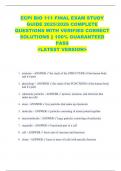
ECPI BIO 111 FINAL EXAM STUDY GUIDE 2025/2026 COMPLETE QUESTIONS WITH VERIFIED CORRECT SOLUTIONS || 100% GUARANTEED PASS <LATEST VERSION>

Rating
-
Sold
-
Pages
95
Grade
A+
Uploaded on
23-06-2025
Written in
2024/2025

ECPI BIO 111 FINAL EXAM STUDY GUIDE 2025/2026 COMPLETE QUESTIONS WITH VERIFIED CORRECT SOLUTIONS || 100% GUARANTEED PASS &lt;LATEST VERSION&gt; 1. anatomy - ANSWER the study of the STRUCTURE of the human body and it's parts 2. physiology - ANSWER the study of the FUNCTIONS of the human body and it's parts 3. subatomic particles - ANSWER protons, neutrons, and electrons that make up cells 4. atom - ANSWER tiny particles that make up chemicals 5. molecule - ANSWER particles consisting of atoms joined together 6. macromolecule - ANSWER large particles consisting of molecules 7. organelle - ANSWER functional part of a cell 8. cell - ANSWER basic unit of structure and functions 9. tissue - ANSWER layer or mass of cells with specific function 10. organ - ANSWER group of different tissues with a function 11. organ system - ANSWER group of organs with common functions 12. organism - ANSWER composed of interacting organ systems 13. metabolism - ANSWER the sum of all chemical reactions in a living system 14. 5 requirements of life - ANSWER water, food, oxygen, heat and pressure 15. homeostasis - ANSWER Maintenace of a stable internal environment 16. 3 parts of homeostatic mechanisms - ANSWER receptor, control center, effector 17. negative feedback - ANSWER effectors return conditions toward normal range 18. positive feedback - ANSWER the change/deviation is intensified instead of reversed 19. axial portion of the body - ANSWER head, neck, trunk 20. appendicular portion of the body - ANSWER upper and lower limbs 21. cranial cavity - ANSWER houses brain 22. exchange reaction - ANSWER chemical bonds are broken and new bonds are formed 23. reversible reaction - ANSWER the products can change back to the reactants 24. electrolytes - ANSWER substances that release ions into water 25. acids - ANSWER release hydrogen ions in water 26. bases - ANSWER release ions that can combine with hydrogen ions 27. salts - ANSWER electrolytes formed by the reaction between an acid and a base 28. acidemia - ANSWER when blood pH drops to 7.0-7.3 29. alkalemia - ANSWER when blood pH rises to 7.5-7.8 30. buffers - ANSWER chemicals which act to resist pH changes 31. examples of organic molecules - ANSWER carbohydrates, proteins, lipids, and nucleic acids 32. examples of inorganic molecules - ANSWER water, oxygen, carbon dioxide, and inorganic salts 33. amino acids - ANSWER building blocks of proteins 34. primary protein structure - ANSWER amino acid sequence 35. secondary protein structure - ANSWER pleated or twisted structure formed by hydrogen bonding 36. tertiary protein structure - ANSWER 3-dimensional folded shape 37. nucleotides - ANSWER building blocks of nucleic acids 38. nucleic acids - ANSWER carry genetic information to make proteins and dna 39. dna - ANSWER long term storage of genetic information and double chain of nucleotides 40. rna - ANSWER a single chain of nucleotides 41. dna is found in - ANSWER nucleus 42. rna is found in - ANSWER nucleus and ribosomes 43. cholesterol - ANSWER stabilizes membrane, helps keep it impermeable to water-soluble substances 44. carbohydrates function - ANSWER cell recognition and interaction 45. ribosomes - ANSWER composed of rRNA and protein; link amino acids in protein synthesis 46. endoplasmic reticulum - ANSWER contains ribosomes; conducts protein synthesis 47. the "packaging and shipping center" of the cell - ANSWER golgi body 48. mitochondria - ANSWER Powerhouse of the cell; produces most of our ATP 49. lysosomes - ANSWER enzymes that digest proteins, carbohydrates, nucleic acids, bacteria, debris, worn out cell parts 50. peroxisomes - ANSWER enzymes that digest lipids, alcohol, hydrogen peroxide 51. centrosomes - ANSWER composed of microtubules; produce spindle fibers during cell division 52. cilia - ANSWER propel mucus in respiratory tract, propel egg toward uterus 53. nucleolus - ANSWER site of ribosome production 54. chomatin - ANSWER contains DNA wound around proteins 55. osmosis - ANSWER movement of water from high water concentration to lower water concentration 56. isotonic solutions - ANSWER cells have no net gain or loss 57. hypertonic solutions - ANSWER cells lose water 58. hypotonic solutions - ANSWER cells gain water 59. endocytosis - ANSWER movement of a substance into the cell inside a vesicle 60. exocytosis - ANSWER release of substances/particles from cell 61. phases of mitosis - ANSWER PMAT 62. prophase - ANSWER first and longest phase of mitosis, during which the chromosomes become visible and the centrioles separate and take up positions on the opposite sides of the nucleus 63. metaphase - ANSWER Chromosomes line up in the middle of the cell 64. anaphase - ANSWER chromosomes separate and move to opposite ends of the cell 65. telophase - ANSWER After the chromosome seperates, the cell seals off, Final Phase of Mitosis. 66. metabolic reaction that requires ATP - ANSWER anabolism 67. metabolic reaction that releases ATP - ANSWER catabolism 68. enzymes - ANSWER speed up reaction rates for chemical reacations 69. active site - ANSWER part of the enzyme that the substrate "plugs in to" 70. metabolic pathways - ANSWER series of enzyme-controlled reactions leading to formation of a product 71. rate limiting enzyme - ANSWER a regulatory enzyme that catalyzes one step of pathway typically sets rate for entire reaction sequence 72. cofactor - ANSWER ions elements or small organic molecules; completes shape of enzyme so it can have its full function 73. coenzyme - ANSWER vitamins; completes shape of enzyme so it can have its full function 74. adrenal cortex hormones - ANSWER aldosterone, cortisol, androgens 75. adrenal medulla hormones - ANSWER epinephrine and norepinephrine 76. Pancreas hormones - ANSWER insulin and glucagon 77. anterior pituitary hormones - ANSWER Growth hormone (GH) Thyroid-stimulating hormone (TSH) Adrenocorticotropic hormone (ACTH) Follicle-stimulating hormone (FSH) Luteinizing hormone (LH) Prolactin (PRL) 78. posterior pituitary hormones - ANSWER antidiuretic hormone and oxytocin 79. pineal gland - ANSWER melatonin 80. joint classification - ANSWER fibrous, cartilaginous, synovial 81. joint classification by function - ANSWER Synarthrosis (immovable) Amphiarthrosis (slightly movable) Diarthrosis (freely movable) 82. Synarthrotic - ANSWER immovable joint 83. Amphiarthrotic - ANSWER slightly movable joints 84. Diarthrotic - ANSWER freely movable joint 85. ball and socket joint - ANSWER Multiaxial: flexion, extension, adduction, abduction, and rotation ex:Hip and Shoulder 86. hinge joint - ANSWER uniaxial, flexion and extension ex: elbow 87. saddle joint - ANSWER Biaxial: flexion, extension, adduction, and abduction ex: thumb joint 88. Gomphosis - ANSWER attachment of a tooth to its socket 89. pivot joint example - ANSWER ex:atlas and axis rotation 90. How many daughter cells are produced in mitosis and meiosis? - ANSWER mitosis-2 meiosis-4 91. If you start with a diploid cell (2N), what ploidy will you end up with in mitosis and meiosis? - ANSWER mitosis-diploid meiosis-haploid 92. What is a function of mitosis and meiosis in the human body? - ANSWER mitosis: repair and growth, meiosis: reproduction 93. A fruit fly Drosophila melanogaster somatic cell contains 8 chromosomes. This means that_________ different combinations of chromosomes are possible in the fly's gametes. - ANSWER C.16 (2^4) 94. sister chromatids - ANSWER One of two identical parts of a duplicated chromosome in an eukaryotic cell. 95. autosome - ANSWER A chromosome not directly involved in determining the sex of an individual. 96. locus - ANSWER the site where a genes found on a chromosome 97. Microevolution - ANSWER the change in allele frequencies in a population 98. Micoevoltuion may result from... - ANSWER genetic drift, gene flow, natural selection 99. genetic drift - ANSWER by random fluctuations more likely in small populations 100. gene flow - ANSWER due to movement of individuals or gametes 101. natural selection - ANSWER due to higher fitness of individuals best adapted to the environment 102. A calculated chi-squared statistic for this data is 2.83, which is below the statistical threshold. Does this mean that the population is in Hardy- Weinberg Equilibrium? - ANSWER yes 103. temporal isolation - ANSWER two species of pine trees in the organ mountains produce pollen in different months 104. mechanical isolation - ANSWER genitalia shape differences inhibit successful copulation 105. what will violations of different Hardy-Weinberg assumptions lead to? - ANSWER mechanisms of evolution: mutation, non-random mating, gene flow, genetic drift, and natural selection 106. antibodies - ANSWER immune system cells that attack cells with foreign antigens 107. antigens - ANSWER chemicals, or sugars on the surface of some cells that act as signposts that tell the immune system whether the cell belongs in the body; antibodies recognize antigens 108. heterozygous - ANSWER a pair of different genes, where one is dominant and the other is recessive 109. 110. gene homozygous - ANSWER having two of the same allele recessive - ANSWER a gene that can be masked by a dominant 111. homozygous dominant - ANSWER two of the same dominant alleles 112. 113. 114. 115. 116. 117. 118. Hardy-Weinberg equilibrium - ANSWER p + q = 1 q2 - ANSWER the frequency of the recessive genotype (tt) q - ANSWER the frequency of the recessive allele (t) p2 - ANSWER the frequency of the dominant genotype (TT) p - ANSWER the frequency of the dominant allele (T) 2pq - ANSWER the frequency of heterozygous genotype (Tt) when calculating the values for Hardy-Weinberg equilibrium, why do the values not match up in the end? - ANSWER evolution is occurring! 119. 120. 121. 122. universal receiver - ANSWER AB universal donor - ANSWER O AB - ANSWER no antigens angulation - ANSWER clumping of the blood 123. hypothesis - ANSWER a proposed explanation for a phenomenon that is tested by experimental investigation 124. ex.) Temperature DOES facilitate the spread of the wasting disease among sea stars 125. prediction - ANSWER -Has some mention of the dependent variable(s) collected -"IF [hypothesis] is true, THEN x should happen," OR -"IF [hypothesis] is true, THEN x should be the result of doing y" 126. evolution - ANSWER a process that results in heritable changes in a population speed over many generations (a change in allele frequencies) 127. fitness - ANSWER a measure of an organism by how many offspring they produce, allowing genes to pass down and evolve 128. phylogeny - ANSWER a characteristic tree of relatedness 129. what are the 5 mechanisms necessary for evolution to occur? - ANSWER mutations, migration, genetic drift, natural selection, and sexual selection 130. mutations - ANSWER alterations in a single base or changes in large segments of DNA that include several genes or more -can be detrimental, beneficial, or neutral -most are neutral -essential to evolution -the result of every genetic feature in every organism -reduce an organism's fitness -a SLOW mechanism for evolution 131. migration - ANSWER a change in allele frequencies caused by individuals moving into or out of a population -ex) Lake Erie Water Snakes: caused there to be speckled snakes on the mainland -CAN BE RAPID

Show more Read less
Institution
ECPI BIO 111
Course
ECPI BIO 111


Whoops! We can’t load your doc right now. Try again or contact support.

Written for

Institution
ECPI BIO 111
Course
ECPI BIO 111

Document information

Uploaded on
June 23, 2025
Number of pages
95
Written in
2024/2025
Type
Exam (elaborations)
Contains
Questions & answers

Subjects

Content preview

ECPI BIO 111 FINAL EXAM STUDY
GUIDE 2025/2026 COMPLETE
QUESTIONS WITH VERIFIED CORRECT
SOLUTIONS || 100% GUARANTEED
PASS
<LATEST VERSION>


1. anatomy - ANSWER ✓ the study of the STRUCTURE of the human body
and it's parts

2. physiology - ANSWER ✓ the study of the FUNCTIONS of the human body
and it's parts

3. subatomic particles - ANSWER ✓ protons, neutrons, and electrons that
make up cells

4. atom - ANSWER ✓ tiny particles that make up chemicals

5. molecule - ANSWER ✓ particles consisting of atoms joined together

6. macromolecule - ANSWER ✓ large particles consisting of molecules

7. organelle - ANSWER ✓ functional part of a cell

8. cell - ANSWER ✓ basic unit of structure and functions

9. tissue - ANSWER ✓ layer or mass of cells with specific function

,10.organ - ANSWER ✓ group of different tissues with a function

11.organ system - ANSWER ✓ group of organs with common functions

12.organism - ANSWER ✓ composed of interacting organ systems

13.metabolism - ANSWER ✓ the sum of all chemical reactions in a living
system

14.5 requirements of life - ANSWER ✓ water, food, oxygen, heat and pressure

15.homeostasis - ANSWER ✓ Maintenace of a stable internal environment

16.3 parts of homeostatic mechanisms - ANSWER ✓ receptor, control center,
effector

17.negative feedback - ANSWER ✓ effectors return conditions toward normal
range

18.positive feedback - ANSWER ✓ the change/deviation is intensified instead
of reversed

19.axial portion of the body - ANSWER ✓ head, neck, trunk

20.appendicular portion of the body - ANSWER ✓ upper and lower limbs

21.cranial cavity - ANSWER ✓ houses brain

22.exchange reaction - ANSWER ✓ chemical bonds are broken and new bonds
are formed

23.reversible reaction - ANSWER ✓ the products can change back to the
reactants

24.electrolytes - ANSWER ✓ substances that release ions into water

25.acids - ANSWER ✓ release hydrogen ions in water

,26.bases - ANSWER ✓ release ions that can combine with hydrogen ions

27.salts - ANSWER ✓ electrolytes formed by the reaction between an acid and
a base

28.acidemia - ANSWER ✓ when blood pH drops to 7.0-7.3

29.alkalemia - ANSWER ✓ when blood pH rises to 7.5-7.8

30.buffers - ANSWER ✓ chemicals which act to resist pH changes

31.examples of organic molecules - ANSWER ✓ carbohydrates, proteins,
lipids, and nucleic acids

32.examples of inorganic molecules - ANSWER ✓ water, oxygen, carbon
dioxide, and inorganic salts

33.amino acids - ANSWER ✓ building blocks of proteins

34.primary protein structure - ANSWER ✓ amino acid sequence

35.secondary protein structure - ANSWER ✓ pleated or twisted structure
formed by hydrogen bonding

36.tertiary protein structure - ANSWER ✓ 3-dimensional folded shape

37.nucleotides - ANSWER ✓ building blocks of nucleic acids

38.nucleic acids - ANSWER ✓ carry genetic information to make proteins and
dna

39.dna - ANSWER ✓ long term storage of genetic information and double
chain of nucleotides

40.rna - ANSWER ✓ a single chain of nucleotides

, 41.dna is found in - ANSWER ✓ nucleus

42.rna is found in - ANSWER ✓ nucleus and ribosomes

43.cholesterol - ANSWER ✓ stabilizes membrane, helps keep it impermeable
to water-soluble substances

44.carbohydrates function - ANSWER ✓ cell recognition and interaction

45.ribosomes - ANSWER ✓ composed of rRNA and protein; link amino acids
in protein synthesis

46.endoplasmic reticulum - ANSWER ✓ contains ribosomes; conducts protein
synthesis

47.the "packaging and shipping center" of the cell - ANSWER ✓ golgi body

48.mitochondria - ANSWER ✓ Powerhouse of the cell; produces most of our
ATP

49.lysosomes - ANSWER ✓ enzymes that digest proteins, carbohydrates,
nucleic acids, bacteria, debris, worn out cell parts

50.peroxisomes - ANSWER ✓ enzymes that digest lipids, alcohol, hydrogen
peroxide

51.centrosomes - ANSWER ✓ composed of microtubules; produce spindle
fibers during cell division

52.cilia - ANSWER ✓ propel mucus in respiratory tract, propel egg toward
uterus

53.nucleolus - ANSWER ✓ site of ribosome production

54.chomatin - ANSWER ✓ contains DNA wound around proteins

Get to know the seller

Seller avatar
Reputation scores are based on the amount of documents a seller has sold for a fee and the reviews they have received for those documents. There are three levels: Bronze, Silver and Gold. The better the reputation, the more your can rely on the quality of the sellers work.
ProfBenjamin Havard School
View profile
Follow You need to be logged in order to follow users or courses
Sold
389
Member since
1 year
Number of followers
14
Documents
2783
Last sold
2 hours ago
EXCELLENT ACHIEVERS LIBRARY

As a professional tutor, I provide exceptional assistance with homework, quizzes, and exams across various subjects, including Psychology, Nursing, Biological Sciences, Business, Engineering, Human Resource Management, and Mathematics. I am dedicated to offering high-quality support and ensuring that all work meets scholarly standards. To enhance the effectiveness of our services, I work with a team of experienced tutors to create comprehensive and effective revision materials. Together, we are committed to helping students achieve excellent grades through our collaborative efforts and expertise.

Read more Read less
3.9

71 reviews

5
31
4
11
3
21
2
4
1
4

Recently viewed by you

Why students choose Stuvia

Created by fellow students, verified by reviews

Quality you can trust: written by students who passed their tests and reviewed by others who've used these notes.

Didn't get what you expected? Choose another document

No worries! You can instantly pick a different document that better fits what you're looking for.

Pay as you like, start learning right away

No subscription, no commitments. Pay the way you're used to via credit card and download your PDF document instantly.

Student with book image

“Bought, downloaded, and aced it. It really can be that simple.”

Alisha Student

Frequently asked questions