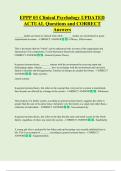
EPPP- Diagnosis and Psychopathology Exam Questions
With Complete Solutions
A child diagnosed with Attention-Deficit/Hyperactivity Disorder
is most likely to also be diagnosed with: Correct Answers
Conduct Disorder
A person with Bipolar II Disorder would have no history of
Correct Answers manic episodes.
According to current cognitive-behavioral theories, a central
factor in the maintenance of anorexia nervosa symptom is
Correct Answers the need to control eating.
According to Millon, when narcissistic people experience
personal failure and public humiliation, they resort to: Correct
Answers defense mechanisms -- first repression, and if that
fails, then rationalization and projection.
acute stress disorder Correct Answers An anxiety disorder in
which fear and related symptoms are experienced soon after a
traumatic event and last less than a month
Akathisia Correct Answers a movement disorder characterized
by a feeling of restlessness, an inability to sit or keep still, a
pressing need to be in constant motion and behaviors such as
fidgeting, crossing and uncrossing the legs while sitting, rocking
from foot to foot, marching in place and pacing
Alcohol Withdrawal is characterized by two or more of the
following symptoms, Correct Answers autonomic hyperactivity
, (e.g., sweating, increased pulse), hand tremor, insomnia, nausea
or vomiting, transient hallucinations or illusions, psychomotor
agitation, anxiety, and grand mal seizures.
Alogia Correct Answers a lack of spontaneous speech
Anxiety and depression share what symptoms? Correct
Answers a general distress factor, sometimes referred to as
"negative affect"
Avolition Correct Answers a lack of initiative, motivation or
goal-directed activities and is considered a "negative" symptom
of Schizophrenia or Schizophreniform disorder when it is severe
enough to prevent an individual from doing basic activities.
Behavioral treatment for obsessions would most likely involve:
Correct Answers exposure with response prevention and
thought stopping.
Best single treatment for Agoraphobia Correct Answers
Flooding
Blood-Injection-Injury Type of Specific Phobia, relative to other
types of Specific Phobias, is characterized by: Correct Answers
low blood pressure
Briquet's syndrome Correct Answers a chronic Somatoform
Disorder with multiple physical symptoms that cannot be
explained entirely by a general medical condition or the effects
of a substance
With Complete Solutions
A child diagnosed with Attention-Deficit/Hyperactivity Disorder
is most likely to also be diagnosed with: Correct Answers
Conduct Disorder
A person with Bipolar II Disorder would have no history of
Correct Answers manic episodes.
According to current cognitive-behavioral theories, a central
factor in the maintenance of anorexia nervosa symptom is
Correct Answers the need to control eating.
According to Millon, when narcissistic people experience
personal failure and public humiliation, they resort to: Correct
Answers defense mechanisms -- first repression, and if that
fails, then rationalization and projection.
acute stress disorder Correct Answers An anxiety disorder in
which fear and related symptoms are experienced soon after a
traumatic event and last less than a month
Akathisia Correct Answers a movement disorder characterized
by a feeling of restlessness, an inability to sit or keep still, a
pressing need to be in constant motion and behaviors such as
fidgeting, crossing and uncrossing the legs while sitting, rocking
from foot to foot, marching in place and pacing
Alcohol Withdrawal is characterized by two or more of the
following symptoms, Correct Answers autonomic hyperactivity
, (e.g., sweating, increased pulse), hand tremor, insomnia, nausea
or vomiting, transient hallucinations or illusions, psychomotor
agitation, anxiety, and grand mal seizures.
Alogia Correct Answers a lack of spontaneous speech
Anxiety and depression share what symptoms? Correct
Answers a general distress factor, sometimes referred to as
"negative affect"
Avolition Correct Answers a lack of initiative, motivation or
goal-directed activities and is considered a "negative" symptom
of Schizophrenia or Schizophreniform disorder when it is severe
enough to prevent an individual from doing basic activities.
Behavioral treatment for obsessions would most likely involve:
Correct Answers exposure with response prevention and
thought stopping.
Best single treatment for Agoraphobia Correct Answers
Flooding
Blood-Injection-Injury Type of Specific Phobia, relative to other
types of Specific Phobias, is characterized by: Correct Answers
low blood pressure
Briquet's syndrome Correct Answers a chronic Somatoform
Disorder with multiple physical symptoms that cannot be
explained entirely by a general medical condition or the effects
of a substance