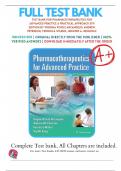
,2025 Pharmacotherapeutics Certification Prep:
Arcangelo & Peterson Edition
📘 Verified | Detailed Rationales | 1,120 Questions | Designed for Guaranteed Clinical
Competency
Table of Contents
1. Issues for the Practitioner in Drug Therapy
2. Pharmacokinetic Basis of Therapeutics and Pharmacodynamic Principles
3. Impact of Drug Interactions and Adverse Events on Therapeutics
4. Principles of Pharmacotherapy in Pediatrics, Pregnancy and Lactation
5. Pharmacotherapy Principles in Older Adults
6. Principles of Antimicrobial Therapy
7. Pharmacogenomics
8. The Economics of Pharmacotherapeutics
9. Principles of Pharmacology in Pain Management
10. Pain Management in Opioid Use Disorder (OUD) Patients
11. Cannabis and Pain Management
12. Dermatitis
13. Bacterial, Fungal, and Viral Infections of the Skin
14. Psoriasis
15. Acne Vulgaris and Rosacea
16. Ophthalmic Disorders
17. Otitis Media and Otitis Externa
18. Hypertension
19. Hyperlipidemia
20. Chronic Stable Angina and Myocardial Infarction
,21. Heart Failure
22. Arrhythmias
23. Respiratory Infections
24. Asthma and Chronic Obstructive Pulmonary Disease
25. Gastric, Functional and Inflammatory Bowel Disorders
26. Gastroesophageal Reflux Disease and Peptic Ulcer Disease
27. Liver Diseases
28. Urinary Tract Infection
29. Prostatic Disorders and Erectile Dysfunction
30. Overactive Bladder
31. Sexually Transmitted Infections
32. Osteoarthritis and Gout
33. Osteoporosis
34. Rheumatoid Arthritis
35. Headaches
36. Seizure Disorders
37. Alzheimer’s Disease
38. Parkinson Disease
39. Major Depressive Disorder and Bipolar Disorders
40. Anxiety Disorders
41. Sleep Disorders
42. Attention Deficit Hyperactivity Disorder
43. Substance Use Disorders
44. Diabetes Mellitus
45. Thyroid and Parathyroid Disorders
46. Allergies and Allergic Reactions
47. Human Immunodeficiency Virus
,48. Organ Transplantation
49. Pharmacotherapy for Select Thromboembolic Disorders
50. Anemias
51. Immunizations
52. Smoking Cessation
53. Weight Loss
54. Contraception
55. Menopause
56. Vaginitis
,1–10: Prescriptive Authority & State-Specific Legal Scope
1. An advanced practice provider (APP) in State X wishes to
prescribe a Schedule II opioid. Before writing the prescription,
the APP should:
A. Confirm State X allows independent prescriptive authority
for Schedule II drugs B. Delegate the prescription authorization
to a supervising physician C. Prescribe based on institutional
policy without reviewing state law D. Only prescribe Schedule II
opioids in emergencies
Answer: A Rationale: APPs must verify state law permits
independent Schedule II prescribing. B is incorrect—delegation
does not substitute legal scope. C is incorrect—state law
supersedes institutional policy. D is too restrictive; emergencies
do not override legal requirements.
2. In which scenario would an APP exceed their legal scope of
practice?
A. Prescribing hormonal contraceptives without physician
oversight in a state allowing independent APP authority B.
Initiating chemotherapy agents when state law requires
oncology collaboration C. Writing a prescription for
antihypertensive medication under a collaborative agreement
D. Adjusting insulin dosage per protocol within a clinic’s
standing orders
Answer: B Rationale: State law requiring oncology
collaboration makes independent chemo prescribing outside
,scope. A is permitted. C follows collaborative agreement. D
uses standing orders—within scope.
3. Before an APP practices in a new state, the most important
step is to:
A. Notify current patients of relocation B. Verify prescriptive
authority and required supervision level C. Purchase a new DEA
license immediately D. Update electronic health record
preferences
Answer: B Rationale: Ensuring legal authority and supervision
requirements in the new state is critical. A, C, and D are
secondary or premature until scope is confirmed.
4. Under a standardized protocol, an APP may prescribe
naloxone without a direct patient-specific order because:
A. Naloxone is noncontrolled and allowed by all states B.
Standing orders grant preauthorization for public health
emergencies C. APPs have universal naloxone-prescribing
authority D. Patients can obtain naloxone over-the-counter
nationwide
Answer: B Rationale: Public health protocols often permit
standing orders. A is false—some states regulate. C
overgeneralizes authority. D is incorrect—OTC status varies.
5. Which document outlines an APP’s authority to prescribe
independently in State Y?
,A. State Nurse Practice Act B. Hospital bylaws C. Specialty
society guidelines D. Federal Controlled Substances Act
Answer: A Rationale: The Nurse Practice Act defines scope. B
may supplement but cannot expand legal scope. C are
recommendations. D regulates controlled substances but not
APP-specific scope.
6. A collaborative practice agreement must include all EXCEPT:
A. Specific patient conditions managed B. Prescriptive authority
scope C. APP’s personal malpractice history D.
Supervision/consultation procedures
Answer: C Rationale: Malpractice history is not required. A, B,
and D are essential components.
7. In states with full practice authority, APPs can:
A. Prescribe Schedule II–V medications independently B. Only
prescribe noncontrolled medications C. Require cosignature on
all prescriptions D. Provide prescriptions only in inpatient
settings
Answer: A Rationale: Full practice authority includes
independent prescribing of controlled substances. B, C, and D
are restrictive beyond full practice.
8. The DEA allows prescribers to register in multiple states; an
APP must:
A. Obtain a separate state license and DEA registration for each
state practiced B. Use home-state DEA number for all
,telehealth prescriptions C. Only prescribe controlled substances
within 50 miles of home address D. Apply for federal special
prescribing privileges
Answer: A Rationale: Each state requires separate licensure,
and DEA registration must match state. B is noncompliant. C
and D are incorrect.
9. When delegating prescriptive tasks to a clinical pharmacist,
an APP must:
A. Transfer DEA registration to the pharmacist B. Ensure state
law allows pharmacist prescribing under APP’s protocol C.
Provide only verbal orders for controlled substances D. Assume
pharmacist holds equal legal responsibility
Answer: B Rationale: Delegation requires state-authorized
protocols. A is impossible; B is correct. C violates DEA
regulations. D misrepresents liability.
10. To renew prescriptive authority, an APP should:
A. Repeat national certification exam B. Submit proof of
continuing education per state board C. Request a waiver from
the DEA D. Update patient charts with new templates
Answer: B Rationale: States mandate CE for license renewal. A
is unnecessary; C is unrelated; D is administrative but not
required for renewal.
11–20: Ethical Prescribing & Provider Accountability
,11. An APP offers a free sample of a branded drug to all eligible
patients. The primary ethical concern is:
A. Beneficence B. Justice C. Nonmaleficence D. Autonomy
Answer: B Rationale: Offering only branded samples may
create inequity (justice). A, C, and D are less directly implicated.
12. A pharmaceutical rep provides a gift to an APP in exchange
for prescribing a new drug. This raises a violation of:
A. HIPAA B. Drug Enforcement Administration regulations C.
Anti-kickback statutes D. State licensure boards
Answer: C Rationale: Gifts tied to prescribing are prohibited by
anti-kickback laws. A relates to privacy; B and D do not govern
gifts.
13. An APP realizes they miscalculated a pediatric dose and
administered 50% overdose. The first step is to:
A. Document the error in the chart without notifying anyone B.
Disclose the error to the patient’s guardian and supervisor C.
Wait to see if adverse effects occur D. Blame a nurse to avoid
personal liability
Answer: B Rationale: Ethical accountability demands
disclosure. A conceals error, C delays action, D is unethical and
unprofessional.
14. Which principle supports prescribing the least expensive
effective medication to a low-income patient?
A. Autonomy B. Justice C. Beneficence D. Fidelity
, Answer: B Rationale: Fair distribution of resources aligns with
justice. Beneficence also applies but justice emphasizes equity.
15. Under the principle of nonmaleficence, an APP should:
A. Avoid prescribing medications with high risk when safer
alternatives exist B. Respect patients’ right to refuse
medications C. Ensure all prescriptions are filled at the patient’s
pharmacy of choice D. Provide written informed consent only
for surgeries
Answer: A Rationale: Nonmaleficence means “do no harm.” B
relates to autonomy; C and D are less relevant.
16. A patient requests an off-label use of an antibiotic. The APP
should:
A. Deny based on lack of FDA approval B. Review evidence,
discuss risks/benefits, document consent C. Automatically
approve because antibiotics are low risk D. Delegate decision to
pharmacy
Answer: B Rationale: Ethical prescribing includes evidence
review and informed consent. A is paternalistic; C is negligent;
D abrogates responsibility.
17. Provider accountability includes all EXCEPT:
A. Reporting adverse drug reactions B. Participating in peer
review for prescribing practices C. Avoiding documentation to
maintain efficiency D. Maintaining current knowledge of
pharmacotherapy
Arcangelo & Peterson Edition
📘 Verified | Detailed Rationales | 1,120 Questions | Designed for Guaranteed Clinical
Competency
Table of Contents
1. Issues for the Practitioner in Drug Therapy
2. Pharmacokinetic Basis of Therapeutics and Pharmacodynamic Principles
3. Impact of Drug Interactions and Adverse Events on Therapeutics
4. Principles of Pharmacotherapy in Pediatrics, Pregnancy and Lactation
5. Pharmacotherapy Principles in Older Adults
6. Principles of Antimicrobial Therapy
7. Pharmacogenomics
8. The Economics of Pharmacotherapeutics
9. Principles of Pharmacology in Pain Management
10. Pain Management in Opioid Use Disorder (OUD) Patients
11. Cannabis and Pain Management
12. Dermatitis
13. Bacterial, Fungal, and Viral Infections of the Skin
14. Psoriasis
15. Acne Vulgaris and Rosacea
16. Ophthalmic Disorders
17. Otitis Media and Otitis Externa
18. Hypertension
19. Hyperlipidemia
20. Chronic Stable Angina and Myocardial Infarction
,21. Heart Failure
22. Arrhythmias
23. Respiratory Infections
24. Asthma and Chronic Obstructive Pulmonary Disease
25. Gastric, Functional and Inflammatory Bowel Disorders
26. Gastroesophageal Reflux Disease and Peptic Ulcer Disease
27. Liver Diseases
28. Urinary Tract Infection
29. Prostatic Disorders and Erectile Dysfunction
30. Overactive Bladder
31. Sexually Transmitted Infections
32. Osteoarthritis and Gout
33. Osteoporosis
34. Rheumatoid Arthritis
35. Headaches
36. Seizure Disorders
37. Alzheimer’s Disease
38. Parkinson Disease
39. Major Depressive Disorder and Bipolar Disorders
40. Anxiety Disorders
41. Sleep Disorders
42. Attention Deficit Hyperactivity Disorder
43. Substance Use Disorders
44. Diabetes Mellitus
45. Thyroid and Parathyroid Disorders
46. Allergies and Allergic Reactions
47. Human Immunodeficiency Virus
,48. Organ Transplantation
49. Pharmacotherapy for Select Thromboembolic Disorders
50. Anemias
51. Immunizations
52. Smoking Cessation
53. Weight Loss
54. Contraception
55. Menopause
56. Vaginitis
,1–10: Prescriptive Authority & State-Specific Legal Scope
1. An advanced practice provider (APP) in State X wishes to
prescribe a Schedule II opioid. Before writing the prescription,
the APP should:
A. Confirm State X allows independent prescriptive authority
for Schedule II drugs B. Delegate the prescription authorization
to a supervising physician C. Prescribe based on institutional
policy without reviewing state law D. Only prescribe Schedule II
opioids in emergencies
Answer: A Rationale: APPs must verify state law permits
independent Schedule II prescribing. B is incorrect—delegation
does not substitute legal scope. C is incorrect—state law
supersedes institutional policy. D is too restrictive; emergencies
do not override legal requirements.
2. In which scenario would an APP exceed their legal scope of
practice?
A. Prescribing hormonal contraceptives without physician
oversight in a state allowing independent APP authority B.
Initiating chemotherapy agents when state law requires
oncology collaboration C. Writing a prescription for
antihypertensive medication under a collaborative agreement
D. Adjusting insulin dosage per protocol within a clinic’s
standing orders
Answer: B Rationale: State law requiring oncology
collaboration makes independent chemo prescribing outside
,scope. A is permitted. C follows collaborative agreement. D
uses standing orders—within scope.
3. Before an APP practices in a new state, the most important
step is to:
A. Notify current patients of relocation B. Verify prescriptive
authority and required supervision level C. Purchase a new DEA
license immediately D. Update electronic health record
preferences
Answer: B Rationale: Ensuring legal authority and supervision
requirements in the new state is critical. A, C, and D are
secondary or premature until scope is confirmed.
4. Under a standardized protocol, an APP may prescribe
naloxone without a direct patient-specific order because:
A. Naloxone is noncontrolled and allowed by all states B.
Standing orders grant preauthorization for public health
emergencies C. APPs have universal naloxone-prescribing
authority D. Patients can obtain naloxone over-the-counter
nationwide
Answer: B Rationale: Public health protocols often permit
standing orders. A is false—some states regulate. C
overgeneralizes authority. D is incorrect—OTC status varies.
5. Which document outlines an APP’s authority to prescribe
independently in State Y?
,A. State Nurse Practice Act B. Hospital bylaws C. Specialty
society guidelines D. Federal Controlled Substances Act
Answer: A Rationale: The Nurse Practice Act defines scope. B
may supplement but cannot expand legal scope. C are
recommendations. D regulates controlled substances but not
APP-specific scope.
6. A collaborative practice agreement must include all EXCEPT:
A. Specific patient conditions managed B. Prescriptive authority
scope C. APP’s personal malpractice history D.
Supervision/consultation procedures
Answer: C Rationale: Malpractice history is not required. A, B,
and D are essential components.
7. In states with full practice authority, APPs can:
A. Prescribe Schedule II–V medications independently B. Only
prescribe noncontrolled medications C. Require cosignature on
all prescriptions D. Provide prescriptions only in inpatient
settings
Answer: A Rationale: Full practice authority includes
independent prescribing of controlled substances. B, C, and D
are restrictive beyond full practice.
8. The DEA allows prescribers to register in multiple states; an
APP must:
A. Obtain a separate state license and DEA registration for each
state practiced B. Use home-state DEA number for all
,telehealth prescriptions C. Only prescribe controlled substances
within 50 miles of home address D. Apply for federal special
prescribing privileges
Answer: A Rationale: Each state requires separate licensure,
and DEA registration must match state. B is noncompliant. C
and D are incorrect.
9. When delegating prescriptive tasks to a clinical pharmacist,
an APP must:
A. Transfer DEA registration to the pharmacist B. Ensure state
law allows pharmacist prescribing under APP’s protocol C.
Provide only verbal orders for controlled substances D. Assume
pharmacist holds equal legal responsibility
Answer: B Rationale: Delegation requires state-authorized
protocols. A is impossible; B is correct. C violates DEA
regulations. D misrepresents liability.
10. To renew prescriptive authority, an APP should:
A. Repeat national certification exam B. Submit proof of
continuing education per state board C. Request a waiver from
the DEA D. Update patient charts with new templates
Answer: B Rationale: States mandate CE for license renewal. A
is unnecessary; C is unrelated; D is administrative but not
required for renewal.
11–20: Ethical Prescribing & Provider Accountability
,11. An APP offers a free sample of a branded drug to all eligible
patients. The primary ethical concern is:
A. Beneficence B. Justice C. Nonmaleficence D. Autonomy
Answer: B Rationale: Offering only branded samples may
create inequity (justice). A, C, and D are less directly implicated.
12. A pharmaceutical rep provides a gift to an APP in exchange
for prescribing a new drug. This raises a violation of:
A. HIPAA B. Drug Enforcement Administration regulations C.
Anti-kickback statutes D. State licensure boards
Answer: C Rationale: Gifts tied to prescribing are prohibited by
anti-kickback laws. A relates to privacy; B and D do not govern
gifts.
13. An APP realizes they miscalculated a pediatric dose and
administered 50% overdose. The first step is to:
A. Document the error in the chart without notifying anyone B.
Disclose the error to the patient’s guardian and supervisor C.
Wait to see if adverse effects occur D. Blame a nurse to avoid
personal liability
Answer: B Rationale: Ethical accountability demands
disclosure. A conceals error, C delays action, D is unethical and
unprofessional.
14. Which principle supports prescribing the least expensive
effective medication to a low-income patient?
A. Autonomy B. Justice C. Beneficence D. Fidelity
, Answer: B Rationale: Fair distribution of resources aligns with
justice. Beneficence also applies but justice emphasizes equity.
15. Under the principle of nonmaleficence, an APP should:
A. Avoid prescribing medications with high risk when safer
alternatives exist B. Respect patients’ right to refuse
medications C. Ensure all prescriptions are filled at the patient’s
pharmacy of choice D. Provide written informed consent only
for surgeries
Answer: A Rationale: Nonmaleficence means “do no harm.” B
relates to autonomy; C and D are less relevant.
16. A patient requests an off-label use of an antibiotic. The APP
should:
A. Deny based on lack of FDA approval B. Review evidence,
discuss risks/benefits, document consent C. Automatically
approve because antibiotics are low risk D. Delegate decision to
pharmacy
Answer: B Rationale: Ethical prescribing includes evidence
review and informed consent. A is paternalistic; C is negligent;
D abrogates responsibility.
17. Provider accountability includes all EXCEPT:
A. Reporting adverse drug reactions B. Participating in peer
review for prescribing practices C. Avoiding documentation to
maintain efficiency D. Maintaining current knowledge of
pharmacotherapy