Diff er ent System s:
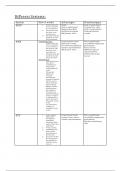
System How it w or k s Advan tages Disadvantages
FPTP 1. Vo ter s casts o ne
vote for a per so n
Quick Lack of voter choice
Easy to under stand Unequal vote value
in a co nstiuency Major ity gov lik ely Lack of pop m ajor ity
2. Th e per so n w ith
Excludes extr em ists Dispr opor tionate
th e m o st vo tes
w ins th e seat MP/Constit. Link r esults
3. Th e par ty w ith th e
m ajo r ity of seats
fo r go ver nm ent
AMS Co nstituency Vo te:
- Vo ter s casts o ne
Pr opor tionate r esult Mor e com plicated.
Split-tick et voting An unlik ely single par ty
vote for a per so n Gov W br oad popular ity gover nm ent.
in a co nstiuency
Gr eater r epr esentation Par ty contr ol.
- Th e per so n w ith
th e m o st vo tes MP/Constit. Link Diff er ent types of
w ins th e seat r epr esentatives.
- Th e par ty w ith th e FPTP used for fi r st
m ajo r ity of seats r ound.
fo r go ver nm ent
Regio nal Vo te:
- Each par ty dr aw s
up a list o f
candidates fo r
each r egio n,
r anking th em in
o r der .
- Th e seco nd
ballo ts ar e
co unted.
- Th e d’Ho ndt
fo r m ula Is used in
th e fi r st seat is
allo cated to th e
par ty w ith th e
h igh est num ber
r esulting fro m
this equatio n.
- Th e pro cess is
r epeated until all
seats in a r egio n
o r allo cated to a
par ty. Th e par ty
th en gives it seats
to th e
co r r espo nding
num ber o f
candidates fr o m
its list.
STV 1. Vo ter is given
ballo t paper
Pr opor tional r esult. Mor e com plicated.
Gr eater Voter choice. An unlik ely single par ty
sho w ing all Gr eater r epr esentation. gover nm ent.
candidates
W eak er constituency
r unnin g in th eir
r egio n. Th ey th en link .
r ank th em .
2. Vo tes co unted.
3. Candidates w h o
achieved th e
dr o o p quo ta o r
given a seat.
4. If no o ne r each es
th e dr o o p quo ta,
th e candidates
w ith th e few est
votes is
, elim inated and
th eir vo tes ar e
r edistr ibuted.
SV 1. Candidates given
ballo t paper w ith
Major ity r esult. To par ty dom inance.
Gr eater Voter choice. A false m ajor ity.
all candidates Sim ple system s. W asted votes
2. Candidates pick
Excludes extr em ists. Tactical voting.
1 st and 2 nd Ch oice
3. If th er e is a
sim ple m ajo r ity,
th ey w in.
4. If not, All but th e
to p tw o ar e
elim anated. Th e
votes ar e
r edistr ibuted And
a w inner Is
decided by a
m ajo r ity.
K ey ter m s
D’H on dt For m ula - a mathematical formula used to allocate seats in a proportional
representation voting system.
- List the par ties: Arrange all political parties or candidates that are contesting the
election.
- Divide votes: For each party, divide the total number of votes they received by a series
of divisors: 1, 2, 3, 4, etc., up to the number of seats being allocated.
- Cr eate a ranking of quotien ts : The results of these divisions (quotients) are listed in
descending order. This creates a ranking of "quotients" from the highest to the lowest.
- Allocate seats: The seats are allocated one by one to the parties based on the highest
quotients in this ranking. The party with the highest quotient gets the first seat, the party
with the second-highest quotient gets the second seat, and so on.
Split-ticket votin g - where voters have two votes to cast. This means that they can choose
different parties.
Dr oop Quota - an equation that takes into account the number of seats and also valid votes
cast in a region. It then decides if a candidate can have a seat. It is calculated by dividing total
votes cast by 1 more than the number of available seats, then adding 1.
B ur kean Pr in ciple - where elected officials are allowed to use their conscience to act in the
best interests of their constituents on the basis of being fully informed.
Or din al votin g – a vote cast in which the voter ranks candidates in order of preference,
choosing as few or as many candidates as they wish.
Spoiled B allot – a ballot that has been filled in incorrectly, which may be deliberate.
System How it w or k s Advan tages Disadvantages
FPTP 1. Vo ter s casts o ne
vote for a per so n
Quick Lack of voter choice
Easy to under stand Unequal vote value
in a co nstiuency Major ity gov lik ely Lack of pop m ajor ity
2. Th e per so n w ith
Excludes extr em ists Dispr opor tionate
th e m o st vo tes
w ins th e seat MP/Constit. Link r esults
3. Th e par ty w ith th e
m ajo r ity of seats
fo r go ver nm ent
AMS Co nstituency Vo te:
- Vo ter s casts o ne
Pr opor tionate r esult Mor e com plicated.
Split-tick et voting An unlik ely single par ty
vote for a per so n Gov W br oad popular ity gover nm ent.
in a co nstiuency
Gr eater r epr esentation Par ty contr ol.
- Th e per so n w ith
th e m o st vo tes MP/Constit. Link Diff er ent types of
w ins th e seat r epr esentatives.
- Th e par ty w ith th e FPTP used for fi r st
m ajo r ity of seats r ound.
fo r go ver nm ent
Regio nal Vo te:
- Each par ty dr aw s
up a list o f
candidates fo r
each r egio n,
r anking th em in
o r der .
- Th e seco nd
ballo ts ar e
co unted.
- Th e d’Ho ndt
fo r m ula Is used in
th e fi r st seat is
allo cated to th e
par ty w ith th e
h igh est num ber
r esulting fro m
this equatio n.
- Th e pro cess is
r epeated until all
seats in a r egio n
o r allo cated to a
par ty. Th e par ty
th en gives it seats
to th e
co r r espo nding
num ber o f
candidates fr o m
its list.
STV 1. Vo ter is given
ballo t paper
Pr opor tional r esult. Mor e com plicated.
Gr eater Voter choice. An unlik ely single par ty
sho w ing all Gr eater r epr esentation. gover nm ent.
candidates
W eak er constituency
r unnin g in th eir
r egio n. Th ey th en link .
r ank th em .
2. Vo tes co unted.
3. Candidates w h o
achieved th e
dr o o p quo ta o r
given a seat.
4. If no o ne r each es
th e dr o o p quo ta,
th e candidates
w ith th e few est
votes is
, elim inated and
th eir vo tes ar e
r edistr ibuted.
SV 1. Candidates given
ballo t paper w ith
Major ity r esult. To par ty dom inance.
Gr eater Voter choice. A false m ajor ity.
all candidates Sim ple system s. W asted votes
2. Candidates pick
Excludes extr em ists. Tactical voting.
1 st and 2 nd Ch oice
3. If th er e is a
sim ple m ajo r ity,
th ey w in.
4. If not, All but th e
to p tw o ar e
elim anated. Th e
votes ar e
r edistr ibuted And
a w inner Is
decided by a
m ajo r ity.
K ey ter m s
D’H on dt For m ula - a mathematical formula used to allocate seats in a proportional
representation voting system.
- List the par ties: Arrange all political parties or candidates that are contesting the
election.
- Divide votes: For each party, divide the total number of votes they received by a series
of divisors: 1, 2, 3, 4, etc., up to the number of seats being allocated.
- Cr eate a ranking of quotien ts : The results of these divisions (quotients) are listed in
descending order. This creates a ranking of "quotients" from the highest to the lowest.
- Allocate seats: The seats are allocated one by one to the parties based on the highest
quotients in this ranking. The party with the highest quotient gets the first seat, the party
with the second-highest quotient gets the second seat, and so on.
Split-ticket votin g - where voters have two votes to cast. This means that they can choose
different parties.
Dr oop Quota - an equation that takes into account the number of seats and also valid votes
cast in a region. It then decides if a candidate can have a seat. It is calculated by dividing total
votes cast by 1 more than the number of available seats, then adding 1.
B ur kean Pr in ciple - where elected officials are allowed to use their conscience to act in the
best interests of their constituents on the basis of being fully informed.
Or din al votin g – a vote cast in which the voter ranks candidates in order of preference,
choosing as few or as many candidates as they wish.
Spoiled B allot – a ballot that has been filled in incorrectly, which may be deliberate.