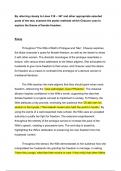
By referring closely to Lines 318 – 347 and other appropriate selected
parts of the text, examine the poetic methods which Chaucer uses to
explore the theme of female freedom.
Essay
Throughout “The Wife of Bath’s Prologue and Tale”, Chaucer explores
the titular character’s quest for female freedom, as well as her desire to share
it with other women. The dramatic monologue of the prologue resembles a
lecture, with various direct addresses to her fellow pilgrims. She advocates for
husbands to give more freedom to their wives, and Chaucer uses this desire
for freedom as a means to contradict the archetype of a demure woman in
mediaeval literature.
The Wife teaches the male pilgrims that they should grant wives more
freedom, referencing the “wise astrologien, Daun Ptholome”. The classical
allusion inspires confidence in the Wife’s words, supporting the idea that
female freedom is a logical concept to implement in society. To Ptolemy, the
Wife attributes a key proverb, reminding her audience that “Of alle men his
wisdom is the hyeste / That rekketh nevere who hath the world in honde.” By
using the words of a well-respected male scholar, the Wife uses an accepted
authority to justify her fight for freedom. The extensive enjambement
throughout the entirety of the prologue serves to increase the pace of the
Wife’s speech, creating a persuasive tone. The end-stop is assertive,
highlighting the Wife’s dedication to preserving her own freedom from her
husbands’ control.
Throughout the extract, the Wife demonstrates to her audience how she
manipulated her husbands into granting her freedom in marriage. In asking
“Have thou ynogh, what thar thee recche or care / How mirily that other folkes
, fare?”. Chaucer uses the rhetorical question to create an accusatory tone,
showing how the Wife shamed her husbands into granting her “maistrie”. The
use of the rhyming couplet lends a musicality to the line, accentuating the
Wife’s intelligence and creativity. This contrasts the prevalent mediaeval view
that women were intellectually inferior, perpetuated by the Church. Therefore,
Chaucer challenges this restrictive ideology through the Wife’s plea for
freedom, demonstrating that these restrictions are unjust. Therefore, the
Wife’s willingness to argue for freedom partially proves that she deserves it.
Furthermore, an intense sexual double standard existed in mediaeval
England, when the Wife’s multiple marriages would have been sternly
disapproved of by wider society. By embracing lustful attitudes, the Wife
breaks free of these expectations, asserting “For certeyn, olde dotard, by your
leve, / Ye shul have queynte right ynogh at eve.” The use of the vulgar
language displays how the Wife embraces sexual imagery in her prologue,
defying gender roles and asserting her own freedom from societal
expectations of piety. Additionally, this interpretation of a lustful Wife is
supported in the General Prologue, where she is described as “gat-tothed”,
symbolising her sexual vivacity. Furthermore, the caesura displays the Wife’s
mocking tone towards her husband. This demonstrates her ability to reverse
the power that husbands would traditionally have over their wives, ensuring
her own freedom.
Chaucer was highly critical of the extreme influence of the Church in
mediaeval England, and this is seen in how he displays the use of religion to
persecute women. This is evident in the Wife’s admonishment of “And yet,
with sorwe! thou most enforce thee, / And seye thise wordes in the Apostles
name”. The iambic rhythm emphasises “wordes”, highlighting the Wife’s
disdain for how men use written “auctoritee” to oppress female experience.
Moreover, the exclamatio conveys a sardonic tone, demonstrating how the
Wife undermines this authority of her would-be oppressors to reclaim her
parts of the text, examine the poetic methods which Chaucer uses to
explore the theme of female freedom.
Essay
Throughout “The Wife of Bath’s Prologue and Tale”, Chaucer explores
the titular character’s quest for female freedom, as well as her desire to share
it with other women. The dramatic monologue of the prologue resembles a
lecture, with various direct addresses to her fellow pilgrims. She advocates for
husbands to give more freedom to their wives, and Chaucer uses this desire
for freedom as a means to contradict the archetype of a demure woman in
mediaeval literature.
The Wife teaches the male pilgrims that they should grant wives more
freedom, referencing the “wise astrologien, Daun Ptholome”. The classical
allusion inspires confidence in the Wife’s words, supporting the idea that
female freedom is a logical concept to implement in society. To Ptolemy, the
Wife attributes a key proverb, reminding her audience that “Of alle men his
wisdom is the hyeste / That rekketh nevere who hath the world in honde.” By
using the words of a well-respected male scholar, the Wife uses an accepted
authority to justify her fight for freedom. The extensive enjambement
throughout the entirety of the prologue serves to increase the pace of the
Wife’s speech, creating a persuasive tone. The end-stop is assertive,
highlighting the Wife’s dedication to preserving her own freedom from her
husbands’ control.
Throughout the extract, the Wife demonstrates to her audience how she
manipulated her husbands into granting her freedom in marriage. In asking
“Have thou ynogh, what thar thee recche or care / How mirily that other folkes
, fare?”. Chaucer uses the rhetorical question to create an accusatory tone,
showing how the Wife shamed her husbands into granting her “maistrie”. The
use of the rhyming couplet lends a musicality to the line, accentuating the
Wife’s intelligence and creativity. This contrasts the prevalent mediaeval view
that women were intellectually inferior, perpetuated by the Church. Therefore,
Chaucer challenges this restrictive ideology through the Wife’s plea for
freedom, demonstrating that these restrictions are unjust. Therefore, the
Wife’s willingness to argue for freedom partially proves that she deserves it.
Furthermore, an intense sexual double standard existed in mediaeval
England, when the Wife’s multiple marriages would have been sternly
disapproved of by wider society. By embracing lustful attitudes, the Wife
breaks free of these expectations, asserting “For certeyn, olde dotard, by your
leve, / Ye shul have queynte right ynogh at eve.” The use of the vulgar
language displays how the Wife embraces sexual imagery in her prologue,
defying gender roles and asserting her own freedom from societal
expectations of piety. Additionally, this interpretation of a lustful Wife is
supported in the General Prologue, where she is described as “gat-tothed”,
symbolising her sexual vivacity. Furthermore, the caesura displays the Wife’s
mocking tone towards her husband. This demonstrates her ability to reverse
the power that husbands would traditionally have over their wives, ensuring
her own freedom.
Chaucer was highly critical of the extreme influence of the Church in
mediaeval England, and this is seen in how he displays the use of religion to
persecute women. This is evident in the Wife’s admonishment of “And yet,
with sorwe! thou most enforce thee, / And seye thise wordes in the Apostles
name”. The iambic rhythm emphasises “wordes”, highlighting the Wife’s
disdain for how men use written “auctoritee” to oppress female experience.
Moreover, the exclamatio conveys a sardonic tone, demonstrating how the
Wife undermines this authority of her would-be oppressors to reclaim her