ISyE 7406 Exam #1 (v1) Questions & Answers
Latest Update.
Name: Solution
A. True and False Questions:
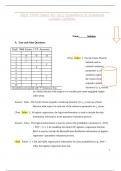
ISyE 7406 Exam-1 T/F Answers:
v1 v2 v3
1 F (True, False) 1. For the Gauss-Newton
2 F F method used to
3 F
4 F estimate unknown
5 parameters γ_vector in
6
nonlinear regressions,
7 F
8 F F the Taylor-Series
9
expands a nonlinear
10 F
All solutions not marked with "F" (False) are True. function f (x, γ_vector)
as a linear function with respect to x-variable plus some negligible higher-
order terms.
Answer: False. The Taylor-Series expands a nonlinear function f (x, γ_vector) as a linear
function with respect to each one of the unknown parameters in γ_vector.
(True, False) 2. In logistic regressions, the logit-transformation is used to include the data
distribution information in the parameter estimation process.
Answer: False. The logit-transformation is used to remove the probability constraints 0 ≤ E(Y)
= Pr(Y = 1) ≤ 1 for modeling the mean E(Y) against a regression function.
MLE is used to include the Bernoulli data distribution information in logistic
regression’s parameter estimation process.
(True, False) 3. LDA and QDA require prior information for class probabilities (e.g., Pr(Y =
red)), but logistics regression does not.
1
, Answer: True. LDA and QDA decide the classification by maximizing the posterior probability
of assigning an observation Y into a particular class given the x-input-variable
information. The (Bayesian) posterior probability is a product of prior
probability and data-likelihood. Logistic regression models regression
parameters against the logit-transformation of p = Pr(Y = class #1) and then
decides the classification Y to class #1 if p is greater than 50%. There is no
posterior probability calculation in logistic regression.
(True, False) 4. The functional form for GLM’s link-function depends on data-distribution’s
pdf (or pmf).
Answer: True. Firstly, data distribution for a GLM needs to be in the exponential family. Then,
express the pdf (or pmf) of data-distribution into the “functional form” for the
exponential family distributions. Use the “functional form” to locate the link
function.
(True, False) 5. Kernel regression does not require a pre-specified regression functional form.
Answer: True. Kernel regression is a nonparametric regression, which uses data to estimate the
regression functional form.
(True, False) 6. Classification tree, Neural Network and Support Vector Machine do not utilize
information from data’s probability density (or mass) function (pdf/pmf).
Answer: True. These three procedures are computing (or optimization) based procedures, where
data’s pdf/pmf information is not involved.
(True, False) 7. Discriminant Analysis (DA) assumes that the explanatory/input variables
x_vector are random variables, which have probability distributions.
Answer: True. LDA, QDA and RDA are Bayes classifiers. They use the joint pdfs of x_vector to
construct a class-dependent data likelihood for calculating posterior
probabilities in making classification decisions.
(True, False) 8. Cross-validations are usually used to estimate regression coefficients in the
linear, nonlinear and GLM regressions.
2
Latest Update.
Name: Solution
A. True and False Questions:
ISyE 7406 Exam-1 T/F Answers:
v1 v2 v3
1 F (True, False) 1. For the Gauss-Newton
2 F F method used to
3 F
4 F estimate unknown
5 parameters γ_vector in
6
nonlinear regressions,
7 F
8 F F the Taylor-Series
9
expands a nonlinear
10 F
All solutions not marked with "F" (False) are True. function f (x, γ_vector)
as a linear function with respect to x-variable plus some negligible higher-
order terms.
Answer: False. The Taylor-Series expands a nonlinear function f (x, γ_vector) as a linear
function with respect to each one of the unknown parameters in γ_vector.
(True, False) 2. In logistic regressions, the logit-transformation is used to include the data
distribution information in the parameter estimation process.
Answer: False. The logit-transformation is used to remove the probability constraints 0 ≤ E(Y)
= Pr(Y = 1) ≤ 1 for modeling the mean E(Y) against a regression function.
MLE is used to include the Bernoulli data distribution information in logistic
regression’s parameter estimation process.
(True, False) 3. LDA and QDA require prior information for class probabilities (e.g., Pr(Y =
red)), but logistics regression does not.
1
, Answer: True. LDA and QDA decide the classification by maximizing the posterior probability
of assigning an observation Y into a particular class given the x-input-variable
information. The (Bayesian) posterior probability is a product of prior
probability and data-likelihood. Logistic regression models regression
parameters against the logit-transformation of p = Pr(Y = class #1) and then
decides the classification Y to class #1 if p is greater than 50%. There is no
posterior probability calculation in logistic regression.
(True, False) 4. The functional form for GLM’s link-function depends on data-distribution’s
pdf (or pmf).
Answer: True. Firstly, data distribution for a GLM needs to be in the exponential family. Then,
express the pdf (or pmf) of data-distribution into the “functional form” for the
exponential family distributions. Use the “functional form” to locate the link
function.
(True, False) 5. Kernel regression does not require a pre-specified regression functional form.
Answer: True. Kernel regression is a nonparametric regression, which uses data to estimate the
regression functional form.
(True, False) 6. Classification tree, Neural Network and Support Vector Machine do not utilize
information from data’s probability density (or mass) function (pdf/pmf).
Answer: True. These three procedures are computing (or optimization) based procedures, where
data’s pdf/pmf information is not involved.
(True, False) 7. Discriminant Analysis (DA) assumes that the explanatory/input variables
x_vector are random variables, which have probability distributions.
Answer: True. LDA, QDA and RDA are Bayes classifiers. They use the joint pdfs of x_vector to
construct a class-dependent data likelihood for calculating posterior
probabilities in making classification decisions.
(True, False) 8. Cross-validations are usually used to estimate regression coefficients in the
linear, nonlinear and GLM regressions.
2