Test bank for:
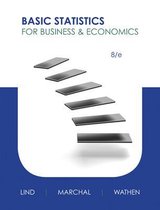
For Basic Statistics For Business And Economics 8th Edition
By Douglas A. Lind Latest Update Graded A+
,Chapter 01
True / False Questions
1. A Frequency Distribution Groups Data Into Classes Showing The
Number Of Observations In Each Class.
True False
2. A Frequency Distribution For Qualitative Data Has Class Limits.
True False
3. To Summarize The Gender Of Students Attending A College, The
Number Of Classes In A Frequency Distribution Depends On The
Number Of Students.
True False
4. In Frequency Distributions, Classes Are Mutually Exclusive If Each
Individual, Object, Or Measurement Is Included In Only One
Category.
True False
5. In A Bar Chart, The X-Axis Is Labeled With The Values Of A
Qualitative Variable.
True False
,6. In A Bar Chart, The Heights Of The Bars Represent The Frequencies In
Each Class.
True False
7. The Midpoint Of A Class, Which Is Also Called A Class Mark, Is
Halfway Between The Lower And Upper Limits.
True False
8. A Class Interval, Or Class Width, Can Be Determined By Subtracting
The Lower Limit Of A Class From The Lower Limit Of The Next Higher
Class.
True False
9. To Convert A Frequency Distribution To A Relative Frequency
Distribution, Divide Each Class Frequency By The Sum Of The Class
Frequencies.
True False
10 To Convert A Frequency Distribution To A Relative Frequency Distribution,
. Divide Each Class Frequency By The Number Of Classes.
True False
11 A Pie Chart Is Similar To A Relative Frequency Distribution.
.
True False
12 A Pie Chart Shows The Relative Frequency In Each Class.
.
True False
13 To Construct A Pie Chart, Relative Class Frequencies Are Used To Graph
. The "Slices" Of The Pie.
True False
14 A Cumulative Frequency Distribution Is Used When We Want To Determine
. How Many Observations Lie Above Or Below Certain Values.
, True False
For Basic Statistics For Business And Economics 8th Edition
By Douglas A. Lind Latest Update Graded A+
,Chapter 01
True / False Questions
1. A Frequency Distribution Groups Data Into Classes Showing The
Number Of Observations In Each Class.
True False
2. A Frequency Distribution For Qualitative Data Has Class Limits.
True False
3. To Summarize The Gender Of Students Attending A College, The
Number Of Classes In A Frequency Distribution Depends On The
Number Of Students.
True False
4. In Frequency Distributions, Classes Are Mutually Exclusive If Each
Individual, Object, Or Measurement Is Included In Only One
Category.
True False
5. In A Bar Chart, The X-Axis Is Labeled With The Values Of A
Qualitative Variable.
True False
,6. In A Bar Chart, The Heights Of The Bars Represent The Frequencies In
Each Class.
True False
7. The Midpoint Of A Class, Which Is Also Called A Class Mark, Is
Halfway Between The Lower And Upper Limits.
True False
8. A Class Interval, Or Class Width, Can Be Determined By Subtracting
The Lower Limit Of A Class From The Lower Limit Of The Next Higher
Class.
True False
9. To Convert A Frequency Distribution To A Relative Frequency
Distribution, Divide Each Class Frequency By The Sum Of The Class
Frequencies.
True False
10 To Convert A Frequency Distribution To A Relative Frequency Distribution,
. Divide Each Class Frequency By The Number Of Classes.
True False
11 A Pie Chart Is Similar To A Relative Frequency Distribution.
.
True False
12 A Pie Chart Shows The Relative Frequency In Each Class.
.
True False
13 To Construct A Pie Chart, Relative Class Frequencies Are Used To Graph
. The "Slices" Of The Pie.
True False
14 A Cumulative Frequency Distribution Is Used When We Want To Determine
. How Many Observations Lie Above Or Below Certain Values.
, True False