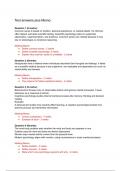
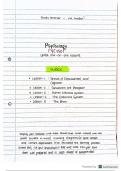
Test answers plus Memo:
Question 1 (6 marks) :
Common sense is based on intuition, personal experience, or cultural beliefs. It’s informal,
often biased, and lacks scientific testing. Scientific psychology relies on systematic
observation, experimentation, and evidence. Common sense can mislead because it may
rely on stereotypes or emotional reasoning
Marking Memo:
● Define common sense - 2 marks
● Define scientific psychology- 2 marks
● Explain why common sense is unreliable - 2 marks
Question 2 (6marks):
Introspection was a method where individuals described their thoughts and feelings. It failed
as a scientific method because it was subjective, non-replicable and dependent too much on
verbal ability and honesty
Marking Memo:
● Define introspection - 2 marks
● Two reasons for failure explained clearly - 4 marks
Question 3 (6 marks):
Behaviourism focuses only on observable actions and ignores mental processes, It sees
behaviour as a response to stimuli.
Cognitive psychology studies internal mental processes like memory, thinking and decision
making
Example:
A behaviourist studies how rewards affect learning. A cognitive psychologist studies how
learners process and remember information
Marking Memo:
● Correct comparison - 3 marks
● Example of each - 3 marks
Question 4 (6marks):
The mind-body problem asks whether the mind and body are separate or one.
Dualism says the mind and body are distinct (descartes)
Monism says mental activity comes from the physical brain
Modern psychology aligns with monism, using neuroscience to study mental processes
Marking Memo:
● Define dualism - 2 marks
● Define monism - 2 marks
● State which one psychology supports and why - 2 marks
Question 1 (6 marks) :
Common sense is based on intuition, personal experience, or cultural beliefs. It’s informal,
often biased, and lacks scientific testing. Scientific psychology relies on systematic
observation, experimentation, and evidence. Common sense can mislead because it may
rely on stereotypes or emotional reasoning
Marking Memo:
● Define common sense - 2 marks
● Define scientific psychology- 2 marks
● Explain why common sense is unreliable - 2 marks
Question 2 (6marks):
Introspection was a method where individuals described their thoughts and feelings. It failed
as a scientific method because it was subjective, non-replicable and dependent too much on
verbal ability and honesty
Marking Memo:
● Define introspection - 2 marks
● Two reasons for failure explained clearly - 4 marks
Question 3 (6 marks):
Behaviourism focuses only on observable actions and ignores mental processes, It sees
behaviour as a response to stimuli.
Cognitive psychology studies internal mental processes like memory, thinking and decision
making
Example:
A behaviourist studies how rewards affect learning. A cognitive psychologist studies how
learners process and remember information
Marking Memo:
● Correct comparison - 3 marks
● Example of each - 3 marks
Question 4 (6marks):
The mind-body problem asks whether the mind and body are separate or one.
Dualism says the mind and body are distinct (descartes)
Monism says mental activity comes from the physical brain
Modern psychology aligns with monism, using neuroscience to study mental processes
Marking Memo:
● Define dualism - 2 marks
● Define monism - 2 marks
● State which one psychology supports and why - 2 marks