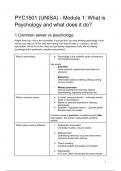
PYC1501 (UNISA) - Module 1: What is
Psychology and what does it do?
1.Common sense vs psychology:
Alright, listen up - this is the foundation. If you get this, you stop thinking psychology is just
‘advice you read on TikTok’ and start seeing it for what it really is: a science, not soft
speculation. We’re not in the ‘vibes and gut feeling’ department here. We’re building
knowledge that’s systematic, testable and powerful…
What is psychology: ● Psychology is the scientific study of behaviour
and mental processes
Key words:
- Scientific:
Uses research, experiments and data (not
opinions)
- Behaviour:
Observable actions (walking, talking, texting
your ex at 2am)
- Mental processes:
Internal experiences (thinking, feeling,
daydreaming, regretting texting said ex)
What is common sense: ● It’s what “everyone knows” - culturally shared
ideas or assumptions
● Based on personal experience, hearsay,
stereotypes
● Example: “Opposites attract.” - Sounds good?
Science says not usually.
Common sense is post-hoc: it explains events after
they happen, but doesn’t really predict anything
reliably.
What makes science different: 1. Systematic observation:
Controlled studies, not just stories
2. Measurement:
Quantifying behaviour (e.g how many times
someone checks their phone)
3. Theory building:
Creating models that explain and predict
4. Replicability:
If it’s true, others should get the same results
1
,Side-by-side comparison:
Feature: Common Sense: Scientific Psychology:
Based on: Personal experience, Empirical data, research
intuition
Biased? Often. Confirmation bias, Controlled for bias not to
cultural bias take place
Can it be predicted? Rarely Yes - with tested theories
Reliable? Situational Consistent across studies
Why common sense can be dangerous in
psychology:
Let’s say someone says:
Psychology asks:
What causes depression biologically,
socially, cognitively?
How can we test treatments?
What works across cultures and contexts?
We don’t guess, we test!
Scientific thinking in psychology involves
Exam Tip:
Examiners loves to test
this section with
scenario-style MCQs!
2
, Mini Case Study (because this is also a
favourite):
Scenario:
Sipho believes people are born with the natural ability to read others’ emotions. His
friend Thandi says she read a study showing people improve their emotional
recognition through training.
Question:
Who is using a scientific approach?
Answer:
Thandi - she refers to a study (data + study)
In Summary:
● Psychology is a science - not personal advice or a gut feeling.
● Common sense is intuitive but often flawed, biased or flat out wrong
● Scientific thinking relies on data, critical thinking and replaceable evidence
● Your job as a psychology student is to challenge assumptions and rely on tested
knowledge.
3
Psychology and what does it do?
1.Common sense vs psychology:
Alright, listen up - this is the foundation. If you get this, you stop thinking psychology is just
‘advice you read on TikTok’ and start seeing it for what it really is: a science, not soft
speculation. We’re not in the ‘vibes and gut feeling’ department here. We’re building
knowledge that’s systematic, testable and powerful…
What is psychology: ● Psychology is the scientific study of behaviour
and mental processes
Key words:
- Scientific:
Uses research, experiments and data (not
opinions)
- Behaviour:
Observable actions (walking, talking, texting
your ex at 2am)
- Mental processes:
Internal experiences (thinking, feeling,
daydreaming, regretting texting said ex)
What is common sense: ● It’s what “everyone knows” - culturally shared
ideas or assumptions
● Based on personal experience, hearsay,
stereotypes
● Example: “Opposites attract.” - Sounds good?
Science says not usually.
Common sense is post-hoc: it explains events after
they happen, but doesn’t really predict anything
reliably.
What makes science different: 1. Systematic observation:
Controlled studies, not just stories
2. Measurement:
Quantifying behaviour (e.g how many times
someone checks their phone)
3. Theory building:
Creating models that explain and predict
4. Replicability:
If it’s true, others should get the same results
1
,Side-by-side comparison:
Feature: Common Sense: Scientific Psychology:
Based on: Personal experience, Empirical data, research
intuition
Biased? Often. Confirmation bias, Controlled for bias not to
cultural bias take place
Can it be predicted? Rarely Yes - with tested theories
Reliable? Situational Consistent across studies
Why common sense can be dangerous in
psychology:
Let’s say someone says:
Psychology asks:
What causes depression biologically,
socially, cognitively?
How can we test treatments?
What works across cultures and contexts?
We don’t guess, we test!
Scientific thinking in psychology involves
Exam Tip:
Examiners loves to test
this section with
scenario-style MCQs!
2
, Mini Case Study (because this is also a
favourite):
Scenario:
Sipho believes people are born with the natural ability to read others’ emotions. His
friend Thandi says she read a study showing people improve their emotional
recognition through training.
Question:
Who is using a scientific approach?
Answer:
Thandi - she refers to a study (data + study)
In Summary:
● Psychology is a science - not personal advice or a gut feeling.
● Common sense is intuitive but often flawed, biased or flat out wrong
● Scientific thinking relies on data, critical thinking and replaceable evidence
● Your job as a psychology student is to challenge assumptions and rely on tested
knowledge.
3