COMBANK 9- Questions with Correct Answers Verified by Experts| Latest Update
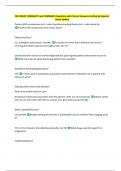
An 18-year-old male presents to the Emergency Room with unilateral upper extremity paresis.
History reveals he was binge drinking the night before and passed out in a chair with his arm
draped over the back of the chair. The etiology is believed to involve a nerve that innervates the
lateral portion of the brachialis muscle. The radial nerve (C5-T1) branches from the posterior
cord, starts medial to the humerus, and crosses posteriorly to the spiral groove of the humerus,
innervating the triceps brachii and the lateral portion of the brachialis muscles.
compression of axilla (e.g., due to crutches or sleeping with arm over chair ("Saturday night
palsy")
A 30-year-old male complains of elbow pain and a weak grip. Physical examination reveals
weakness of the interosseous muscles of the hand. The etiology is determined to involve a
nerve which passes under the arcade of Struther's, posterior to the medial epicondyle, and
under the ligament of Osborne as it descends into the forearm. The ulnar nerve (C[7] 8-T1)
branches from the medial cord, runs anterior to the posterior compartment, under the arcade
of Struthers, through the medial head of the triceps, posterior to the medial epicondyle, and
through the cubital tunnel. The ulnar nerve does not supply any motor or sensory innervations
to the arm.
A 45-year-old male presents to the Emergency Department after a self-inflicting superficial cut
in his upper arm from a chain saw. He complains of a lack of sensation in the medial arm. The
etiology is determined to involve a branch of the medial cord of the brachial plexus that
terminates within the upper arm. The medial cutaneous nerve of the arm (C8-T1) branches
from the medial cord of the brachial plexus, joins with the intercostobrachial nerve, and runs
subcutaneously within the medial arm, supplying sensation. This nerve has no motor
innervation and terminates as sensory branches within the medial arm.
Maternal diabetes Maternal diabetes is a common cause of neonatal hypoglycemia due to
excess insulin production by the fetus.The large infant is at increased risk for trauma during
delivery.
anti-cyclic citrullinated peptide antibody is more specific for rheumatoid arthritis
80% have ⊕ rheumatoid factor (anti-IgG antibody);
,anti-cyclic citrullinated peptide antibody is more specific.
Strong association with HLA-DR4.
hyperextension of the proximal interphalangeal joint with distal interphalangeal joint flexion
swan neck deformity
Anemia of chronic disease ↑Hepcidin causes iron to be trapped inside macrophages
↓
↓plasma iron levels
↑ferritin level ↓Transferin ↓TIBC
normocytic→microcytic
↑erythrocyte sedimentation rate
↑C-reactive protein.
Hepcidin regulates the intestinal absorption of dietary iron, the release of iron from
macrophages, and the transfer of iron stored in hepatocytes
An ↑ hepcidin levels occurs in chronic inflammatory diseases. Hepcidin causes iron to be
trapped inside macrophages.
Sideroblastic anemia causes alcohol
isoniazid toxicity
lead toxicity
vitamin B6 deficiency
iron overload
copper deficiency
zinc toxicity.
, low MCV, high Fe2+, low TIBC sideroblastic anemia
low MCV, normal Fe2+, normal TIBC beta thalassemia trait
normal MCV, low Fe2+, low TIBC Anemia of chronic disease
normal MCV, normal Fe2+, normal TIBC sickle cell anemia
low MCV, low Fe2+, high TIBC iron deficiency anemia
sideroblastic anemia microcytic, hypochromic anemia. The hypochromic red cells have
coarse basophilic granules that stain positive for iron with a Prussian blue stain. The granules
may completely surround the nucleus and form the diagnostic feature ringed sideroblasts.
Laboratory results can also reveal an
↑red cell volume distribution width,
↑serum iron,
↓total iron binding capacity (↓TIBC)
↑serum transferrin saturation
↑serum ferritin levels.
Binds MHC-II and T-cell receptor simultaneously, activating large numbers of T cells to stimulate
release of IFN-γ and IL-2. This action is responsible for the symptoms of high fever, low blood
pressure, rash, and multiple-organ abnormalities. toxic shock syndrome toxin-1 (TSST-1) is a
superantigen
Activates a G protein through ADP ribosylation, which activates large numbers of T cells to
stimulate release of IFN-γ and IL-2 Bordetella pertussis and Vibrio cholerae have an exotoxin
that activates G proteins, and this leads to a loss of water from the affected cells.
An 18-year-old male presents to the Emergency Room with unilateral upper extremity paresis.
History reveals he was binge drinking the night before and passed out in a chair with his arm
draped over the back of the chair. The etiology is believed to involve a nerve that innervates the
lateral portion of the brachialis muscle. The radial nerve (C5-T1) branches from the posterior
cord, starts medial to the humerus, and crosses posteriorly to the spiral groove of the humerus,
innervating the triceps brachii and the lateral portion of the brachialis muscles.
compression of axilla (e.g., due to crutches or sleeping with arm over chair ("Saturday night
palsy")
A 30-year-old male complains of elbow pain and a weak grip. Physical examination reveals
weakness of the interosseous muscles of the hand. The etiology is determined to involve a
nerve which passes under the arcade of Struther's, posterior to the medial epicondyle, and
under the ligament of Osborne as it descends into the forearm. The ulnar nerve (C[7] 8-T1)
branches from the medial cord, runs anterior to the posterior compartment, under the arcade
of Struthers, through the medial head of the triceps, posterior to the medial epicondyle, and
through the cubital tunnel. The ulnar nerve does not supply any motor or sensory innervations
to the arm.
A 45-year-old male presents to the Emergency Department after a self-inflicting superficial cut
in his upper arm from a chain saw. He complains of a lack of sensation in the medial arm. The
etiology is determined to involve a branch of the medial cord of the brachial plexus that
terminates within the upper arm. The medial cutaneous nerve of the arm (C8-T1) branches
from the medial cord of the brachial plexus, joins with the intercostobrachial nerve, and runs
subcutaneously within the medial arm, supplying sensation. This nerve has no motor
innervation and terminates as sensory branches within the medial arm.
Maternal diabetes Maternal diabetes is a common cause of neonatal hypoglycemia due to
excess insulin production by the fetus.The large infant is at increased risk for trauma during
delivery.
anti-cyclic citrullinated peptide antibody is more specific for rheumatoid arthritis
80% have ⊕ rheumatoid factor (anti-IgG antibody);
,anti-cyclic citrullinated peptide antibody is more specific.
Strong association with HLA-DR4.
hyperextension of the proximal interphalangeal joint with distal interphalangeal joint flexion
swan neck deformity
Anemia of chronic disease ↑Hepcidin causes iron to be trapped inside macrophages
↓
↓plasma iron levels
↑ferritin level ↓Transferin ↓TIBC
normocytic→microcytic
↑erythrocyte sedimentation rate
↑C-reactive protein.
Hepcidin regulates the intestinal absorption of dietary iron, the release of iron from
macrophages, and the transfer of iron stored in hepatocytes
An ↑ hepcidin levels occurs in chronic inflammatory diseases. Hepcidin causes iron to be
trapped inside macrophages.
Sideroblastic anemia causes alcohol
isoniazid toxicity
lead toxicity
vitamin B6 deficiency
iron overload
copper deficiency
zinc toxicity.
, low MCV, high Fe2+, low TIBC sideroblastic anemia
low MCV, normal Fe2+, normal TIBC beta thalassemia trait
normal MCV, low Fe2+, low TIBC Anemia of chronic disease
normal MCV, normal Fe2+, normal TIBC sickle cell anemia
low MCV, low Fe2+, high TIBC iron deficiency anemia
sideroblastic anemia microcytic, hypochromic anemia. The hypochromic red cells have
coarse basophilic granules that stain positive for iron with a Prussian blue stain. The granules
may completely surround the nucleus and form the diagnostic feature ringed sideroblasts.
Laboratory results can also reveal an
↑red cell volume distribution width,
↑serum iron,
↓total iron binding capacity (↓TIBC)
↑serum transferrin saturation
↑serum ferritin levels.
Binds MHC-II and T-cell receptor simultaneously, activating large numbers of T cells to stimulate
release of IFN-γ and IL-2. This action is responsible for the symptoms of high fever, low blood
pressure, rash, and multiple-organ abnormalities. toxic shock syndrome toxin-1 (TSST-1) is a
superantigen
Activates a G protein through ADP ribosylation, which activates large numbers of T cells to
stimulate release of IFN-γ and IL-2 Bordetella pertussis and Vibrio cholerae have an exotoxin
that activates G proteins, and this leads to a loss of water from the affected cells.