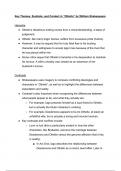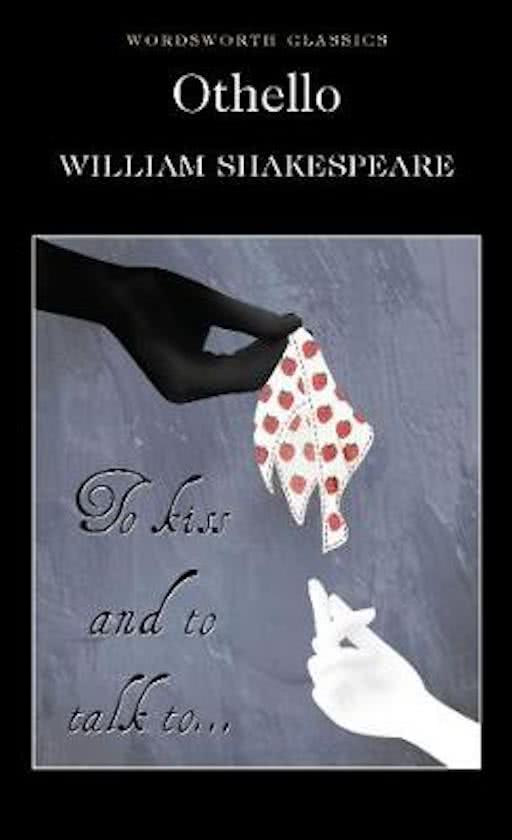
Key Themes, Symbols, and Context in “Othello” by William Shakespeare
Hamartia
● Othello’s disastrous ending comes from a misunderstanding- a lapse of
judgement.
● Othello, like many tragic heroes, suffers from excessive pride (hubris).
● However, it may be argued that his truly fatal flaw is his trusting
character and willingness to accept Iago’s lies because of the trust that
he has placed within him.
● Some critics argue that Othello’s hamartia is his desperation to maintain
his honour. A wife’s chastity was viewed as an extension of her
husband’s honour.
Contrasts
● Shakespeare uses imagery to compare conflicting ideologies and
characters in “Othello”, as well as to highlight the differences between
expectation and reality.
● Contrast is also important when recognising the differences between
what people appear to be, and what they actually are.
○ For example, Iago presents himself as a loyal friend to Othello,
but is actually the titular character’s undoing.
○ For example, Desdemona appears to be (to Othello, at least) an
unfaithful wife, but is actually a loving and innocent woman.
● Key contrasts and conflicts include
○ Love vs lust (this is particularly evident in how the other
characters, like Brabantio, perceive the marriage between
Desdemona and Othello versus the genuine affection that it has
in reality).
■ In Act One, Iago describes the relationship between
Desdemona and Othello as a rancid, lewd affair. Later in
, the act, Desdemona and Othello provide a tender recount
of their marriage and “course of love”.
○ Heaven vs Hell
○ Civilisation vs barbarism (Iago describes Othello as a primitive
beast, but Othello is introduced to the audience as a logical, calm,
and intelligent man).
○ Christianity vs heathenism (the conflict between ordered religion
and the primitive hatred within mankind).
Additional Context
● Mirrors the story of Venus and Vulcan.
○ Cyprus is named after Venus
○ Venus is associated with war (like Cyprus)
● Vulcan is driven to action over his jealousy over Venus’ lover. This
mirrors how Iago wishes to make a mockery out of the relationship
between Desdemona and Othello.
● “And out of her own goodness make the net”- Iago
○ Reference to nets and traps in regards to Iago.
● Venice is the order and logic in comparison to the passion and chaos of
Cyprus.
● The trip to Cyprus represents the approaching madness and jealousy of
Cyprus (seen in the pathetic fallacy of the storm).
● Desdemona is “a moth of peace”, which juxtaposes the position of
Othello.
Women in the 17th Century
● Marriage and childbirth was not only a burden. Many women were
honoured to marry and be mothers, and found the arrangement
beneficial to themselves as they could take advantage of their
husbands’ status and property.
Hamartia
● Othello’s disastrous ending comes from a misunderstanding- a lapse of
judgement.
● Othello, like many tragic heroes, suffers from excessive pride (hubris).
● However, it may be argued that his truly fatal flaw is his trusting
character and willingness to accept Iago’s lies because of the trust that
he has placed within him.
● Some critics argue that Othello’s hamartia is his desperation to maintain
his honour. A wife’s chastity was viewed as an extension of her
husband’s honour.
Contrasts
● Shakespeare uses imagery to compare conflicting ideologies and
characters in “Othello”, as well as to highlight the differences between
expectation and reality.
● Contrast is also important when recognising the differences between
what people appear to be, and what they actually are.
○ For example, Iago presents himself as a loyal friend to Othello,
but is actually the titular character’s undoing.
○ For example, Desdemona appears to be (to Othello, at least) an
unfaithful wife, but is actually a loving and innocent woman.
● Key contrasts and conflicts include
○ Love vs lust (this is particularly evident in how the other
characters, like Brabantio, perceive the marriage between
Desdemona and Othello versus the genuine affection that it has
in reality).
■ In Act One, Iago describes the relationship between
Desdemona and Othello as a rancid, lewd affair. Later in
, the act, Desdemona and Othello provide a tender recount
of their marriage and “course of love”.
○ Heaven vs Hell
○ Civilisation vs barbarism (Iago describes Othello as a primitive
beast, but Othello is introduced to the audience as a logical, calm,
and intelligent man).
○ Christianity vs heathenism (the conflict between ordered religion
and the primitive hatred within mankind).
Additional Context
● Mirrors the story of Venus and Vulcan.
○ Cyprus is named after Venus
○ Venus is associated with war (like Cyprus)
● Vulcan is driven to action over his jealousy over Venus’ lover. This
mirrors how Iago wishes to make a mockery out of the relationship
between Desdemona and Othello.
● “And out of her own goodness make the net”- Iago
○ Reference to nets and traps in regards to Iago.
● Venice is the order and logic in comparison to the passion and chaos of
Cyprus.
● The trip to Cyprus represents the approaching madness and jealousy of
Cyprus (seen in the pathetic fallacy of the storm).
● Desdemona is “a moth of peace”, which juxtaposes the position of
Othello.
Women in the 17th Century
● Marriage and childbirth was not only a burden. Many women were
honoured to marry and be mothers, and found the arrangement
beneficial to themselves as they could take advantage of their
husbands’ status and property.