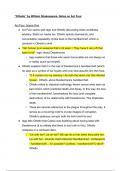
“Othello” by William Shakespeare- Notes on Act Four
Act Four, Scene One
● Act Four opens with Iago and Othello discussing what constitutes
adultery. Starts en media res. Othello spirals downwards, and
conversation repeatedly circles back to the handkerchief, which is
constant in Othello’s mind.
● “Her honour is an essence that’s not seen; / They have it very oft that
have it not”- Iago, about Desdemona
○ Iago explains that those who seem honourable are not always so
in reality (such as himself).
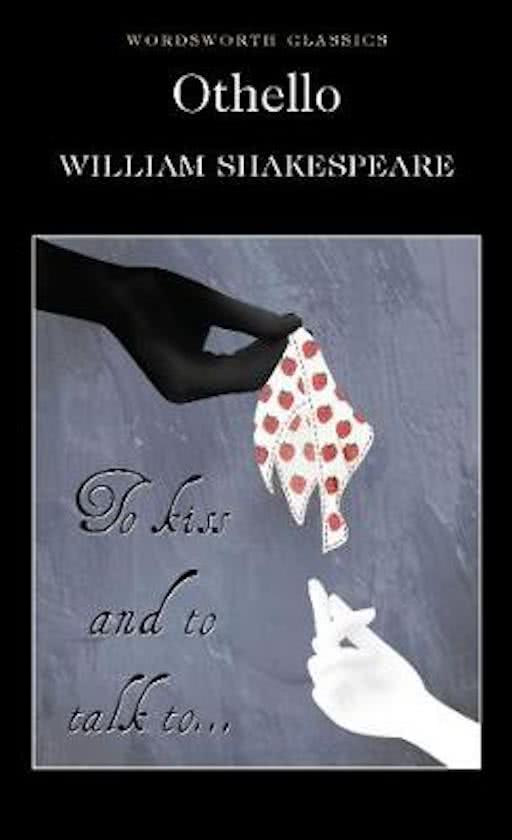
● Othello explains that it is the loss of Desdemona’s handkerchief (which
he sees as a symbol of her loyalty and love) that disturbs him the most.
○ “O it comes o’er my memory / As doth the raven o’er the infected
house”- Othello, about Desdemona’s handkerchief.
○ Othello refers to classical mythology, where ravens were seen as
bad omens which predicted death and decay. In this way, the loss
of the handkerchief, foreshadows the loss (and complete
destruction) of his relationship with Desdemona. This forebodes
death.
○ There are several references to the plague throughout the play. It
serves as a recurring motif to invoke images of corruption.
Othello’s jealousy corrupts both his mind and his soul.
● Iago tells Othello that Cassio was boasting about having slept with
Desdemona (it is unlikely that there is any truth to this). Othello
collapses in a confused daze.
○ “Lie with her? Lie on her? We say lie on her when they belie her.
Lie with her - Zounds, that’s fulsome! Handkerchief - confessions
- handkerchief!... Is’t possible? Confess - handkerchief! O devil!”-
Othello
, ○ For the first time, Othello speaks at length fully in prose, rather
than verse. This highlights his mental deterioration. Furthermore,
the fragmented syntax reveals his fragmented mental state
(fractured) and his growing mental instability. This is strengthened
by his reputation of “handkerchief”, which accentuates his
confusion (especially with the accompanying exclamation).
○ Othello is dehumanising himself in the depths of his misery.
○ Othello’s resultant sickness represents his emotional vulnerability
(where he is at Iago’s mercy) and the physical deterioration which
accompanies his descent into madness. It is a visual metaphor for
the breakdown of Othello’s reason, under the influence of Iago.
This foreshadows a complete and fatal collapse (as seen in Act
Five).
■ “My lord is fall’n into an epilepsy. / This is his second fit: he
had one yesterday.”- Iago
■ Iago exploits Othello’s weaknesses as the primary
antagonist. Othello lacks confidence in his relationship with
Desdemona, making him additionally susceptible to Iago’s
manipulative exploitation of pre-existing insecurities.
● Iago revels in Othello’s misery.
○ “Work on, / My medicine, work! Thus credulous fools are caught, /
And many worthy and chaste dames, even thus, / All guiltless,
meet reproach. What ho, my lord! / My lord, I say! Othello!”- Iago
○ Iago speaks as though he is addressing Othello, although it is
clear that the general is in no position to understand him (and
Iago would not reveal this malice if he were). Therefore, in directly
addressing Othello, Iago adopts a mocking tone. He taunts
Othello in his unconsciousness.
○ The metaphor of a trap prevails.
● Iago asks Othello how his head is, to which Othello responds “Dost thou
mock me?”. This is because cuckolds (ie. men with unfaithful wives)
Act Four, Scene One
● Act Four opens with Iago and Othello discussing what constitutes
adultery. Starts en media res. Othello spirals downwards, and
conversation repeatedly circles back to the handkerchief, which is
constant in Othello’s mind.
● “Her honour is an essence that’s not seen; / They have it very oft that
have it not”- Iago, about Desdemona
○ Iago explains that those who seem honourable are not always so
in reality (such as himself).
● Othello explains that it is the loss of Desdemona’s handkerchief (which
he sees as a symbol of her loyalty and love) that disturbs him the most.
○ “O it comes o’er my memory / As doth the raven o’er the infected
house”- Othello, about Desdemona’s handkerchief.
○ Othello refers to classical mythology, where ravens were seen as
bad omens which predicted death and decay. In this way, the loss
of the handkerchief, foreshadows the loss (and complete
destruction) of his relationship with Desdemona. This forebodes
death.
○ There are several references to the plague throughout the play. It
serves as a recurring motif to invoke images of corruption.
Othello’s jealousy corrupts both his mind and his soul.
● Iago tells Othello that Cassio was boasting about having slept with
Desdemona (it is unlikely that there is any truth to this). Othello
collapses in a confused daze.
○ “Lie with her? Lie on her? We say lie on her when they belie her.
Lie with her - Zounds, that’s fulsome! Handkerchief - confessions
- handkerchief!... Is’t possible? Confess - handkerchief! O devil!”-
Othello
, ○ For the first time, Othello speaks at length fully in prose, rather
than verse. This highlights his mental deterioration. Furthermore,
the fragmented syntax reveals his fragmented mental state
(fractured) and his growing mental instability. This is strengthened
by his reputation of “handkerchief”, which accentuates his
confusion (especially with the accompanying exclamation).
○ Othello is dehumanising himself in the depths of his misery.
○ Othello’s resultant sickness represents his emotional vulnerability
(where he is at Iago’s mercy) and the physical deterioration which
accompanies his descent into madness. It is a visual metaphor for
the breakdown of Othello’s reason, under the influence of Iago.
This foreshadows a complete and fatal collapse (as seen in Act
Five).
■ “My lord is fall’n into an epilepsy. / This is his second fit: he
had one yesterday.”- Iago
■ Iago exploits Othello’s weaknesses as the primary
antagonist. Othello lacks confidence in his relationship with
Desdemona, making him additionally susceptible to Iago’s
manipulative exploitation of pre-existing insecurities.
● Iago revels in Othello’s misery.
○ “Work on, / My medicine, work! Thus credulous fools are caught, /
And many worthy and chaste dames, even thus, / All guiltless,
meet reproach. What ho, my lord! / My lord, I say! Othello!”- Iago
○ Iago speaks as though he is addressing Othello, although it is
clear that the general is in no position to understand him (and
Iago would not reveal this malice if he were). Therefore, in directly
addressing Othello, Iago adopts a mocking tone. He taunts
Othello in his unconsciousness.
○ The metaphor of a trap prevails.
● Iago asks Othello how his head is, to which Othello responds “Dost thou
mock me?”. This is because cuckolds (ie. men with unfaithful wives)