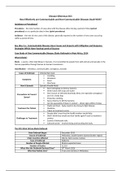
Disease Dilemmas SG3
How Effectively are Communicable and Non-Communicable Diseases Dealt With?
Incidence or Prevalence?
Prevalence – the total number of cases alive with the disease either during a period of time (period
prevalence) or at a particular date in time (point prevalence)
Incidence – the rate of new cases of the disease, generally reported as the number of new cases occurring
within a period of time
Key Idea 3.a.: Communicable Diseases Have Causes and Impacts with Mitigation and Response
Strategies Which Have Varying Levels of Success
Case Study of One Communicable Disease: Ebola Outbreak in West Africa, 2014
What is Ebola?
Ebola – a severe, often fatal illness in humans. It is transmitted to people from wild animals and spreads in the
human population through human-to-human transmission
Classification – infectious, communicable, contagious, zoonotic
Cause of Outbreak Infected bat meat
Vomiting
Weakness
Symptoms
Fever
Diarrhoea
How it Spreads Spread of bodily fluids
Burn belongings to destroy bacteria
Wash hands with soap and water
Don’t touch an infected dead body (they are especially contagious) –
Precautions to Prevent
put it in a body bag
Spread
Protective clothing
Spray chlorine to kill the bacteria
Go into quarantine if been in contact – shows signs within 21 days
Fluids and food – body needs to be strong to fight disease
Treatment for Patient Medicine
Taken to treatment centre
People didn’t trust that the health workers would help
Didn’t think they would see their family again if sent to treatment
Challenges to Treatment centres
Scared of biohazard suits
Cultural burials – involve kissing and touching the body
The 2014 West African Ebola Outbreak
Date Outbreak Began December 2013
Source of Outbreak Meliandou, South-Eastern Guinea (border region)
Main Countries Affected Liberia, Sierra Leone, Guinea
Type of Outbreak Epidemic
Number of People Affected 28,616 suspected cases
Number of Deaths 11,310
When Was the Outbreak Declared Over? 29th March 2016
Who Was Patient Zero? A two year old boy in Meliandou
, Pattern of Disease Diffusion:
Expansion diffusion – spreads from one place to another, also links to Neighbourhood Effect
Contagious diffusion – through contact with an infected person
Relocation diffusion – leaves an area and moves to another e.g. isolated cases in US, UK and Europe
Morbidity and Mortality
Morbidity – refers to the unhealthy state of an individual, e.g. a morbidity rate looks at the incidence of a
disease across a population or geographical location during a single year
Mortality – refers to the state of being dead or alive, e.g. a mortality rate is the rate of death of a population
Variation in Morbidity and Mortality Rates of Ebola:
Morbidity Mortality
Highest number of cases US and Spain shows 100% mortality rate, though they only
concentrated in Guinea had one death
(1,350), Sierra Leone (2,950) Guinea = 58%
and Liberia (4,076) Sierra Leone = 32%
Isolated cases in US (1 case) Liberia = 57%
and Europe (1 case in Spain) These figures seem much lower, but morbidity was higher
so the amount of people who died would be higher
The Cause of the Outbreak
Environmental Human
Climate influences the Deforestation means people moving closer to forests and
number of bats with the forces bats closer towards urban areas
virus – dry seasons Mining – flow of people to areas are mines are for jobs
followed by heavy increases disease diffusion
rainfalls produce an Poverty and Civil war – forced rapid urbanisation in Freetown
abundance of fruit, so and damaged health services. Led to lack of money to
the number of fruit bats coordinate response and for proper sanitary facilities. People
increases have to hunt in forest, so increased contact with fruit bats
The 2 fruit bat species Human induced climate change (anthropogenic) exaggerated
with the disease are dry and wet seasons – dry seasons increase leading to more
found in Guinea fruit bats
The Impacts of Ebola
Agriculture is the largest employer in Sierra Leone with 80% of the
population working in the sector
Rice is the most important staple crop – the areas of Sierra Leone most
seriously affected by Ebola are responsible for 18% of the country’s rice
Impact on
output
Agriculture
40% of farmers abandoned their land because of the fear of being infected
In the farms not abandoned seasonal workers didn’t make the journey to
participate in the harvest
As a result, rice prices rose by 30% in these regions
Many local traders who had lost family to Ebola faced fear from customers
that their produce was ‘tainted’ or that they themselves were infected
Impact on
Farmers struggled to feed their families on their heavily reduced income
Economic and Food
The delivery of goods nationally was affected by regional quarantine, so
Security
food was not getting through to some outlying districts, increasing the cost
of food and necessities beyond normal levels
Impact on GDP Liberia lost 11% of GDP ($228m)
Sierra Leone lost 4% of GDP ($439m)
How Effectively are Communicable and Non-Communicable Diseases Dealt With?
Incidence or Prevalence?
Prevalence – the total number of cases alive with the disease either during a period of time (period
prevalence) or at a particular date in time (point prevalence)
Incidence – the rate of new cases of the disease, generally reported as the number of new cases occurring
within a period of time
Key Idea 3.a.: Communicable Diseases Have Causes and Impacts with Mitigation and Response
Strategies Which Have Varying Levels of Success
Case Study of One Communicable Disease: Ebola Outbreak in West Africa, 2014
What is Ebola?
Ebola – a severe, often fatal illness in humans. It is transmitted to people from wild animals and spreads in the
human population through human-to-human transmission
Classification – infectious, communicable, contagious, zoonotic
Cause of Outbreak Infected bat meat
Vomiting
Weakness
Symptoms
Fever
Diarrhoea
How it Spreads Spread of bodily fluids
Burn belongings to destroy bacteria
Wash hands with soap and water
Don’t touch an infected dead body (they are especially contagious) –
Precautions to Prevent
put it in a body bag
Spread
Protective clothing
Spray chlorine to kill the bacteria
Go into quarantine if been in contact – shows signs within 21 days
Fluids and food – body needs to be strong to fight disease
Treatment for Patient Medicine
Taken to treatment centre
People didn’t trust that the health workers would help
Didn’t think they would see their family again if sent to treatment
Challenges to Treatment centres
Scared of biohazard suits
Cultural burials – involve kissing and touching the body
The 2014 West African Ebola Outbreak
Date Outbreak Began December 2013
Source of Outbreak Meliandou, South-Eastern Guinea (border region)
Main Countries Affected Liberia, Sierra Leone, Guinea
Type of Outbreak Epidemic
Number of People Affected 28,616 suspected cases
Number of Deaths 11,310
When Was the Outbreak Declared Over? 29th March 2016
Who Was Patient Zero? A two year old boy in Meliandou
, Pattern of Disease Diffusion:
Expansion diffusion – spreads from one place to another, also links to Neighbourhood Effect
Contagious diffusion – through contact with an infected person
Relocation diffusion – leaves an area and moves to another e.g. isolated cases in US, UK and Europe
Morbidity and Mortality
Morbidity – refers to the unhealthy state of an individual, e.g. a morbidity rate looks at the incidence of a
disease across a population or geographical location during a single year
Mortality – refers to the state of being dead or alive, e.g. a mortality rate is the rate of death of a population
Variation in Morbidity and Mortality Rates of Ebola:
Morbidity Mortality
Highest number of cases US and Spain shows 100% mortality rate, though they only
concentrated in Guinea had one death
(1,350), Sierra Leone (2,950) Guinea = 58%
and Liberia (4,076) Sierra Leone = 32%
Isolated cases in US (1 case) Liberia = 57%
and Europe (1 case in Spain) These figures seem much lower, but morbidity was higher
so the amount of people who died would be higher
The Cause of the Outbreak
Environmental Human
Climate influences the Deforestation means people moving closer to forests and
number of bats with the forces bats closer towards urban areas
virus – dry seasons Mining – flow of people to areas are mines are for jobs
followed by heavy increases disease diffusion
rainfalls produce an Poverty and Civil war – forced rapid urbanisation in Freetown
abundance of fruit, so and damaged health services. Led to lack of money to
the number of fruit bats coordinate response and for proper sanitary facilities. People
increases have to hunt in forest, so increased contact with fruit bats
The 2 fruit bat species Human induced climate change (anthropogenic) exaggerated
with the disease are dry and wet seasons – dry seasons increase leading to more
found in Guinea fruit bats
The Impacts of Ebola
Agriculture is the largest employer in Sierra Leone with 80% of the
population working in the sector
Rice is the most important staple crop – the areas of Sierra Leone most
seriously affected by Ebola are responsible for 18% of the country’s rice
Impact on
output
Agriculture
40% of farmers abandoned their land because of the fear of being infected
In the farms not abandoned seasonal workers didn’t make the journey to
participate in the harvest
As a result, rice prices rose by 30% in these regions
Many local traders who had lost family to Ebola faced fear from customers
that their produce was ‘tainted’ or that they themselves were infected
Impact on
Farmers struggled to feed their families on their heavily reduced income
Economic and Food
The delivery of goods nationally was affected by regional quarantine, so
Security
food was not getting through to some outlying districts, increasing the cost
of food and necessities beyond normal levels
Impact on GDP Liberia lost 11% of GDP ($228m)
Sierra Leone lost 4% of GDP ($439m)