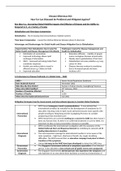
Disease Dilemmas SG4
How Far Can Diseased be Predicted and Mitigated Against?
Key Idea 4.a.: Increasing Global Mobility Impacts the Diffusion of Disease and the Ability to
Respond to it, at a Variety of Scales
Globalisation and Time Space Compression
Globalisation – the increasing interconnectedness of global systems
Time Space Compression – causes the relative distances between places to decrease
Advantages and Disadvantages for Global Health and Disease Mitigation Due to Globalisation:
Opportunities That Globalisation Has Created for Challenges Created for Disease Management and
Better Health and Disease Management Worldwide Health by Globalisation
Distribution of vaccinations Relocation diffusion – mobility of people
Improved technology allows rapid means contagious diseases spread easily
exchange of information Obesity due to globalisation of fast food
WHO – improved technology helps them Globalisation increases pollution e.g. lung
coordinate responses cancer in China
Health care workers able to travel in Diseases become resistant to medicines
affected areas e.g. Cholera in Haiti due to increased spread and more
Improved education incidence of it
A Contemporary Disease Outbreak at a Global Scale – SARS
SARS = Severe Acute Respiratory Syndrome
Date Outbreak Started November 2002
Who Was the First Victim? Farmer in Foshan County, Guangdong Provence
When Was WHO Notified? 10th February 2003
Number of Countries Affected 29
Number of Deaths 1,000
When Was the Outbreak Declared Over July 2003
Mitigation Strategies Used by Governments and International Agencies to Combat Global Pandemics
WHO issued emergency travel recommendations – it was advised that
international travellers be watchful for the development of symptoms for 10
days after returning. Early in April, travel advisories became more specific with
International people traveling to Hong Kong and the Guangdong Provence to consider
Prevention postponing all but essential travel
WHO researchers are currently working on a vaccine for SARS but there haven’t
been any human trials. As there’s no confirmed treatment or cure for SARS, it is
important to take as many preventative measures as possible
WHO coordinated the international investigation with the assistance of the
Global Outbreak Alert and Response Network by mobilising its networks of 11
leading laboratories in 9 countries
International The most important message for international travellers is to be aware of the
Diagnosis main symptoms – high fever, shortness of breath, dry cough, breathing
difficulties. The WHO ensured that an education campaign took place to inform
travellers of the symptoms
Various lab tests by the WHO have been developed to detect the SARS virus
Government The Singapore Government enforced a compulsory quarantine of any infected
Prevention person. It also decided to close schools and all public events were postponed
Government The Singapore Government advised persons who experience the symptoms and
Diagnosis who had been in an area where there had been a recent local transmission of
How Far Can Diseased be Predicted and Mitigated Against?
Key Idea 4.a.: Increasing Global Mobility Impacts the Diffusion of Disease and the Ability to
Respond to it, at a Variety of Scales
Globalisation and Time Space Compression
Globalisation – the increasing interconnectedness of global systems
Time Space Compression – causes the relative distances between places to decrease
Advantages and Disadvantages for Global Health and Disease Mitigation Due to Globalisation:
Opportunities That Globalisation Has Created for Challenges Created for Disease Management and
Better Health and Disease Management Worldwide Health by Globalisation
Distribution of vaccinations Relocation diffusion – mobility of people
Improved technology allows rapid means contagious diseases spread easily
exchange of information Obesity due to globalisation of fast food
WHO – improved technology helps them Globalisation increases pollution e.g. lung
coordinate responses cancer in China
Health care workers able to travel in Diseases become resistant to medicines
affected areas e.g. Cholera in Haiti due to increased spread and more
Improved education incidence of it
A Contemporary Disease Outbreak at a Global Scale – SARS
SARS = Severe Acute Respiratory Syndrome
Date Outbreak Started November 2002
Who Was the First Victim? Farmer in Foshan County, Guangdong Provence
When Was WHO Notified? 10th February 2003
Number of Countries Affected 29
Number of Deaths 1,000
When Was the Outbreak Declared Over July 2003
Mitigation Strategies Used by Governments and International Agencies to Combat Global Pandemics
WHO issued emergency travel recommendations – it was advised that
international travellers be watchful for the development of symptoms for 10
days after returning. Early in April, travel advisories became more specific with
International people traveling to Hong Kong and the Guangdong Provence to consider
Prevention postponing all but essential travel
WHO researchers are currently working on a vaccine for SARS but there haven’t
been any human trials. As there’s no confirmed treatment or cure for SARS, it is
important to take as many preventative measures as possible
WHO coordinated the international investigation with the assistance of the
Global Outbreak Alert and Response Network by mobilising its networks of 11
leading laboratories in 9 countries
International The most important message for international travellers is to be aware of the
Diagnosis main symptoms – high fever, shortness of breath, dry cough, breathing
difficulties. The WHO ensured that an education campaign took place to inform
travellers of the symptoms
Various lab tests by the WHO have been developed to detect the SARS virus
Government The Singapore Government enforced a compulsory quarantine of any infected
Prevention person. It also decided to close schools and all public events were postponed
Government The Singapore Government advised persons who experience the symptoms and
Diagnosis who had been in an area where there had been a recent local transmission of