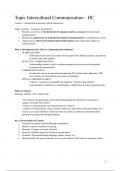
Topic Intercultural Communication - HC
Lecture 1: introduction & national cultural dimensions
Today’s journey - Laying the groundwork
1. Provide an overview of the historical development and key concepts of intercultural
communication
2. Illustrate the importance of studying intercultural communication in contemporary society
3. Explore classic theories of national cultural dimensions and evaluate their impact on
communication
Why is this important for YOU as Communication Scientists?
- GLOBALIZATION
- Globalization has made it necessary for the people from different cultures and nations
to interact and work together
- EFFECTIVE COMMUNICATION
- Understanding culture is key to crafting messages that are received as intended,
avoiding miscommunication
- CAREER RELEVANCE
- Essential for careers in international marketing, PR, global media, diplomacy, HR,
and virtually any field with diverse teams orr audiences
- SOCIAL COHESION & SDG’S
- Culture is “an agent of sustainable development”. Effective intercultural
communication contributes to understanding, collaboration & achieving global goals.
What is Culture?
Defining ‘Culture’: Not a simple task!
- “The collective programming of the mind distinguishing the members of one group or
category of people from others”
- “Culture is communication, and communication is culture”
- A system of shared beliefs, values, customs, behaviors, and artifacts that the members of a
society use to cope with their world and with one another, and that are transmitted from
generation to generation through learning.
Key Characteristics of Culture
1. Learned: Not innate; acquired through socialization.
2. Shared: Connects members of a group.
3. Dynamic: Changes over time; not static.
4. Systemic: Different aspects of culture are interrelated.
5. Symbolic: Expressed through language, rituals, objects, etc.
6. Often Invisible: We may not be aware of our own cultural "lens" until we encounter others
1
,Development of the field
Understanding how communication varies across cultures has evolved.
Key Milestones & Theorists:
1950s-1970s: Edward T. Hall - The “Founding Father”
- Pioneered the field, working with US Foreign Service
- Key Concepts: High-`context vs. Low-Context Cultures, Proxemics (space), Chronemics
(time).
- Focus today: High/Low context
1970s-1980s (and beyond): Geert Hofstede - Cultural Dimensions
- Landmark IBM studies
- Identified dimensions of national culture (Individualism, Power Distance)
- Highly influential, though also critiqued.
- Focus today: Hofstede’s Dimensions
1990s: fons Trompenaars & Charles Hampden-Turner - 7 dimensions
- Expanded on Hofstede’s work, focusing on business contexts
- We’ll touch on this later
1990s: Harry C. Triandis - Individualism & Collectivism
- Deepened the understanding of individualism and collectivism, adding concepts like
“vertical” and “horizontal” dimensions
- We’ll briefly explore this in the second part of the lecture
2000s: Project GLOBE (Global Leadership and Organizational Behavior Effectiveness)
- Large-scale study across many cultures
- Expanded on Hofstede’s dimensions, looking at practices (“as is”) and values (“should be”).
- We’ll introduce this today.
2020s & Beyond: Contemporary Issues
- Focus on communication competencies, culture’s role in sustainable development (SDGs),
digital intercultural communication, intersectionality.
National Culture
Theories & Dimensions
Hall’s High-Context vs. Low-Context Cultures
2
,Hall's High-Context vs. Low-Context Cultures
- Edward T. Hall: The Hidden Dimensions of Communication
- Context: The amount of information that is explicitly stated in a message versus what is
already understood by the communicators.
- High-Context (HC) Cultures:
- Information is often implicit, in the context or internalized in the person.
- Emphasis on non-verbal cues, relationships, shared history, and status.
- Messages are often indirect; "reading between the lines" is expected.
- Long-term relationships are valued.
- Examples often cited: Japan, China, Korea, Arab countries, Latin American cultures.
(Kim et al., 1998 mention Chinese and Korean cultures as high-context)
- Low-Context (LC) Cultures:
- Information is explicitly stated in the verbal message.
- Emphasis on directness, clarity, and facts.
- What is said is what is meant.
- Tasks and individual achievements may be prioritized over relationships.
- Examples often cited: Germany, Switzerland, Scandinavia, USA, Australia. (Kim et
al., 1998, for example, mention American culture as low-context)
Hall’s High-Context vs. Low-Context Cultures
FEATURE HIGH-CONTEXT LOW-CONTEXT
COMMUNICATION COMMUNICATION
Clarity Indirect, subtle, nuanced Direct, explicit, precise
Reliance on Non-verbal cues, shared Verbal message, written word
understanding
Disagreement Expressed subtly, to save face Expressed directly, openly
Contracts Less detailed, relationship is Detailed, specific, legally
key binding
“Getting to Yes” May take longer, trust-building Faster, focus on deal points
is crucial
Feedback Often indirect, positive first More direct, can be critical
3
, Kim, Pan & Park (1998) Study:
- Compared Chinese, Korean (HC), and American (LC) cultures.
- Found significant differences in communication styles, e.g.:
- Koreans more likely to use indirect communication strategies.
- Americans more likely to use direct communication strategies.
- Emphasis on "face-saving" in HC cultures influences communication.
- Low-Context Advertising Example (e.g., an ad in Germany or the US):
- Focus: Product features, benefits, price, direct comparisons.
- Message: Explicit, with clear calls to action ("Buy now!", "Limited time offer!").
- Information: Lots of text, specifications, facts, and figures.
- Goal: Provide information for a rational decision.
High-Context Advertising Example (e.g., an ad in Japan or China):
- Focus: Mood, atmosphere, aesthetics, symbolism.
- Message: Often indirect, relying on visuals and emotional connection.
- Celebrity Endorsers: May focus on their status and trustworthiness (building relationship with
the brand).
- Goal: Build trust, show understanding of values (harmony, family, group).
Question for you: Can you think of an ad you've seen recently that might be more HC or LC in
its approach?
Why does it matter for Communication Professionals?
Practical Implications of H/L Context
MARKETING & ADVERTISING
Adapting campaigns for HC or LC markets can be crucial for effectiveness.
BUSINESS NEGOTIATIONS
HC cultures may prioritize relationship-building before business; LC may want to get straight to the
point.
TEAMWORK
Misunderstandings can arise from differing communication styles regarding directness, feedback, and
conflict.
4
Lecture 1: introduction & national cultural dimensions
Today’s journey - Laying the groundwork
1. Provide an overview of the historical development and key concepts of intercultural
communication
2. Illustrate the importance of studying intercultural communication in contemporary society
3. Explore classic theories of national cultural dimensions and evaluate their impact on
communication
Why is this important for YOU as Communication Scientists?
- GLOBALIZATION
- Globalization has made it necessary for the people from different cultures and nations
to interact and work together
- EFFECTIVE COMMUNICATION
- Understanding culture is key to crafting messages that are received as intended,
avoiding miscommunication
- CAREER RELEVANCE
- Essential for careers in international marketing, PR, global media, diplomacy, HR,
and virtually any field with diverse teams orr audiences
- SOCIAL COHESION & SDG’S
- Culture is “an agent of sustainable development”. Effective intercultural
communication contributes to understanding, collaboration & achieving global goals.
What is Culture?
Defining ‘Culture’: Not a simple task!
- “The collective programming of the mind distinguishing the members of one group or
category of people from others”
- “Culture is communication, and communication is culture”
- A system of shared beliefs, values, customs, behaviors, and artifacts that the members of a
society use to cope with their world and with one another, and that are transmitted from
generation to generation through learning.
Key Characteristics of Culture
1. Learned: Not innate; acquired through socialization.
2. Shared: Connects members of a group.
3. Dynamic: Changes over time; not static.
4. Systemic: Different aspects of culture are interrelated.
5. Symbolic: Expressed through language, rituals, objects, etc.
6. Often Invisible: We may not be aware of our own cultural "lens" until we encounter others
1
,Development of the field
Understanding how communication varies across cultures has evolved.
Key Milestones & Theorists:
1950s-1970s: Edward T. Hall - The “Founding Father”
- Pioneered the field, working with US Foreign Service
- Key Concepts: High-`context vs. Low-Context Cultures, Proxemics (space), Chronemics
(time).
- Focus today: High/Low context
1970s-1980s (and beyond): Geert Hofstede - Cultural Dimensions
- Landmark IBM studies
- Identified dimensions of national culture (Individualism, Power Distance)
- Highly influential, though also critiqued.
- Focus today: Hofstede’s Dimensions
1990s: fons Trompenaars & Charles Hampden-Turner - 7 dimensions
- Expanded on Hofstede’s work, focusing on business contexts
- We’ll touch on this later
1990s: Harry C. Triandis - Individualism & Collectivism
- Deepened the understanding of individualism and collectivism, adding concepts like
“vertical” and “horizontal” dimensions
- We’ll briefly explore this in the second part of the lecture
2000s: Project GLOBE (Global Leadership and Organizational Behavior Effectiveness)
- Large-scale study across many cultures
- Expanded on Hofstede’s dimensions, looking at practices (“as is”) and values (“should be”).
- We’ll introduce this today.
2020s & Beyond: Contemporary Issues
- Focus on communication competencies, culture’s role in sustainable development (SDGs),
digital intercultural communication, intersectionality.
National Culture
Theories & Dimensions
Hall’s High-Context vs. Low-Context Cultures
2
,Hall's High-Context vs. Low-Context Cultures
- Edward T. Hall: The Hidden Dimensions of Communication
- Context: The amount of information that is explicitly stated in a message versus what is
already understood by the communicators.
- High-Context (HC) Cultures:
- Information is often implicit, in the context or internalized in the person.
- Emphasis on non-verbal cues, relationships, shared history, and status.
- Messages are often indirect; "reading between the lines" is expected.
- Long-term relationships are valued.
- Examples often cited: Japan, China, Korea, Arab countries, Latin American cultures.
(Kim et al., 1998 mention Chinese and Korean cultures as high-context)
- Low-Context (LC) Cultures:
- Information is explicitly stated in the verbal message.
- Emphasis on directness, clarity, and facts.
- What is said is what is meant.
- Tasks and individual achievements may be prioritized over relationships.
- Examples often cited: Germany, Switzerland, Scandinavia, USA, Australia. (Kim et
al., 1998, for example, mention American culture as low-context)
Hall’s High-Context vs. Low-Context Cultures
FEATURE HIGH-CONTEXT LOW-CONTEXT
COMMUNICATION COMMUNICATION
Clarity Indirect, subtle, nuanced Direct, explicit, precise
Reliance on Non-verbal cues, shared Verbal message, written word
understanding
Disagreement Expressed subtly, to save face Expressed directly, openly
Contracts Less detailed, relationship is Detailed, specific, legally
key binding
“Getting to Yes” May take longer, trust-building Faster, focus on deal points
is crucial
Feedback Often indirect, positive first More direct, can be critical
3
, Kim, Pan & Park (1998) Study:
- Compared Chinese, Korean (HC), and American (LC) cultures.
- Found significant differences in communication styles, e.g.:
- Koreans more likely to use indirect communication strategies.
- Americans more likely to use direct communication strategies.
- Emphasis on "face-saving" in HC cultures influences communication.
- Low-Context Advertising Example (e.g., an ad in Germany or the US):
- Focus: Product features, benefits, price, direct comparisons.
- Message: Explicit, with clear calls to action ("Buy now!", "Limited time offer!").
- Information: Lots of text, specifications, facts, and figures.
- Goal: Provide information for a rational decision.
High-Context Advertising Example (e.g., an ad in Japan or China):
- Focus: Mood, atmosphere, aesthetics, symbolism.
- Message: Often indirect, relying on visuals and emotional connection.
- Celebrity Endorsers: May focus on their status and trustworthiness (building relationship with
the brand).
- Goal: Build trust, show understanding of values (harmony, family, group).
Question for you: Can you think of an ad you've seen recently that might be more HC or LC in
its approach?
Why does it matter for Communication Professionals?
Practical Implications of H/L Context
MARKETING & ADVERTISING
Adapting campaigns for HC or LC markets can be crucial for effectiveness.
BUSINESS NEGOTIATIONS
HC cultures may prioritize relationship-building before business; LC may want to get straight to the
point.
TEAMWORK
Misunderstandings can arise from differing communication styles regarding directness, feedback, and
conflict.
4