Edward VI Government
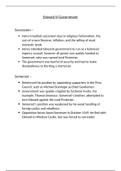
Succession –
Had a troubled succession due to religious factionalism, the
ruin of crown finances, inflation, and the selling of most
monastic lands.
Henry intended Edwards government to run as a balanced
regency council, however all power was quickly handed to
Somerset, who was named Lord Protector.
The government was fearful of security and had to make
disobedience to the King a mortal sin.
Somerset –
Reinforced his position by appointing supporters in the Privy
Council, such as Michael Stanhope as Chief Gentlemen.
Government was quickly crippled by factional rivalry. For
example, Thomas Seymour, Somerset’s brother, attempted to
turn Edward against the Lord Protector.
Somerset’s position was weakened by his weak handling of
foreign policy and rebellions.
Opposition forces faced Somerset in October 1549. He fled with
Edward to Windsor Castle, but was forced to surrender.
Succession –
Had a troubled succession due to religious factionalism, the
ruin of crown finances, inflation, and the selling of most
monastic lands.
Henry intended Edwards government to run as a balanced
regency council, however all power was quickly handed to
Somerset, who was named Lord Protector.
The government was fearful of security and had to make
disobedience to the King a mortal sin.
Somerset –
Reinforced his position by appointing supporters in the Privy
Council, such as Michael Stanhope as Chief Gentlemen.
Government was quickly crippled by factional rivalry. For
example, Thomas Seymour, Somerset’s brother, attempted to
turn Edward against the Lord Protector.
Somerset’s position was weakened by his weak handling of
foreign policy and rebellions.
Opposition forces faced Somerset in October 1549. He fled with
Edward to Windsor Castle, but was forced to surrender.