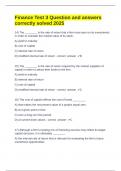
Finance Test 3 Question and answers
correctly solved 2025
14) The ________ is the rate of return that a firm must earn on its investments
in order to maintain the market value of its stock.
A) yield to maturity
B) cost of capital
C) internal rate of return
D) modified internal rate of return - correct answer ✔B
15) The ________ is the rate of return required by the market suppliers of
capital in order to attract their funds to the firm.
A) yield to maturity
B) internal rate of return
C) cost of capital
D) modified internal rate of return - correct answer ✔C
16) The cost of capital reflects the cost of funds ________.
A) that makes the net present value of a project equal zero
B) at a given point in time
C) over a long-run time period
D) at current book values - correct answer ✔C
17) Although a firm's existing mix of financing sources may reflect its target
capital structure, it is ultimately ________.
A) the internal rate of return that is relevant for evaluating the firm's future
investment opportunities
,B) the marginal cost of capital that is relevant for evaluating the firm's future
investment opportunities
C) the risk-free rate of return that is relevant for evaluating the firm's future
investment opportunities
D) the risk-free rate of return that is relevant for evaluating the firm's future
financing opportunities - correct answer ✔B
18) The ________ is a weighted average of the cost of funds which reflects
the interrelationship of financing decisions.
A) internal rate of return
B) sunk cost
C) cost of capital
D) risk-free rate - correct answer ✔C
19) The ________ is the firm's desired optimal mix of debt and equity
financing.
A) book value
B) market value
C) cost of capital
D) target capital structure - correct answer ✔D
20) The cost to a firm of each type of capital is dependent upon ________.
A) the risk-free rate of bonds plus the business risk of the firm
B) the risk-free rate of each type of capital plus the business risk of the firm
C) the risk-free rate of each type of capital plus the financial risk of the firm
D) the risk-free rate of each type of capital plus the business risk and the
financial risk of the firm - correct answer ✔D
,21) In order to recognize the interrelationship between financing and
investments, a firm should use ________ when evaluating an investment.
A) the least costly source of financing
B) the most costly source of financing
C) the weighted average cost of all financing sources
D) the current opportunity cost - correct answer ✔C
22) The four basic sources of long-term funds for a firm are ________.
A) current liabilities, long-term debt, common stock, and preferred stock
B) current liabilities, long-term debt, common stock, and retained earnings
C) long-term debt, paid-in capital in excess of par, common stock, and
retained earnings
D) long-term debt, common stock, preferred stock, and retained earnings -
correct answer ✔D
23) Which of the following is true of long-term funds?
A) They provide an easy way to reduce financing costs because they are
relatively cheaper than short-term funds.
B) They are a type of investment fund which invests in money market
investments of high quality and low risk.
C) They are the sources that supply the financing necessary to support a
firm's capital budgeting activities.
D) They are the funds available to a business on the basis of inventory held
and require detailed inventory tracking. - correct answer ✔C
24) Which of the following is a source of long-term funds?
A) commercial paper
B) retained earnings
, C) factoring
D) money market instruments - correct answer ✔B
9) A tax adjustment must be made in determining the cost of ________.
A) long-term debt
B) common stock
C) preferred stock
D) retained earnings - correct answer ✔A
10) The ________ from the sale of a security are the funds actually received
from the sale after ________.
A) gross proceeds: adding the after-tax costs
B) gross proceeds: reducing the flotation costs
C) net proceeds: reducing the flotation costs
D) net proceeds: adding the after-tax costs - correct answer ✔C
11) The approximate before-tax cost of debt for a 15-year, 10 percent, $1,000
par value bond selling at $950 is ________.
A) 10 percent
B) 10.7 percent
C) 12 percent
D) 15.4 percent - correct answer ✔B
12) The approximate before-tax cost of debt for a 10-year, 8 percent, $1,000
par value bond selling at $1,150 is ________.
A) 5.97 percent
B) 8.33 percent
correctly solved 2025
14) The ________ is the rate of return that a firm must earn on its investments
in order to maintain the market value of its stock.
A) yield to maturity
B) cost of capital
C) internal rate of return
D) modified internal rate of return - correct answer ✔B
15) The ________ is the rate of return required by the market suppliers of
capital in order to attract their funds to the firm.
A) yield to maturity
B) internal rate of return
C) cost of capital
D) modified internal rate of return - correct answer ✔C
16) The cost of capital reflects the cost of funds ________.
A) that makes the net present value of a project equal zero
B) at a given point in time
C) over a long-run time period
D) at current book values - correct answer ✔C
17) Although a firm's existing mix of financing sources may reflect its target
capital structure, it is ultimately ________.
A) the internal rate of return that is relevant for evaluating the firm's future
investment opportunities
,B) the marginal cost of capital that is relevant for evaluating the firm's future
investment opportunities
C) the risk-free rate of return that is relevant for evaluating the firm's future
investment opportunities
D) the risk-free rate of return that is relevant for evaluating the firm's future
financing opportunities - correct answer ✔B
18) The ________ is a weighted average of the cost of funds which reflects
the interrelationship of financing decisions.
A) internal rate of return
B) sunk cost
C) cost of capital
D) risk-free rate - correct answer ✔C
19) The ________ is the firm's desired optimal mix of debt and equity
financing.
A) book value
B) market value
C) cost of capital
D) target capital structure - correct answer ✔D
20) The cost to a firm of each type of capital is dependent upon ________.
A) the risk-free rate of bonds plus the business risk of the firm
B) the risk-free rate of each type of capital plus the business risk of the firm
C) the risk-free rate of each type of capital plus the financial risk of the firm
D) the risk-free rate of each type of capital plus the business risk and the
financial risk of the firm - correct answer ✔D
,21) In order to recognize the interrelationship between financing and
investments, a firm should use ________ when evaluating an investment.
A) the least costly source of financing
B) the most costly source of financing
C) the weighted average cost of all financing sources
D) the current opportunity cost - correct answer ✔C
22) The four basic sources of long-term funds for a firm are ________.
A) current liabilities, long-term debt, common stock, and preferred stock
B) current liabilities, long-term debt, common stock, and retained earnings
C) long-term debt, paid-in capital in excess of par, common stock, and
retained earnings
D) long-term debt, common stock, preferred stock, and retained earnings -
correct answer ✔D
23) Which of the following is true of long-term funds?
A) They provide an easy way to reduce financing costs because they are
relatively cheaper than short-term funds.
B) They are a type of investment fund which invests in money market
investments of high quality and low risk.
C) They are the sources that supply the financing necessary to support a
firm's capital budgeting activities.
D) They are the funds available to a business on the basis of inventory held
and require detailed inventory tracking. - correct answer ✔C
24) Which of the following is a source of long-term funds?
A) commercial paper
B) retained earnings
, C) factoring
D) money market instruments - correct answer ✔B
9) A tax adjustment must be made in determining the cost of ________.
A) long-term debt
B) common stock
C) preferred stock
D) retained earnings - correct answer ✔A
10) The ________ from the sale of a security are the funds actually received
from the sale after ________.
A) gross proceeds: adding the after-tax costs
B) gross proceeds: reducing the flotation costs
C) net proceeds: reducing the flotation costs
D) net proceeds: adding the after-tax costs - correct answer ✔C
11) The approximate before-tax cost of debt for a 15-year, 10 percent, $1,000
par value bond selling at $950 is ________.
A) 10 percent
B) 10.7 percent
C) 12 percent
D) 15.4 percent - correct answer ✔B
12) The approximate before-tax cost of debt for a 10-year, 8 percent, $1,000
par value bond selling at $1,150 is ________.
A) 5.97 percent
B) 8.33 percent