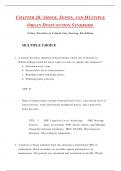
C HAPTER 26: S HOCK , S EPSIS , AND M ULTIPLE
O RGAN D YSFUNCTION S YNDROME
Urden: Priorities in Critical Care Nursing, 8th Edition
MULTIPLE CHOICE
1. A patient has been admitted in hypovolemic shock due to blood loss.
Which finding would the nurse expect to note to support this diagnosis?
a. Distended neck veins
b. Decreased level of consciousness
c. Bounding radial and pedal pulses
d. Widening pulse pressure
ANS: B
Signs of hypovolemia include flattened neck veins, a decreased level of
consciousness, weak and thready peripheral pulses, and a narrowed
pulse pressure.
PTS: 1 DIF: Cognitive Level: Anal yzing OBJ: Nursing
Process Step: Assessment TOP: Shock, Sepsis, and Multiple
Organ Dysfunction Syndrome MSC: NC LEX: Physiological
Integrit y: Physiological Adaptation
2. A patient is being admitted from the emergency department (ED) in
cardiogenic shock secondary to unstable angina unresponsive to
medications. The patient was intu bated and ventilated in the ED. Which
, intervention should the nurse prepare to initiate when the practitioner
arrives in the unit?
a. Administration of sodium bicarbonate
b. Rapid infusion of crystalloids
c. Insertion of an intra -aortic balloon pump (IABP)
d. Insertion of dial ysis catheters for continuous renal replacement
therapy (CRRT)
ANS: C
Mechanical circulatory assist devices are used if adequate tissue
perfusion cannot be immediatel y restored. Options include an intra -
aortic balloon pump (IABP), a percutaneous v entricular assist device
(VAD), or an extracorporeal membrane oxygenator. The IABP is used
to decrease m yocardial workload by improving m yocardial suppl y and
decreasing m yocardial demand. It achieves this goal by improving
coronary artery perfusion and red ucing left ventricular afterload.
Sodium bicarbonate, fluids, and dial ysis are not indicated in this
situation.
PTS: 1 DIF: Cognitive Level: Anal yzing OBJ: Nursing
Process Step: Planning TOP: Shock, Sepsis, and
Multiple Organ Dysfunction S yndrome MSC: NC LEX:
Physiological Integrity: Reduction of Risk Potential
3. A patient is being admitted in cardiogenic shock secondary to acute
heart failure. In addition to a diuretic, which medication would the nurse
anticipate the practitioner ordering for the pat ient?
a. Epinephrine
b. Nitroprusside
c. Dobutamine
, d. Nitrogl ycerine
ANS: A
Inotropic agents are used to increase contractilit y and maintain
adequate blood pressure and tissue perfusion. Dobutamine is the
inotrope of choice. A vasopressor, preferabl y norepinephrine ( not
Epinephrine), may be necessary to maintain blood pressure when
hypotension is severe. Diuretics may be used for preload reduction.
Vasodilating agents (Nitrogl ycerine and Nitroprusside) are used for
preload and afterload reduction onl y in specific situ ations in
conjunction with an inotrope or when the patient is no longer in shock.
PTS: 1 DIF: Cognitive Level: Appl ying OBJ: Nursing
Process Step: Planning TOP: Shock, Sepsis, and Multiple
Organ Dysfunction Syndrome MSC: NC LEX: Physiological
Integrit y: Pharmacological Therapies
4. The nurse is caring for a patient who was just admitted in septic shock.
The nurse knows that certain interventions should be completed within 3
hours of time of presentation. Which intervention would be a priorit y for
the nurse to implement upon receipt of a practitioner’s order?
a. Administer fresh -frozen plasma.
b. Obtain a serum lactate level.
c. Administer epinephrine.
d. Measure central venous pressure.
ANS: B
O RGAN D YSFUNCTION S YNDROME
Urden: Priorities in Critical Care Nursing, 8th Edition
MULTIPLE CHOICE
1. A patient has been admitted in hypovolemic shock due to blood loss.
Which finding would the nurse expect to note to support this diagnosis?
a. Distended neck veins
b. Decreased level of consciousness
c. Bounding radial and pedal pulses
d. Widening pulse pressure
ANS: B
Signs of hypovolemia include flattened neck veins, a decreased level of
consciousness, weak and thready peripheral pulses, and a narrowed
pulse pressure.
PTS: 1 DIF: Cognitive Level: Anal yzing OBJ: Nursing
Process Step: Assessment TOP: Shock, Sepsis, and Multiple
Organ Dysfunction Syndrome MSC: NC LEX: Physiological
Integrit y: Physiological Adaptation
2. A patient is being admitted from the emergency department (ED) in
cardiogenic shock secondary to unstable angina unresponsive to
medications. The patient was intu bated and ventilated in the ED. Which
, intervention should the nurse prepare to initiate when the practitioner
arrives in the unit?
a. Administration of sodium bicarbonate
b. Rapid infusion of crystalloids
c. Insertion of an intra -aortic balloon pump (IABP)
d. Insertion of dial ysis catheters for continuous renal replacement
therapy (CRRT)
ANS: C
Mechanical circulatory assist devices are used if adequate tissue
perfusion cannot be immediatel y restored. Options include an intra -
aortic balloon pump (IABP), a percutaneous v entricular assist device
(VAD), or an extracorporeal membrane oxygenator. The IABP is used
to decrease m yocardial workload by improving m yocardial suppl y and
decreasing m yocardial demand. It achieves this goal by improving
coronary artery perfusion and red ucing left ventricular afterload.
Sodium bicarbonate, fluids, and dial ysis are not indicated in this
situation.
PTS: 1 DIF: Cognitive Level: Anal yzing OBJ: Nursing
Process Step: Planning TOP: Shock, Sepsis, and
Multiple Organ Dysfunction S yndrome MSC: NC LEX:
Physiological Integrity: Reduction of Risk Potential
3. A patient is being admitted in cardiogenic shock secondary to acute
heart failure. In addition to a diuretic, which medication would the nurse
anticipate the practitioner ordering for the pat ient?
a. Epinephrine
b. Nitroprusside
c. Dobutamine
, d. Nitrogl ycerine
ANS: A
Inotropic agents are used to increase contractilit y and maintain
adequate blood pressure and tissue perfusion. Dobutamine is the
inotrope of choice. A vasopressor, preferabl y norepinephrine ( not
Epinephrine), may be necessary to maintain blood pressure when
hypotension is severe. Diuretics may be used for preload reduction.
Vasodilating agents (Nitrogl ycerine and Nitroprusside) are used for
preload and afterload reduction onl y in specific situ ations in
conjunction with an inotrope or when the patient is no longer in shock.
PTS: 1 DIF: Cognitive Level: Appl ying OBJ: Nursing
Process Step: Planning TOP: Shock, Sepsis, and Multiple
Organ Dysfunction Syndrome MSC: NC LEX: Physiological
Integrit y: Pharmacological Therapies
4. The nurse is caring for a patient who was just admitted in septic shock.
The nurse knows that certain interventions should be completed within 3
hours of time of presentation. Which intervention would be a priorit y for
the nurse to implement upon receipt of a practitioner’s order?
a. Administer fresh -frozen plasma.
b. Obtain a serum lactate level.
c. Administer epinephrine.
d. Measure central venous pressure.
ANS: B