Henry VIII Religion
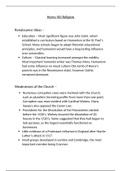
Renaissance Ideas –
Education – Most significant figure was John Colet, whom
established a curriculum based on Humanism at the St. Paul’s
School. Many schools began to adopt Platonist educational
principles, and humanism would have a long-lasting influence
over universities.
Culture – Classical learning increased amongst the nobility.
Most important humanist writer was Thomas More. Humanism
had some influence on visual culture (the tomb of Henry’s
parents was in the Renaissance style), however Gothic
remained dominant.
Weaknesses of the Church –
Numerous corruption cases were involved with the church,
such as pluralism (receiving profits from more than one post).
Corruption was most evident with Cardinal Wolsey. Many
lawyers also opposed the Canon Law.
Precedents for the Dissolution of the Monasteries existed
before the 1530’s. Wolsey ensured the dissolution of 20
houses in the 1520’s. Some suggested that they had begun to
lack purpose, as the largest essentially functioned as
businesses.
Little evidence of a Protestant influence in England after Martin
Luther’s attack in 1517.
Small groups developed in London and Cambridge, the most
important member being Cranmer.
Renaissance Ideas –
Education – Most significant figure was John Colet, whom
established a curriculum based on Humanism at the St. Paul’s
School. Many schools began to adopt Platonist educational
principles, and humanism would have a long-lasting influence
over universities.
Culture – Classical learning increased amongst the nobility.
Most important humanist writer was Thomas More. Humanism
had some influence on visual culture (the tomb of Henry’s
parents was in the Renaissance style), however Gothic
remained dominant.
Weaknesses of the Church –
Numerous corruption cases were involved with the church,
such as pluralism (receiving profits from more than one post).
Corruption was most evident with Cardinal Wolsey. Many
lawyers also opposed the Canon Law.
Precedents for the Dissolution of the Monasteries existed
before the 1530’s. Wolsey ensured the dissolution of 20
houses in the 1520’s. Some suggested that they had begun to
lack purpose, as the largest essentially functioned as
businesses.
Little evidence of a Protestant influence in England after Martin
Luther’s attack in 1517.
Small groups developed in London and Cambridge, the most
important member being Cranmer.