ECON 102 Homework 3 Answer (Penn State University)
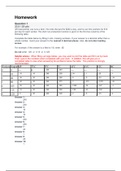
ECON 102 Homework 3 Answer (Penn State University) Question 1 (25 total points) Joe runs a farm. He rents the land for $240 a day, and he can hire workers for $10 per day for each worker. His short run production function is given in the first two columns of the following table. Complete the table below by filling in ALL missing numbers. If your answer is a decimal rather than a whole number, round your answer to the nearest 2 decimal places. Also, do not enter leading zeroes. For example, if the answer to a field is 1/8, enter .13 Question 2 In the table you just filled out, find where diminishing marginal productivity begins. Specifically, which is the first worker to add less marginal output than the previous worker? Question 3 According to the table (and general theory), what is true? Question 4 For the following 6 questions, refer to the table you filled out above. Plot the labor input (workers) against the output. Put the labor input on the horizontal axis and the output on the vertical axis. What is the general shape of this function? Question 5 Plot the labor input (workers) against the MP (marginal product). Put the labor input on the horizontal axis and the MP on the vertical axis. What is the general shape of this function? Question 6 Plot the output against the TVC (total variable cost). Put the output on the horizontal axis and the TVC on the vertical axis. What is the general shape of this function? Question 7 Plot the output against the TC (total cost). Put the output on the horizontal axis and the TC on the vertical axis. What is the general shape of this function? Question 8 Plot the output against the TFC (total fixed cost). Put the output on the horizontal axis and the TFC on the vertical axis. What is the general shape of this function? Question 9 Plot the output against the AFC (average fixed cost). Put the output on the horizontal axis and the AFC on the vertical axis. What is the general shape of this function? Question 10 Think about the general relationship between the marginal product of labor (MPL) and the marginal cost of output (MC). As MPL increases, what happens to MC? Question 11 Think about the general relationship between the marginal product of labor (MPL) and the marginal cost of output (MC). As MPL decreases, what happens to MC? Question 12 If the margin is greater than the average, what can we say about the average and margin? Question 13 What is the general relationship between AVC, ATC, and MC? Question 14 Diminishing marginal returns to labor Question 15 In the long run, what is true about increasing returns to scale? Increasing returns to scale means that doubling our inputs will result in _________ the output, and the long run average cost curve is ___________. Question 16 In the long run, what is true about constant returns to scale? Constant returns to scale means that doubling our inputs will result in _________ the output, and the long run average cost curve is ___________. Question 17 What is considered to be a cause of decreasing returns to scale (also called diseconomies of scale)? Question 18 What is an intuitive explanation for increasing returns to scale (also called economies of scale)? Question 19 Suppose there is an increased demand for output. How will this affect the demand curve for labor? Question 20 Suppose that capital and labor are complements in production. Assume there is an increase in the quantity of capital. How will this affect the demand curve for labor? Question 21 2 / 2 pts Suppose that capital and labor are complements in production. Assume there is a decrease in the quantity of capital. How will this affect the demand curve for labor? Question 22 The Marginal Revenue Product of Labor (MRPL) curve is equivalent to: Question 23 A profit-maximizing firm will continue to hire labor inputs as long as Question 24 Suppose that capital and labor are substitutes in production. In other words, the firm can generally use capital or labor to get the production completed. Suppose the cost of capital increases greatly. How will this affect the demand for labor? Question 25 Billy is an employee at BigCo. Suppose that at a wage rate of w = $10 per hour, Billy worked 40 hours per week. After Billy gets a raise to a new wage of w = $12, he decides to work 45 hours per week. What can we infer about Billy from this information? Question 26 LeatherTown sells wallets for a price of $50 each. The firm pays its workers $100 per day. How many workers should LeatherTown hire? Question 27 In this problem, the short run production function is given. In other words, we are able to see the total output that is produced when different amounts of labor inputs are hired. Each output unit produced by this firm is sold at a price of P = $4. Fill out the rest of the table from the given information. Recall that MP = Marginal Product, MRP = Marginal Revenue Product, and TR = Total Revenue. Question 28 Having filled out the above table, we now consider the number of workers that will be hired by the profit-maximizing firm. In the table below, fill in Quantity of Labor demanded column. In other words, we are asking the following: How many workers will the firm hire at each wage rate?
Written for
- Institution
- Penn State University
- Course
- ECON 102 Homework 3 Answer
Document information
- Uploaded on
- September 21, 2020
- Number of pages
- 17
- Written in
- 2020/2021
- Type
- Exam (elaborations)
- Contains
- Questions & answers
Subjects
-
econ 102 homework 3 answer penn state university

Also available in package deal