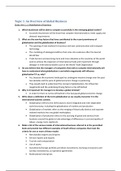
Topic 1: An Overview of Global Business
Study Unit 1.1: Globalisation of business
1. Which businesses will be able to compete successfully in the emerging global market?
• Successful businesses will be those that compete internationally to meet supply and
demand requirements
2. What are the new key factors that have contributed to the recent prominence of
globalisation and the globalisation of business?
• The opening of new markets for business and new communication and transport
technology
• The crumbling of ideological edifices that came into existence after the Second
World War
• Trade barriers are becoming more and more obsolete as the countries of the world
seek to achieve the expansion of international trade and investment through
dialogue in international bodies such as the World Trade Organisation
3. Do you believe that the managers of companies that seek to compete internationally will
have to understand what globalisation is and which megatrends will influence
globalisation? If so, why?
• Yes, because the economic landscape has undergone massive change over the past
two decades and the pace of global economic change is quickening
• They would need to understand the concept of globalisation, the influential
megatrends and the underlying driving factors or be left behind
4. Why is it important for managers to develop a global mindset?
• In order for them to not be left behind in the fast paced global economic change
5. Write down a definition of the term globalisation as we usually encounter it in the
international business context.
• Globalisation refers to the shift toward a more integrated and inter-dependent
world economy, including the globalisation of markets and production
• Globalisation of markets refers to the merging of historically distinct and separate
national markets into one global marketplace
• Globalisation of production refers to the sourcing of goods and services from
locations around the globe to take advantage of differences in cost and quality of
labour, energy, land, capital etc.
6. Make a list of the various modes of international business referred to in the prescribed
book and provide two different examples of South African companies that meet the
criteria for one or more of these modes
• Merchandise exports and imports
• Service imports and exports
• Tourism and transportation
• Use of assets
• Investments (foreign portfolio and direct investments, licensing concessions and
turnkey investments), co-operative agreements
• Multinational enterprises
,Study Unit 1.2: Macroeconomic theories of international business
1. Explain the term “macroeconomic theories”.
• Refers to the theories on macroeconomic factors that influence global business
expansion
2. Define the theory of comparative advantage.
• All countries possess various resources in various quantities and forms – results in
different cost structures and different prices for exploiting and converting these
resources into manufactured products
• Because of these differences, one country has a comparative cost benefit when it
comes to the exploitation of a resource or the manufacturing of a product
• Countries therefore tend to export products with the greatest comparative
advantage benefit, and import those with the smallest comparative benefit
3. Explain in your own words the interaction between technological renewal and production
expertise.
• Technological renewal makes it possible to expand peoples skills – training and
traditional expertise in a certain industry means that peoples skills grow
• Over the past 50 years there have been massive technological changes worldwide –
particularly evident in the radical renewal or improvement of the technology that
governs communications, transportation and information processing
4. Explain why FDI is important especially in a developing country like South Africa.
• Foreign direct investment is usually the outcome of a company moving beyond the
borders of its home country to purchase and control a business activity in another
country (host country)
• General theory of capital flow: capital will move from countries where it is abundant
to countries where it is scarce (low rate of return on investment to high)
• Developing countries also benefit from these flourishing economic ties which create
wealth and jobs
5. What is the oligopoly model and does it have any relevance for South Africa?
• Helps us understand the characteristics of large scale FDI when an industry or
business sector is controlled by a small number of companies
• Shifts the focus of theories on the international movement of capital to an analysis
of the motivation and behaviour of businesses and their role in the movement of
international capital
6. Identify an example of the international transfer of resources that has benefited South
Africa. Consult the media and the Internet.
• International business is influenced by the transfer of resources over national
borders (resources include technology, management expertise, capital, labour and
natural resources)
• Geographic distribution of resources is not evenly balanced
• These distribution differences (differentials), create opportunities for multinational
enterprises by causing economic pressure which facilitates the movement of
resources between the countries concerned
• Governments can also influence the movement of resources
,Study Unit 1.3: Internationalisation and the development of multinational enterprises
1. Define a multinational enterprise
• A firm that owns or controls productive business activities in two or more countries
– comes into existence as a result of FDI
2. List, discuss and evaluate the different strategies that companies use for
internationalisation.
• Various companies in different industries find themselves at different levels of
internationalisation from low to high international involvement
• Different strategies are therefore necessary for companies to operate successfully
and to honour international commitments
a. Impetus for International business
▪ Passive response to proposals → active search for opportunities
b. Internal vs. External handling of foreign operations
▪ Other firms handle external contracts → company handles its own
foreign operations
c. Mode of operations
▪ Limited foreign functions, usually import/ export → limited foreign
production and multiple functions → extensive production abroad
with FDI and all functions
d. Number of foreign countries in which a firm does business
▪ One → several → many
e. Degree of similarity between foreign and domestic countries
▪ Quite similar → moderately similar → very dissimilar
3. Evaluate the different phases of evolution through which a domestic company could
progress to become a multinational enterprise (MNE).
• Phase 1: International inquiries
o Company receives inquiry about one of its products directly from a foreign
business person/ independent domestic exporter and importer
o May use domestic export intermediate (export merchant, export
commission house, resident buyer, broker combination export manager)
• Phase 2: Export Manager
o Company’s exports expand
o Export manager with a small staff employed to actively search for foreign
markets for the firms products
• Phase 3: Export department and direct overseas sales
o Full-fledged export department established at same level as domestic sales
department as company has difficulty coping with upward surge in sales
o Company drops domestic export intermediary and sells directly to
importers/ buyers located in foreign markets
• Phase 4: Overseas branches and subsidiaries
o Further growth requires establishment of sales branches abroad to handle
sales and promotions – sales branch manager responsible to home office;
branch sells directly to intermediaries in foreign markets
, o Sales branch gradually evolves into a sales subsidiary – incorporated and
domiciled in foreign country – enjoys greater autonomy than it had as a
sales branch
• Phase 5: Overseas assembly
o Assembly occurs overseas (cheaper shipping costs, lower tariffs, cheaper
labour)
• Phase 6: Overseas manufacturing
o Establishment of production in host country
o Three methods:
▪ Contract manufacturing: foreign producer produces and sells the
company’s product, but the company continues to promote and
distribute it
▪ Licensing: foreign company pays a royalty to international company
for patents, trademarks, trade secrets
▪ Investment in manufacturing: after establishment in host country,
company has a total business to manage
• Phase 7: Integration of overseas subsidiaries
o Foreign subsidiaries lose autonomy once parent company decides to
integrate into one multinational enterprise – strategic decisions now made
by top management at the company headquarters
Topic 2: Globalisation and international trade
Study Unit 2.1: Globalisation and international trade theories
1. Evaluate globalisation as a frame of reference for international trade.
• Globalisation is the economic restructuring of the world economy
• Industrial and service activities are geographically dispersed
• Companies network across borders
• Ideally, globalisation should be reshaped so that all countries have a voice in policies
affecting them and that rewards are equitably shared
2. Explain what international trade is.
• Trading of goods and services with international firms for other countries
3. Identify and explain the international trade theories.
i. Mercantilism
o The use of state power to build up industry, obtain and to increase the
surplus of exports over imports and to accumulate stocks of precious metals
o Centred on the nation state, which was viewed as being in competitive
struggle with other nations
ii. Absolute advantage
o Each country specialises in one product for which it is uniquely suited
o Countries could produce more products in total and trade in the goods that
were cheaper than those produced locally
iii. Comparative advantage
Study Unit 1.1: Globalisation of business
1. Which businesses will be able to compete successfully in the emerging global market?
• Successful businesses will be those that compete internationally to meet supply and
demand requirements
2. What are the new key factors that have contributed to the recent prominence of
globalisation and the globalisation of business?
• The opening of new markets for business and new communication and transport
technology
• The crumbling of ideological edifices that came into existence after the Second
World War
• Trade barriers are becoming more and more obsolete as the countries of the world
seek to achieve the expansion of international trade and investment through
dialogue in international bodies such as the World Trade Organisation
3. Do you believe that the managers of companies that seek to compete internationally will
have to understand what globalisation is and which megatrends will influence
globalisation? If so, why?
• Yes, because the economic landscape has undergone massive change over the past
two decades and the pace of global economic change is quickening
• They would need to understand the concept of globalisation, the influential
megatrends and the underlying driving factors or be left behind
4. Why is it important for managers to develop a global mindset?
• In order for them to not be left behind in the fast paced global economic change
5. Write down a definition of the term globalisation as we usually encounter it in the
international business context.
• Globalisation refers to the shift toward a more integrated and inter-dependent
world economy, including the globalisation of markets and production
• Globalisation of markets refers to the merging of historically distinct and separate
national markets into one global marketplace
• Globalisation of production refers to the sourcing of goods and services from
locations around the globe to take advantage of differences in cost and quality of
labour, energy, land, capital etc.
6. Make a list of the various modes of international business referred to in the prescribed
book and provide two different examples of South African companies that meet the
criteria for one or more of these modes
• Merchandise exports and imports
• Service imports and exports
• Tourism and transportation
• Use of assets
• Investments (foreign portfolio and direct investments, licensing concessions and
turnkey investments), co-operative agreements
• Multinational enterprises
,Study Unit 1.2: Macroeconomic theories of international business
1. Explain the term “macroeconomic theories”.
• Refers to the theories on macroeconomic factors that influence global business
expansion
2. Define the theory of comparative advantage.
• All countries possess various resources in various quantities and forms – results in
different cost structures and different prices for exploiting and converting these
resources into manufactured products
• Because of these differences, one country has a comparative cost benefit when it
comes to the exploitation of a resource or the manufacturing of a product
• Countries therefore tend to export products with the greatest comparative
advantage benefit, and import those with the smallest comparative benefit
3. Explain in your own words the interaction between technological renewal and production
expertise.
• Technological renewal makes it possible to expand peoples skills – training and
traditional expertise in a certain industry means that peoples skills grow
• Over the past 50 years there have been massive technological changes worldwide –
particularly evident in the radical renewal or improvement of the technology that
governs communications, transportation and information processing
4. Explain why FDI is important especially in a developing country like South Africa.
• Foreign direct investment is usually the outcome of a company moving beyond the
borders of its home country to purchase and control a business activity in another
country (host country)
• General theory of capital flow: capital will move from countries where it is abundant
to countries where it is scarce (low rate of return on investment to high)
• Developing countries also benefit from these flourishing economic ties which create
wealth and jobs
5. What is the oligopoly model and does it have any relevance for South Africa?
• Helps us understand the characteristics of large scale FDI when an industry or
business sector is controlled by a small number of companies
• Shifts the focus of theories on the international movement of capital to an analysis
of the motivation and behaviour of businesses and their role in the movement of
international capital
6. Identify an example of the international transfer of resources that has benefited South
Africa. Consult the media and the Internet.
• International business is influenced by the transfer of resources over national
borders (resources include technology, management expertise, capital, labour and
natural resources)
• Geographic distribution of resources is not evenly balanced
• These distribution differences (differentials), create opportunities for multinational
enterprises by causing economic pressure which facilitates the movement of
resources between the countries concerned
• Governments can also influence the movement of resources
,Study Unit 1.3: Internationalisation and the development of multinational enterprises
1. Define a multinational enterprise
• A firm that owns or controls productive business activities in two or more countries
– comes into existence as a result of FDI
2. List, discuss and evaluate the different strategies that companies use for
internationalisation.
• Various companies in different industries find themselves at different levels of
internationalisation from low to high international involvement
• Different strategies are therefore necessary for companies to operate successfully
and to honour international commitments
a. Impetus for International business
▪ Passive response to proposals → active search for opportunities
b. Internal vs. External handling of foreign operations
▪ Other firms handle external contracts → company handles its own
foreign operations
c. Mode of operations
▪ Limited foreign functions, usually import/ export → limited foreign
production and multiple functions → extensive production abroad
with FDI and all functions
d. Number of foreign countries in which a firm does business
▪ One → several → many
e. Degree of similarity between foreign and domestic countries
▪ Quite similar → moderately similar → very dissimilar
3. Evaluate the different phases of evolution through which a domestic company could
progress to become a multinational enterprise (MNE).
• Phase 1: International inquiries
o Company receives inquiry about one of its products directly from a foreign
business person/ independent domestic exporter and importer
o May use domestic export intermediate (export merchant, export
commission house, resident buyer, broker combination export manager)
• Phase 2: Export Manager
o Company’s exports expand
o Export manager with a small staff employed to actively search for foreign
markets for the firms products
• Phase 3: Export department and direct overseas sales
o Full-fledged export department established at same level as domestic sales
department as company has difficulty coping with upward surge in sales
o Company drops domestic export intermediary and sells directly to
importers/ buyers located in foreign markets
• Phase 4: Overseas branches and subsidiaries
o Further growth requires establishment of sales branches abroad to handle
sales and promotions – sales branch manager responsible to home office;
branch sells directly to intermediaries in foreign markets
, o Sales branch gradually evolves into a sales subsidiary – incorporated and
domiciled in foreign country – enjoys greater autonomy than it had as a
sales branch
• Phase 5: Overseas assembly
o Assembly occurs overseas (cheaper shipping costs, lower tariffs, cheaper
labour)
• Phase 6: Overseas manufacturing
o Establishment of production in host country
o Three methods:
▪ Contract manufacturing: foreign producer produces and sells the
company’s product, but the company continues to promote and
distribute it
▪ Licensing: foreign company pays a royalty to international company
for patents, trademarks, trade secrets
▪ Investment in manufacturing: after establishment in host country,
company has a total business to manage
• Phase 7: Integration of overseas subsidiaries
o Foreign subsidiaries lose autonomy once parent company decides to
integrate into one multinational enterprise – strategic decisions now made
by top management at the company headquarters
Topic 2: Globalisation and international trade
Study Unit 2.1: Globalisation and international trade theories
1. Evaluate globalisation as a frame of reference for international trade.
• Globalisation is the economic restructuring of the world economy
• Industrial and service activities are geographically dispersed
• Companies network across borders
• Ideally, globalisation should be reshaped so that all countries have a voice in policies
affecting them and that rewards are equitably shared
2. Explain what international trade is.
• Trading of goods and services with international firms for other countries
3. Identify and explain the international trade theories.
i. Mercantilism
o The use of state power to build up industry, obtain and to increase the
surplus of exports over imports and to accumulate stocks of precious metals
o Centred on the nation state, which was viewed as being in competitive
struggle with other nations
ii. Absolute advantage
o Each country specialises in one product for which it is uniquely suited
o Countries could produce more products in total and trade in the goods that
were cheaper than those produced locally
iii. Comparative advantage