NLN PAX MATH EXAM
Newton's second law
- describes the relationship between force, mass,and acceleration.
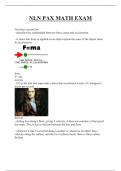
- it states that force is applied on an object equals the mass of the object times
its acceleration
force
F= ma
newton
- (N) is the unit that represents a force that accelerates a mass of 1 kilogram 1
meter per second
friction
- sliding box along a floor, giving it velocity, it does not continue at that speed
but stops. This is due to friction between the box and floor
- whenever a force is exerted along a surface or whenever an object has a
velocity along the surface, and the two surfaces touch, there is force called
friction
,Displacement
- it refers to the distance that a object is from its starting point
Motion
- when an object is motion its displacement is constantly changing
- it is describe by displacement, velocity, and acceleration
Speed
- refers to the distance traveled by an object per unit of time.
velocity
- refers to speed in a given direction; therefore it tells us two things about a
moving object: its speed and its direction
acceleration
- refers to to any change of velocity either positive or negative.
, deceleration
- refers to the negative acceleration or a decrease in velocity and can cause a
change in direction
momentum
- is equal to the mass of an object multiplied by its velocity
- Momentum = (Mass)(Velocity)
conservation of momentum
- States that the total momentum of an isolated system is always constant
-Ex: during a collision between two bodies, the momentum of each body
changes, but the total momentum is is conserved. One object may lose
momentum, but the momentum lost by the object is gained by the other.
vector
- velocity and acceleration can both be described using vectors because they
both have magnitude and direction.
Newton's First Law
- states that objects in motion tend to stay in motion and that objects at rest tend
to stay at rest
inertia
- is the property of matter that resist any change in motion
gravity
- is the force of attraction between all objects in the universe
Newton's second law
- describes the relationship between force, mass,and acceleration.
- it states that force is applied on an object equals the mass of the object times
its acceleration
force
F= ma
newton
- (N) is the unit that represents a force that accelerates a mass of 1 kilogram 1
meter per second
friction
- sliding box along a floor, giving it velocity, it does not continue at that speed
but stops. This is due to friction between the box and floor
- whenever a force is exerted along a surface or whenever an object has a
velocity along the surface, and the two surfaces touch, there is force called
friction
,Displacement
- it refers to the distance that a object is from its starting point
Motion
- when an object is motion its displacement is constantly changing
- it is describe by displacement, velocity, and acceleration
Speed
- refers to the distance traveled by an object per unit of time.
velocity
- refers to speed in a given direction; therefore it tells us two things about a
moving object: its speed and its direction
acceleration
- refers to to any change of velocity either positive or negative.
, deceleration
- refers to the negative acceleration or a decrease in velocity and can cause a
change in direction
momentum
- is equal to the mass of an object multiplied by its velocity
- Momentum = (Mass)(Velocity)
conservation of momentum
- States that the total momentum of an isolated system is always constant
-Ex: during a collision between two bodies, the momentum of each body
changes, but the total momentum is is conserved. One object may lose
momentum, but the momentum lost by the object is gained by the other.
vector
- velocity and acceleration can both be described using vectors because they
both have magnitude and direction.
Newton's First Law
- states that objects in motion tend to stay in motion and that objects at rest tend
to stay at rest
inertia
- is the property of matter that resist any change in motion
gravity
- is the force of attraction between all objects in the universe