

Introduction to Business Statistics
Business statistics involves collecting, analyzing, and interpreting data to support business
decision-making. It includes descriptive statistics, which summarize data, and inferential statistics,
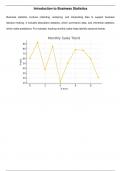
which make predictions. For example, tracking monthly sales helps identify seasonal trends.
, Data Collection & Classification
Data can be primary (collected firsthand) or secondary (gathered from existing sources). It can be
qualitative or quantitative. Frequency distribution tables help organize this data. Example: Analyzing
customer feedback collected from surveys.
Business statistics involves collecting, analyzing, and interpreting data to support business
decision-making. It includes descriptive statistics, which summarize data, and inferential statistics,
which make predictions. For example, tracking monthly sales helps identify seasonal trends.
, Data Collection & Classification
Data can be primary (collected firsthand) or secondary (gathered from existing sources). It can be
qualitative or quantitative. Frequency distribution tables help organize this data. Example: Analyzing
customer feedback collected from surveys.


