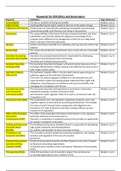
Keywords for CPA Ethics and Governance
Keyword Definition Page Reference
Accountability The fact or condition of being accountable Module 1 (p.3)
Public Interest Anything affecting the rights, health or finances of the public at large Module 1 (p.3)
Enlightened self-interest Professionals are motivated by maintaining monopolies and extracting Module 1 (p.3)
unwarranted wealth and influence from being in that position
Governance The responsibilities of the board of directors towards investors and other Module 1 (p.3)
stakeholders and involves setting the objectives and strategy of the
company and is different from management of the firm on a daily basis,
which is the job of full-time executives
Altruism Actions that bring no benefit to an individual and may even be at their own Module 1 (p.3)
expense
Service Ideal The notion that professions should both serve society and act in the public Module 1 (p.3)
interest
Australian Accounting Australian Accounting Standards Board is responsible for developing, Module 1 (p.4)
Standards Board (AASB) issuing and maintaining Australian Accounting
Standards and related pronouncements
Australian Securities The Australian Securities Exchange is a financial market www.asx.com.au Module 1 (p.4)
Exchange (ASX) exchange offering listing, trading, clearing and settlement services across a
wide range of asset classes.
Australian Taxation The Australian Taxation Office is the principal revenue www.ato.gov.au Module 1 (p.4)
Office (ATO) collection agency of the Australian Government.
Their aim is to achieve taxpayer confidence in the Australian tax and
superannuation systems by helping people understand their rights and
obligations, improving ease of compliance and access to benefits, and
managing non-compliance with the law.
Australian Securities The Australian Securities and Investments Commission is Australia’s Module 1 (p.5)
and Investments integrated corporate, markets, financial services
Commission (ASIC) and consumer credit regulator. Most of its work is carried out under the
Corporations Act.
Corporations Act (2001) The Corporations Act is the legislation regulating companies and it also Module 1 (p.5)
regulates aspects of work done by accounting professionals. This includes
the areas of audit, financial report preparation and lodgement and
insolvency. The roles of directors and other company officers are also
covered in this legislation.
Office of the Australian The Office of the Australian Information Commissioner is the regulatory Module 1 (p.5)
Information body that administers the privacy laws in
Commissioner (OAIC) Australia. It coordinates a complaints process that provides an opportunity
for people’s complaints to be heard.
Auditing and Assurance The Auditing and Assurance Standards Board is responsible for developing Module 1 (p.5)
Standards Board high quality standards and related guidance
(AUASB) for auditors and providers of other assurance services.
Competition and This act seeks to protect people by promoting competition, fair trading Module 1 (p.5)
Consumer Act (2010) practices and regulation in the area of consumer
protection.
Chartered Accountants Chartered Accountants Australia and New Zealand is one of the 3 largest Module 1 (p.5)
Australia and New professional accounting organisations
Zealand (CAANZ) in Australia and a member of the International Federation of Accountants
(IFAC).
CPA Australia (CPAA) CPAA CPA Australia is one of Australia’s largest three professional Module 1 (p.5)
accounting organisations and a member of IFAC.
,Privacy Act (1998) The Privacy Act regulates the privacy and the handling of personal Module 1 (p.5)
information.
Tax Practitioners Board The Tax Practitioners Board is responsible for the registration, oversight Module 1 (p.5)
(TPB) and discipline of professionals that are registered to provide varying
degrees of tax-related advice or services. The TPB also recognises
professional bodies (including CPA) whose voting members may then be
assisted to register or maintain their registration(s) with the TPB.
Accounting Professional The Accounting Professional and Ethical Standards Board is an Module 1 (p.5)
and Ethical Standards independent, national body that sets the code of
Board (APESB) ethics and professional standards with which accounting professionals who
are members of CPAA, CAANZ and IPA must comply.
Institute of Public The Institute of Public Accountants is one of the three largest Professional Module 1 (p.5)
Accountants (IPA) Accounting Organisations in Australia and a
member of IFAC.
Professional Accounting A Professional Accounting Organisation is a professional body (such as Module 1 (p.5)
Organisation (PAO CPA) that has oversight of its members.
International Financial The IFRS Foundation is a not-for-profit, public interest organisation Module 1 (p.5)
Reporting Standards established to develop a single set of
Foundation (IFRS high-quality, understandable, enforceable and globally accepted
accounting standards — IFRS Standards — and to promote and facilitate
adoption of the standards.
Professionalisation The process of establishing professional bodies and codes of conduct Module 1 (p.8)
aimed at raising the standards of the occupation, and to invest in training,
education and respecting quality standards
Monopoly control The situation where members of the profession control who can work in Module 1 (p.8)
the industry by establishing licensing rules and regulations which creates
protection against competition
Ethical standards Standards stipulating the behaviour that is acceptable of people in certain Module 1 (p.10
professions.
Self-regulation Measures a profession takes to regulate the conduct of its own members. Module 1 (p.10)
This is in contrast to regulation imposed by parliament and enforced by a
regulator.
Co-regulation Regulation of a profession or other group of people that is undertaken by a Module 1 (p.10)
professional body or association and government organisations. Co-
regulation reflects a shared regulatory responsibility.
Profession An occupational area or vocation that “involves prolonged training and a Module 1 (p.10)
formal qualification”
Professional Individuals that complete their work with dedication and skill Module 1 (p.10)
International Federation The International Federation of Accountants is the global organization for Module 1 (p.12)
of Accountants (IFAC) the accountancy profession.
Accounting Professional The Accounting Professional & Ethical Standards Board is an independent, Module 1 (p.13)
and Ethical Standards national body that sets out the code of ethics and professional standards
Board (APESB) with which accounting professionals who are members of CPA Australia,
Institute of Chartered Accountants or Institute of Public Accountants must
comply.
Pro Bono Latin word meaning “for the good”, which indicates the provision of Module 1 (p.14)
unpaid work for the public good
Assurance and audit Financial statement attestation, in which the firm examines and attests to Module 1 (p.26)
a company’s financial statements. Other assurance services including
assessing procedures and controls relating to privacy and confidentiality,
, performance measurements, systems reliability, information security and
outsourced process controls.
Financial management Covers performance management, corporate governance, stakeholder Module 1 (p.26)
relations, risk, as well as the traditional financial controls.
Taxation services Covers company and individual taxation, fringe benefits tax (FBT), goods Module 1 (p.26)
and services tax (GST), capital gains tax (CGT) and international tax issues.
Forensic accounting Specialised area that involves engagement for legal issues including fraud, Module 1 (p.26)
disputes or litigation.
Insolvency Specialised area that involves engagements in personal insolvencies Module 1 (p.26)
(bankruptcies) and corporate insolvencies (administrations, liquidations
and receiverships).
Internal audit services Systematic, disciplined approach to evaluating and enhancing risk Module 1 (p.26)
management, control and governance processes.
Business advising Assisting business managers to more successfully achieve value. The tasks Module 1 (p.26)
involved are varied, often reflecting that businesses have internally
recognised weaknesses, or have identified that objective external
evaluations and contributions can be valuable. Business advising can also
extend to advice on business re-engineering, restructuring, takeovers and
mergers.
SME Entities to be of a small or medium size relating to quantitative (E.g. Assets, Module 1 (p.26)
turnover/employees) and/or qualitative characteristics (E.g. Concentration
of ownership and management on a small number of individuals) and
varies by country
Professional Part of IFAC which provides leadership and guidance on relevant issues Module 1 (p.27)
Accountants In Business pertaining to professional accountants in business and their environment
(PAIB)
Board of Directors Collective name for the directors of a company Module 1 (p.28)
Board member Elected to the board of directors to oversee the activities of the company Module 1 (p.28)
or organisation.
Finance director or chief Formulation, management and review of the financial and strategic Module 1 (p.28)
financial officer direction of the company or corporate group.
Financial accountant Preparation of general purpose financial reports, the annual report and Module 1 (p.28)
special purpose financial reports as required. May supervise a
team of accountants.
Treasury accountant Management of treasury functions of the organisation in order to ensure Module 1 (p.28)
sufficient cash flow and the effective use of financial
instruments.
Risk manager Quality and risk management responsibility for the business Module 1 (p.28)
Strategic management Preparation of budgets and forecasts, costing, performance measures for Module 1 (p.28)
accountant analysing and improving organisational performance.
Internal auditor Review of internal controls, information and business processes. Module 1 (p.28)
Human resources Remuneration and payroll-related functions. Module 1 (p.28)
accountant
Company secretary Reporting and regulatory compliance and ensuring, with the chair, the Module 1 (p.28)
efficient functioning of the board of directors.
Not For Profit (NFP) Legal or social entities formed for the purpose of producing goods or Module 1 (p.31)
services and whose status doesn’t permit them to be a source of income,
profit or financial gain for the individuals or firms that establish, control or
finance them
Ethos/Culture Consists of values, norms and symbols Module 1 (p.32)
,Creative Accounting Using the choices available to present information in ways that don’t Module 1 (p.34)
clearly represent reality and which provide a distorted and favourable view
of the firm
Professional Ethics Professional ethics is the application of ethical principles or frameworks by Module 1 (p.36)
professionals who have an obligation to act in the interests of those who
rely on their services as well as in the best interests of the public
Public practice Professional accountants who offer accounting services to businesses and Module 1 (p.40)
the public
Module 2: Ethics
Morals Standards of behaviour expected Module 1 (p.45)
Moral Philosophy The rational study of the meaning and justification of moral claims. Moral Module 2 (p.51
philosophy is usually divided into three distinct subject areas: metaethics,
normative ethics, and applied ethics
Moral claim Evaluates the rightness or wrongness of an action or a person’s Module 2 (p.51
character. For example, “Lying is wrong” claims the act of lying is wrong,
while “One shouldn’t be lazy” claims a character trait (i.e., laziness) is
wrong.
Philosophy A particular system of thought or the study of systems of thought and Module 2 (p.51)
ideas
Normative Theories of Propose principles that distinguish right from wrong by establishing a norm Module 2 (p.51)
Ethics or standard of correct behaviour that should be followed at all times
Virtue ethics or Ethics of This is an area of ethical theory that calls upon people to examine the Module 2 (p.52)
character various traits of individuals in order to determine whether they have
behaved in a manner that is wrong, based on that particular assessment. It
has its origins in the thinking put forward by theorists such as Aristotle.
Deontological Ethical theories that deal with decisions being made on the basis of duties Module 2 (p.52)
and obligations
Teleological Theories Determine right from wrong or good from bad, based solely on the results Module 2 (p.52)
(Consequential) or consequences of the decision or action
Egoism Evaluates the rightness of an action from the perspective of the decision- Module 2 (p.52)
maker (self)
Ethical egoism Contends that the pursuit of self-interest should be constrained by the law Module 2 (p.53)
and the conventions of fair play. Rules and legal systems exist to resolve
conflict. It is, therefore, in the interests of all parties to obey and accept
the decision of arbitration systems because, without them, chaos will
result.
Utilitarianism An example of a normative ethical theory, which defines what is right by Module 2 (p.53)
the outcome that leads to the greatest good for the greatest number of
people and is linked to government decision-making about where to spend
money and which laws to create.
Restricted egoism When self-interest is not allowed to function unbridled by the law or the Module 2 (p.54)
dictates of what is considered fair competition and it sanctions corporate
self-interest and encourages competition to the extent that it leads to the
maximisation of utility and is in the interests of society as a whole.
Rights A moral or ethical entitlement. Module 2 (p.56)
Justice Just behaviour or treatment Module 2 (p.57)
Human Rights Human rights, on the other hand, are more fundamental to society and Module 2 (p.57)
relationships, and are the key to maintaining social order. They are natural
rights that apply to all people simply because they are human beings.
Some commonly recognised human rights are the right to life, freedom of
choice, right to the truth, right to privacy and freedom of speech.
, Virtues Behaviour showing high moral standards Module 2 (p.58)
Moral agent A decision maker who has the ability to make moral judgments based on Module 2 (p.58)
some notion of right and wrong and is held accountable for these actions.
Accountants are a class of professional that may be regarded as being
moral agents.
Professional activity An activity requiring accountancy or related skills undertaken by a Module 2 (p.60)
member, including accounting, auditing, tax, management consulting and
financial management
APES 110 The Code of Ethics for Professional Accountants (including Independence Module 2 (p.60)
Standards) (“the Code”) sets out fundamental principles of ethics for
Members, reflecting the profession’s recognition of its public interest
responsibility. These principles establish the standard of behaviour
expected of a Member. The fundamental principles are: integrity,
objectivity, professional competence and due care, confidentiality, and
professional behaviour.
Non-Compliance with Responding to Non-compliance with Laws and Regulations (NOCLAR) Module 2 (p.60)
Laws and Regulations provides a framework for all members on how best to act in the public
interest when they become aware of non-compliance or suspected non-
compliance with laws and regulations. It allows members to set aside the
principle of confidentiality and report NOCLAR to an appropriate authority,
if that is in the public interest.
Integrity An element of character and is essential to the maintenance of public Module 2 (p.63)
trust. Integrity in accounting is centred on concepts such as trust, honesty,
and honourable and reliable behaviour. Integrity requires strength of
character and the courage to pursue one’s convictions, otherwise good
intentions may not be sufficient.
Objectivity Refers to the state or quality of being true, outside of any individual Module 2 (p.64)
feelings or interpretations. Accountants may be exposed to numerous
situations that may impair their objectivity in the application of
professional judgment. For example, a member in business may feel
pressure from a supervisor to overlook an accounting irregularity.
Professional Professional competence and due care involve two distinct obligations. Module 2 (p.64)
Competence and Due The first obligation is to ‘Attain and maintain professional knowledge and
Care skill at the level required to ensure that a client or employing organisation
receives competent
Confidentiality A professional accountant should respect the confidentiality of information Module 2 (p.65)
acquired as a result of professional and business relationships and should
not disclose any such information to third parties without proper and
specific authority, unless there is a legal or professional right or duty to
disclose it.
Professional Behaviour professional accountant must ‘comply with relevant laws and regulations Module 2 (p.65)
and avoid any conduct that the Member knows or should know might
discredit the profession’ (para. R115.1). Therefore, in addition to their duty
to clients, employers and the public, which comes with a commitment to
act in the public interest, accountants also have a responsibility to the
accounting profession and fellow members.
Rule-based codes Codes that are based on prescriptive behaviours Module 2 (p.68)
Keyword Definition Page Reference
Accountability The fact or condition of being accountable Module 1 (p.3)
Public Interest Anything affecting the rights, health or finances of the public at large Module 1 (p.3)
Enlightened self-interest Professionals are motivated by maintaining monopolies and extracting Module 1 (p.3)
unwarranted wealth and influence from being in that position
Governance The responsibilities of the board of directors towards investors and other Module 1 (p.3)
stakeholders and involves setting the objectives and strategy of the
company and is different from management of the firm on a daily basis,
which is the job of full-time executives
Altruism Actions that bring no benefit to an individual and may even be at their own Module 1 (p.3)
expense
Service Ideal The notion that professions should both serve society and act in the public Module 1 (p.3)
interest
Australian Accounting Australian Accounting Standards Board is responsible for developing, Module 1 (p.4)
Standards Board (AASB) issuing and maintaining Australian Accounting
Standards and related pronouncements
Australian Securities The Australian Securities Exchange is a financial market www.asx.com.au Module 1 (p.4)
Exchange (ASX) exchange offering listing, trading, clearing and settlement services across a
wide range of asset classes.
Australian Taxation The Australian Taxation Office is the principal revenue www.ato.gov.au Module 1 (p.4)
Office (ATO) collection agency of the Australian Government.
Their aim is to achieve taxpayer confidence in the Australian tax and
superannuation systems by helping people understand their rights and
obligations, improving ease of compliance and access to benefits, and
managing non-compliance with the law.
Australian Securities The Australian Securities and Investments Commission is Australia’s Module 1 (p.5)
and Investments integrated corporate, markets, financial services
Commission (ASIC) and consumer credit regulator. Most of its work is carried out under the
Corporations Act.
Corporations Act (2001) The Corporations Act is the legislation regulating companies and it also Module 1 (p.5)
regulates aspects of work done by accounting professionals. This includes
the areas of audit, financial report preparation and lodgement and
insolvency. The roles of directors and other company officers are also
covered in this legislation.
Office of the Australian The Office of the Australian Information Commissioner is the regulatory Module 1 (p.5)
Information body that administers the privacy laws in
Commissioner (OAIC) Australia. It coordinates a complaints process that provides an opportunity
for people’s complaints to be heard.
Auditing and Assurance The Auditing and Assurance Standards Board is responsible for developing Module 1 (p.5)
Standards Board high quality standards and related guidance
(AUASB) for auditors and providers of other assurance services.
Competition and This act seeks to protect people by promoting competition, fair trading Module 1 (p.5)
Consumer Act (2010) practices and regulation in the area of consumer
protection.
Chartered Accountants Chartered Accountants Australia and New Zealand is one of the 3 largest Module 1 (p.5)
Australia and New professional accounting organisations
Zealand (CAANZ) in Australia and a member of the International Federation of Accountants
(IFAC).
CPA Australia (CPAA) CPAA CPA Australia is one of Australia’s largest three professional Module 1 (p.5)
accounting organisations and a member of IFAC.
,Privacy Act (1998) The Privacy Act regulates the privacy and the handling of personal Module 1 (p.5)
information.
Tax Practitioners Board The Tax Practitioners Board is responsible for the registration, oversight Module 1 (p.5)
(TPB) and discipline of professionals that are registered to provide varying
degrees of tax-related advice or services. The TPB also recognises
professional bodies (including CPA) whose voting members may then be
assisted to register or maintain their registration(s) with the TPB.
Accounting Professional The Accounting Professional and Ethical Standards Board is an Module 1 (p.5)
and Ethical Standards independent, national body that sets the code of
Board (APESB) ethics and professional standards with which accounting professionals who
are members of CPAA, CAANZ and IPA must comply.
Institute of Public The Institute of Public Accountants is one of the three largest Professional Module 1 (p.5)
Accountants (IPA) Accounting Organisations in Australia and a
member of IFAC.
Professional Accounting A Professional Accounting Organisation is a professional body (such as Module 1 (p.5)
Organisation (PAO CPA) that has oversight of its members.
International Financial The IFRS Foundation is a not-for-profit, public interest organisation Module 1 (p.5)
Reporting Standards established to develop a single set of
Foundation (IFRS high-quality, understandable, enforceable and globally accepted
accounting standards — IFRS Standards — and to promote and facilitate
adoption of the standards.
Professionalisation The process of establishing professional bodies and codes of conduct Module 1 (p.8)
aimed at raising the standards of the occupation, and to invest in training,
education and respecting quality standards
Monopoly control The situation where members of the profession control who can work in Module 1 (p.8)
the industry by establishing licensing rules and regulations which creates
protection against competition
Ethical standards Standards stipulating the behaviour that is acceptable of people in certain Module 1 (p.10
professions.
Self-regulation Measures a profession takes to regulate the conduct of its own members. Module 1 (p.10)
This is in contrast to regulation imposed by parliament and enforced by a
regulator.
Co-regulation Regulation of a profession or other group of people that is undertaken by a Module 1 (p.10)
professional body or association and government organisations. Co-
regulation reflects a shared regulatory responsibility.
Profession An occupational area or vocation that “involves prolonged training and a Module 1 (p.10)
formal qualification”
Professional Individuals that complete their work with dedication and skill Module 1 (p.10)
International Federation The International Federation of Accountants is the global organization for Module 1 (p.12)
of Accountants (IFAC) the accountancy profession.
Accounting Professional The Accounting Professional & Ethical Standards Board is an independent, Module 1 (p.13)
and Ethical Standards national body that sets out the code of ethics and professional standards
Board (APESB) with which accounting professionals who are members of CPA Australia,
Institute of Chartered Accountants or Institute of Public Accountants must
comply.
Pro Bono Latin word meaning “for the good”, which indicates the provision of Module 1 (p.14)
unpaid work for the public good
Assurance and audit Financial statement attestation, in which the firm examines and attests to Module 1 (p.26)
a company’s financial statements. Other assurance services including
assessing procedures and controls relating to privacy and confidentiality,
, performance measurements, systems reliability, information security and
outsourced process controls.
Financial management Covers performance management, corporate governance, stakeholder Module 1 (p.26)
relations, risk, as well as the traditional financial controls.
Taxation services Covers company and individual taxation, fringe benefits tax (FBT), goods Module 1 (p.26)
and services tax (GST), capital gains tax (CGT) and international tax issues.
Forensic accounting Specialised area that involves engagement for legal issues including fraud, Module 1 (p.26)
disputes or litigation.
Insolvency Specialised area that involves engagements in personal insolvencies Module 1 (p.26)
(bankruptcies) and corporate insolvencies (administrations, liquidations
and receiverships).
Internal audit services Systematic, disciplined approach to evaluating and enhancing risk Module 1 (p.26)
management, control and governance processes.
Business advising Assisting business managers to more successfully achieve value. The tasks Module 1 (p.26)
involved are varied, often reflecting that businesses have internally
recognised weaknesses, or have identified that objective external
evaluations and contributions can be valuable. Business advising can also
extend to advice on business re-engineering, restructuring, takeovers and
mergers.
SME Entities to be of a small or medium size relating to quantitative (E.g. Assets, Module 1 (p.26)
turnover/employees) and/or qualitative characteristics (E.g. Concentration
of ownership and management on a small number of individuals) and
varies by country
Professional Part of IFAC which provides leadership and guidance on relevant issues Module 1 (p.27)
Accountants In Business pertaining to professional accountants in business and their environment
(PAIB)
Board of Directors Collective name for the directors of a company Module 1 (p.28)
Board member Elected to the board of directors to oversee the activities of the company Module 1 (p.28)
or organisation.
Finance director or chief Formulation, management and review of the financial and strategic Module 1 (p.28)
financial officer direction of the company or corporate group.
Financial accountant Preparation of general purpose financial reports, the annual report and Module 1 (p.28)
special purpose financial reports as required. May supervise a
team of accountants.
Treasury accountant Management of treasury functions of the organisation in order to ensure Module 1 (p.28)
sufficient cash flow and the effective use of financial
instruments.
Risk manager Quality and risk management responsibility for the business Module 1 (p.28)
Strategic management Preparation of budgets and forecasts, costing, performance measures for Module 1 (p.28)
accountant analysing and improving organisational performance.
Internal auditor Review of internal controls, information and business processes. Module 1 (p.28)
Human resources Remuneration and payroll-related functions. Module 1 (p.28)
accountant
Company secretary Reporting and regulatory compliance and ensuring, with the chair, the Module 1 (p.28)
efficient functioning of the board of directors.
Not For Profit (NFP) Legal or social entities formed for the purpose of producing goods or Module 1 (p.31)
services and whose status doesn’t permit them to be a source of income,
profit or financial gain for the individuals or firms that establish, control or
finance them
Ethos/Culture Consists of values, norms and symbols Module 1 (p.32)
,Creative Accounting Using the choices available to present information in ways that don’t Module 1 (p.34)
clearly represent reality and which provide a distorted and favourable view
of the firm
Professional Ethics Professional ethics is the application of ethical principles or frameworks by Module 1 (p.36)
professionals who have an obligation to act in the interests of those who
rely on their services as well as in the best interests of the public
Public practice Professional accountants who offer accounting services to businesses and Module 1 (p.40)
the public
Module 2: Ethics
Morals Standards of behaviour expected Module 1 (p.45)
Moral Philosophy The rational study of the meaning and justification of moral claims. Moral Module 2 (p.51
philosophy is usually divided into three distinct subject areas: metaethics,
normative ethics, and applied ethics
Moral claim Evaluates the rightness or wrongness of an action or a person’s Module 2 (p.51
character. For example, “Lying is wrong” claims the act of lying is wrong,
while “One shouldn’t be lazy” claims a character trait (i.e., laziness) is
wrong.
Philosophy A particular system of thought or the study of systems of thought and Module 2 (p.51)
ideas
Normative Theories of Propose principles that distinguish right from wrong by establishing a norm Module 2 (p.51)
Ethics or standard of correct behaviour that should be followed at all times
Virtue ethics or Ethics of This is an area of ethical theory that calls upon people to examine the Module 2 (p.52)
character various traits of individuals in order to determine whether they have
behaved in a manner that is wrong, based on that particular assessment. It
has its origins in the thinking put forward by theorists such as Aristotle.
Deontological Ethical theories that deal with decisions being made on the basis of duties Module 2 (p.52)
and obligations
Teleological Theories Determine right from wrong or good from bad, based solely on the results Module 2 (p.52)
(Consequential) or consequences of the decision or action
Egoism Evaluates the rightness of an action from the perspective of the decision- Module 2 (p.52)
maker (self)
Ethical egoism Contends that the pursuit of self-interest should be constrained by the law Module 2 (p.53)
and the conventions of fair play. Rules and legal systems exist to resolve
conflict. It is, therefore, in the interests of all parties to obey and accept
the decision of arbitration systems because, without them, chaos will
result.
Utilitarianism An example of a normative ethical theory, which defines what is right by Module 2 (p.53)
the outcome that leads to the greatest good for the greatest number of
people and is linked to government decision-making about where to spend
money and which laws to create.
Restricted egoism When self-interest is not allowed to function unbridled by the law or the Module 2 (p.54)
dictates of what is considered fair competition and it sanctions corporate
self-interest and encourages competition to the extent that it leads to the
maximisation of utility and is in the interests of society as a whole.
Rights A moral or ethical entitlement. Module 2 (p.56)
Justice Just behaviour or treatment Module 2 (p.57)
Human Rights Human rights, on the other hand, are more fundamental to society and Module 2 (p.57)
relationships, and are the key to maintaining social order. They are natural
rights that apply to all people simply because they are human beings.
Some commonly recognised human rights are the right to life, freedom of
choice, right to the truth, right to privacy and freedom of speech.
, Virtues Behaviour showing high moral standards Module 2 (p.58)
Moral agent A decision maker who has the ability to make moral judgments based on Module 2 (p.58)
some notion of right and wrong and is held accountable for these actions.
Accountants are a class of professional that may be regarded as being
moral agents.
Professional activity An activity requiring accountancy or related skills undertaken by a Module 2 (p.60)
member, including accounting, auditing, tax, management consulting and
financial management
APES 110 The Code of Ethics for Professional Accountants (including Independence Module 2 (p.60)
Standards) (“the Code”) sets out fundamental principles of ethics for
Members, reflecting the profession’s recognition of its public interest
responsibility. These principles establish the standard of behaviour
expected of a Member. The fundamental principles are: integrity,
objectivity, professional competence and due care, confidentiality, and
professional behaviour.
Non-Compliance with Responding to Non-compliance with Laws and Regulations (NOCLAR) Module 2 (p.60)
Laws and Regulations provides a framework for all members on how best to act in the public
interest when they become aware of non-compliance or suspected non-
compliance with laws and regulations. It allows members to set aside the
principle of confidentiality and report NOCLAR to an appropriate authority,
if that is in the public interest.
Integrity An element of character and is essential to the maintenance of public Module 2 (p.63)
trust. Integrity in accounting is centred on concepts such as trust, honesty,
and honourable and reliable behaviour. Integrity requires strength of
character and the courage to pursue one’s convictions, otherwise good
intentions may not be sufficient.
Objectivity Refers to the state or quality of being true, outside of any individual Module 2 (p.64)
feelings or interpretations. Accountants may be exposed to numerous
situations that may impair their objectivity in the application of
professional judgment. For example, a member in business may feel
pressure from a supervisor to overlook an accounting irregularity.
Professional Professional competence and due care involve two distinct obligations. Module 2 (p.64)
Competence and Due The first obligation is to ‘Attain and maintain professional knowledge and
Care skill at the level required to ensure that a client or employing organisation
receives competent
Confidentiality A professional accountant should respect the confidentiality of information Module 2 (p.65)
acquired as a result of professional and business relationships and should
not disclose any such information to third parties without proper and
specific authority, unless there is a legal or professional right or duty to
disclose it.
Professional Behaviour professional accountant must ‘comply with relevant laws and regulations Module 2 (p.65)
and avoid any conduct that the Member knows or should know might
discredit the profession’ (para. R115.1). Therefore, in addition to their duty
to clients, employers and the public, which comes with a commitment to
act in the public interest, accountants also have a responsibility to the
accounting profession and fellow members.
Rule-based codes Codes that are based on prescriptive behaviours Module 2 (p.68)