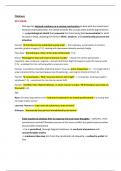
Madness
KEY IDEAS:
- Perhaps his feigned madness is a coping mechanism to deal with his resentment
towards impossible task, his hatred towards the corrupt state and his big emotions
-> a psychological shield that prevents him from being held accountable for what
he says or does, allowing him time to think, observe, and emotionally process the
situation
Hamlet: ‘O that this too too solid flesh would melt’ -> first soliloquy, exclamation of emotion,
suicidal, graphic imagery [1.2] - dealing with depression/already mentally fragile
Marcellus: ‘Something is rotten in the state of Denmark’ [1.4]
Ghost: ‘Revenge his foul and most unnatural murder’ -> doesn’t fit iambic pentameter –
important, also unnatural / regicide – disrupts the Divine Right of Kings/corrupts the natural order
[1.5] - a catalyst for him not being able to cope any more
Hamlet: ‘I perchance hereafter shall think meet / To put an antic disposition on’ -> he might think it
wise to pretend to be mad (will appear less threatening) - warning his friends of this [1.5]
Hamlet: ‘O cursed spite, / That I was ever born to set it right’ -> cursing fate, rhyming couplet =
emphasis [1.5] - resentment for his role he cannot fulfil
Hamlet: ‘whether it be / Bestial oblivion, or some craven scruple / Of thinking too precisely on
the event [4.4]
A05
Ryan: his antic disposition is the “only sane response to an insane predicament in a society that
no longer makes sense”
Lennard: Hamlet is “not a man of action but a man of mind”
Gillespie: “haunted by the past but immobilised by the future”
- Fake madness enables him to express his true inner thoughts – cathartic, even
sometimes comical? Reveals sources of his inner conflict (his performances when
around other characters)
-> he is permitted, through feigned madness, to confront characters with
uncomfortable truths
-> madness liberates him from the constraints of etiquette, a cathartic outlet for
him
, Hamlet: calls Polonius a “fishmonger” whilst commenting on the decay of honesty and age =
indirect ways of criticising the corrupt and sycophantic nature of the court
Hamlet: ‘Get thee to a nunnery, why wouldst thou be a breeder of sinners?’ - so she can remain
chaste – while Hamlet seems to be acting mad here, he is still degrading Ophelia/aware that he is
[3.1] - channels his anger at his mother and his disgust regarding female sexuality
Hamlet: ‘You are the Queen, your husband’s brother’s / wife’ [3.4]
A05
It is true that, like McEvoy says: “Hamlet’s behaviour becomes wilder and more murderous”
e.g. as he confronts Gertrude and accidentally kills Polonius, but this is driven by a logical
repulsion towards his frustration at his mother’s disloyalty and his own inability to act
-> does not reflect madness, just frustration
Doran: Hamlet’s violent treatment towards his mother does hint at madness, but ultimately
frustration – he cries to her afterwards admitting Hamlet: ‘[don’t tell Claudius this:] That I
essentially am not in madness, / But mad in craft’ [3.4] - we do question his sanity
- Hamlet seems to go mad but, set in contrast to Ophelia’s genuine madness, it
seems not - he appears merely as a dramatic, emotional man whose tendency
to overthink severely disrupts his inner peace (his soliloquies that reveal truth –
as an overthinker, perhaps his excessive thought and emotion appears mad, but
really we are just given a rare insight into a troubled prince’s mind who is
experiencing an impossible situation)
-> becomes more emotionally volatile, culminating in the impulsive murder of
Polonius
-> ambiguity allows Shakespeare to demonstrate the inescapable chaos that a
morally rotten world inflicts on the mind
Hamlet: ‘I, the son of a dear father murdered, / Prompted to my revenge by heaven and hell, /
Must, like a whore, unpack my heart with words, / And fall a-cursing like a very drab, / A
stallion!’ [2.2]
Hamlet: ‘whether it be / Bestial oblivion, or some craven scruple / Of thinking too precisely on
the event [4.4]
Gentleman: ‘Her [Ophelia’s] speech is nothing’ - she has gone mad and there is no logic in her
words – contrasts Hamlet’s methodological madness [4.5] - her role as a tragic victim merely
included to contrast Hamlet’s fake madness?
A05
KEY IDEAS:
- Perhaps his feigned madness is a coping mechanism to deal with his resentment
towards impossible task, his hatred towards the corrupt state and his big emotions
-> a psychological shield that prevents him from being held accountable for what
he says or does, allowing him time to think, observe, and emotionally process the
situation
Hamlet: ‘O that this too too solid flesh would melt’ -> first soliloquy, exclamation of emotion,
suicidal, graphic imagery [1.2] - dealing with depression/already mentally fragile
Marcellus: ‘Something is rotten in the state of Denmark’ [1.4]
Ghost: ‘Revenge his foul and most unnatural murder’ -> doesn’t fit iambic pentameter –
important, also unnatural / regicide – disrupts the Divine Right of Kings/corrupts the natural order
[1.5] - a catalyst for him not being able to cope any more
Hamlet: ‘I perchance hereafter shall think meet / To put an antic disposition on’ -> he might think it
wise to pretend to be mad (will appear less threatening) - warning his friends of this [1.5]
Hamlet: ‘O cursed spite, / That I was ever born to set it right’ -> cursing fate, rhyming couplet =
emphasis [1.5] - resentment for his role he cannot fulfil
Hamlet: ‘whether it be / Bestial oblivion, or some craven scruple / Of thinking too precisely on
the event [4.4]
A05
Ryan: his antic disposition is the “only sane response to an insane predicament in a society that
no longer makes sense”
Lennard: Hamlet is “not a man of action but a man of mind”
Gillespie: “haunted by the past but immobilised by the future”
- Fake madness enables him to express his true inner thoughts – cathartic, even
sometimes comical? Reveals sources of his inner conflict (his performances when
around other characters)
-> he is permitted, through feigned madness, to confront characters with
uncomfortable truths
-> madness liberates him from the constraints of etiquette, a cathartic outlet for
him
, Hamlet: calls Polonius a “fishmonger” whilst commenting on the decay of honesty and age =
indirect ways of criticising the corrupt and sycophantic nature of the court
Hamlet: ‘Get thee to a nunnery, why wouldst thou be a breeder of sinners?’ - so she can remain
chaste – while Hamlet seems to be acting mad here, he is still degrading Ophelia/aware that he is
[3.1] - channels his anger at his mother and his disgust regarding female sexuality
Hamlet: ‘You are the Queen, your husband’s brother’s / wife’ [3.4]
A05
It is true that, like McEvoy says: “Hamlet’s behaviour becomes wilder and more murderous”
e.g. as he confronts Gertrude and accidentally kills Polonius, but this is driven by a logical
repulsion towards his frustration at his mother’s disloyalty and his own inability to act
-> does not reflect madness, just frustration
Doran: Hamlet’s violent treatment towards his mother does hint at madness, but ultimately
frustration – he cries to her afterwards admitting Hamlet: ‘[don’t tell Claudius this:] That I
essentially am not in madness, / But mad in craft’ [3.4] - we do question his sanity
- Hamlet seems to go mad but, set in contrast to Ophelia’s genuine madness, it
seems not - he appears merely as a dramatic, emotional man whose tendency
to overthink severely disrupts his inner peace (his soliloquies that reveal truth –
as an overthinker, perhaps his excessive thought and emotion appears mad, but
really we are just given a rare insight into a troubled prince’s mind who is
experiencing an impossible situation)
-> becomes more emotionally volatile, culminating in the impulsive murder of
Polonius
-> ambiguity allows Shakespeare to demonstrate the inescapable chaos that a
morally rotten world inflicts on the mind
Hamlet: ‘I, the son of a dear father murdered, / Prompted to my revenge by heaven and hell, /
Must, like a whore, unpack my heart with words, / And fall a-cursing like a very drab, / A
stallion!’ [2.2]
Hamlet: ‘whether it be / Bestial oblivion, or some craven scruple / Of thinking too precisely on
the event [4.4]
Gentleman: ‘Her [Ophelia’s] speech is nothing’ - she has gone mad and there is no logic in her
words – contrasts Hamlet’s methodological madness [4.5] - her role as a tragic victim merely
included to contrast Hamlet’s fake madness?
A05