Page | 1
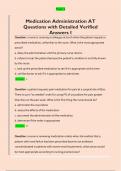
Medication Administration AT
Questions with Detailed Verified
Answers I
Question: a nurse is covering a colleague at lunch when the patient requests a
prescribed medication, unfamiliar to the nurse. What is the most appropriate
action?
a. delay the administration until the primary nurse returns
b. refuse to treat the patient because the patient's condition is not fully known
by this nurse
c. look up the prescribed medication to see if it is appropriate at this time
d. call the doctor to ask if it is appropriate to administer.
Answer: c.
Question: a patient requests pain medication for pain at a surgical site of 8/10.
There is a prn "as needed" order for 10mg PO of oxycodone for pain greater
than 6/10 on the pain scale. What is the first thing the nurse should do?
a. administer the oxycodone
b. assess the effects of the medication
c. document the administration of the medication
d. determine if the order is appropriate
Answer: d
Question: a nurse is reviewing medication orders when she realizes that a
patient with renal failure has been prescribed bactrim (an antibiotic
contraindicated in patients with severe renal impairment). what action would
be most appropriate according to nursing practice laws?
, Page | 2
a. administer the medication as ordered, then discuss with the physician
b. refuse to administer the medication since it is contraindicated for this
patient
c. call the physician who ordered the medication to discuss this inappropriate
order
d. administer the medication and perform frequent assessments for drug
effects
Answer: c
Question: what is the term used for the concentration of drug in the blood
serum that produces the desired effect without causing toxicity?
a. trough level
b. half life
c. therapeutic range
d. peak level
Answer: C. therapeutic range
Question: to which of the following patients would the nurse be most likely to
administer a PRN medication?
a. a patient who is complaining of pain near surgical site
b. a patient who requires daily medication to control hypertension
c. a patient whose asthma is treated with inhaled corticosteroids
d. a patient who is experiencing severe and unprecedented chest pain
Answer: a
Question: when administering oral medications, which of the following
practice should the nurse follow (select all that apply)?
, Page | 3
a. perform hand hygiene before and after medication administration
b. verify patient's response to medication 30 minutes after administration, or
as appropriate
c. keep patients MAR at bedside at all times to ensure safe identification
d. say at bedside until patient has swallowed all medications
e. dispense multiple liquid medication sinto single cup to reduce number of
containers
Answer: A, B, D
Question: a child is to receive amoxicillin 80 mg po. the medication is in an
oral suspension containing 125 mg/ 5mL. how many mL should the child
receive.
a. 2 mL
b. 3.2 mL
c. 32 mL
d. 0.5 mL
Answer: B. 3.2 mL
Question: when a medication acts on receptors they can do which of the
following? (select all that apply)
a. mimic the action of the bodys own hormones
b. change the enzymes made by the target cell
c. make the receptors respond in new ways
d. change the receptors molecular structure
e. block the action of the body's own compounds
Answer: A, E
Medication Administration AT
Questions with Detailed Verified
Answers I
Question: a nurse is covering a colleague at lunch when the patient requests a
prescribed medication, unfamiliar to the nurse. What is the most appropriate
action?
a. delay the administration until the primary nurse returns
b. refuse to treat the patient because the patient's condition is not fully known
by this nurse
c. look up the prescribed medication to see if it is appropriate at this time
d. call the doctor to ask if it is appropriate to administer.
Answer: c.
Question: a patient requests pain medication for pain at a surgical site of 8/10.
There is a prn "as needed" order for 10mg PO of oxycodone for pain greater
than 6/10 on the pain scale. What is the first thing the nurse should do?
a. administer the oxycodone
b. assess the effects of the medication
c. document the administration of the medication
d. determine if the order is appropriate
Answer: d
Question: a nurse is reviewing medication orders when she realizes that a
patient with renal failure has been prescribed bactrim (an antibiotic
contraindicated in patients with severe renal impairment). what action would
be most appropriate according to nursing practice laws?
, Page | 2
a. administer the medication as ordered, then discuss with the physician
b. refuse to administer the medication since it is contraindicated for this
patient
c. call the physician who ordered the medication to discuss this inappropriate
order
d. administer the medication and perform frequent assessments for drug
effects
Answer: c
Question: what is the term used for the concentration of drug in the blood
serum that produces the desired effect without causing toxicity?
a. trough level
b. half life
c. therapeutic range
d. peak level
Answer: C. therapeutic range
Question: to which of the following patients would the nurse be most likely to
administer a PRN medication?
a. a patient who is complaining of pain near surgical site
b. a patient who requires daily medication to control hypertension
c. a patient whose asthma is treated with inhaled corticosteroids
d. a patient who is experiencing severe and unprecedented chest pain
Answer: a
Question: when administering oral medications, which of the following
practice should the nurse follow (select all that apply)?
, Page | 3
a. perform hand hygiene before and after medication administration
b. verify patient's response to medication 30 minutes after administration, or
as appropriate
c. keep patients MAR at bedside at all times to ensure safe identification
d. say at bedside until patient has swallowed all medications
e. dispense multiple liquid medication sinto single cup to reduce number of
containers
Answer: A, B, D
Question: a child is to receive amoxicillin 80 mg po. the medication is in an
oral suspension containing 125 mg/ 5mL. how many mL should the child
receive.
a. 2 mL
b. 3.2 mL
c. 32 mL
d. 0.5 mL
Answer: B. 3.2 mL
Question: when a medication acts on receptors they can do which of the
following? (select all that apply)
a. mimic the action of the bodys own hormones
b. change the enzymes made by the target cell
c. make the receptors respond in new ways
d. change the receptors molecular structure
e. block the action of the body's own compounds
Answer: A, E