4PAHPDEV Psychology and Development Week 6
BSc Psychology Year 1 Cognitive Development: Developmental Stages
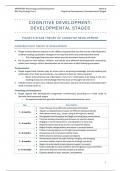
COGNITIVE DEVELOPMENT:
DEVELOPMENTAL STAGES
PIAGET’S STAGE THEORY OF COGNITIVE DEVELOPMENT
CONSTRUCTIVIST THEORY OF DEVELOPMENT
• Piaget’s theory became popular in the 1960s, proposed that over the course of development,
children undergo qualitative changes in the way they think and understand the world
o This challenged behaviourism which was the dominant theory at the time
• He focused on how infants, children, and adults face different developmental constraints,
rather than seeing a child’s development as an extension of adult learning processes
Constructivism
• Piaget argued that children play an active role in acquiring knowledge, actively seeking out
information from their environments—he referred to them as ‘little scientists’
o When encountering new information, they try to understand it by fitting it into pre-
existing structures of knowledge that they have or through trial-and-error
• Children learn on their own, without adult instruction, and are intrinsically motivated (don’t
need a reward) to do so
Chronology of Development
• Piaget argued that development progresses continuously according to a fixed order of
discrete developmental stages
o He approximated the ages that developmental achievements occur
Age Description
• Uses reflexes more efficiently and invites stimulation
• Adapts sucking behaviour based on different feeding methods
1 – 2 months
• Anticipates events (e.g., stops crying at the sight of a bottle)
• Recognises familiar people and begins forming basic associations
• Controls looking voluntarily and focuses on specific objects
• Engages in social interactions, including face-to-face play
3 – 4 months
• Repeats pleasurable body actions and explores objects
• Begins simple categorization and reacts to unusual events
• Follows moving objects out of sight and anticipates movement
5 – 6 months • Recognises and remembers familiar faces
• Shifts attention between people and objects
• Manipulates objects through shaking, banging, and dropping
7 – 8 months • Uncovers hidden objects and explores through mouthing
• Begins to understand simple physical support concepts
• Uses knowledge to solve problems and recognises cause and effect
9 – 10 months • Alternates attention between people and objects
• Explores details of toys, textures, and patterns
1
,4PAHPDEV Psychology and Development Week 6
BSc Psychology Year 1 Cognitive Development: Developmental Stages
• Uses tools (e.g., stacking cups, standing on a chair)
11 months – 1 year • Imitates others and follows their gaze
• Recognizes self in a mirror and inspects objects more closely
• Experiments with object functions and cause-effect relationships
15 months
• Shows social referencing and awareness of others’ perspectives
• Tests object properties and understands “what should be” (e.g., putting
lids on jars)
18 months
• Recognises others’ possessions and uses language to direct attention
• Improves recall memory
• Understands past, present, and future to some degree
21 months • Organises activities into episodes using scripts.
• Begins understanding categories (e.g., colours)
• Uses language to guide attention and behaviour
2 years • Engages in fantasy play and mentally plans solutions
• Starts creative problem-solving and understands conservation
• Improves reasoning about others’ perspectives
3 – 4 years
• Understands part-whole relationships
• Uses mental operations but without fully understanding them
5 years
• Further develops language and problem-solving skills
• Understands conservation of number, mass, liquid, and length
7 years
• Begins describing self in more abstract terms
• Anticipates others’ thoughts and considers perspectives
8 – 10 years
• Understands conservation of weight and area
• Achieves conservation of volume
11 – 12 years • Begins to think deductively
• Can sort things in complicated combinations of attributes
• Thinking becomes more flexible and abstract
12 years plus • Can apply logic to ideas and problems that violate reality
• Can entertain many possible solutions to a problem
Schemas
• Schemas are an organised group of interrelated memories, knowledge, ideas, and strategies
one uses to try and understand a situation and interact with the world
o Piaget believed that throughout development, a child’s schemas become
increasingly organised into more complex structures of knowledge
• They become reorganised over time as children integrate new experiences into their current
knowledge
o For example, a newborn has reflexes like sucking, to help them engage with the world,
but through experience, this schema adapts and evolves, allowing the infant to use
sucking in different ways for various objects, making the schema more complex
• Piaget suggested that many schemas are initially separate, but become more linked as one
learns (e.g. looking at and sucking the same object)
o This organisation is an important developmental change
• During development, children shift from using schemas based on overt physical activities to
those based on internal mental activities and representations, known as operations
o Once a substantial change in schemas or operations occur, children change to an
entirely new way of approaching the world—stages
2
, 4PAHPDEV Psychology and Development Week 6
BSc Psychology Year 1 Cognitive Development: Developmental Stages
Stagewise Development
• Piaget described three processes by which infants and children learn to adapt and develop
their schemas to relate to the everyday world (adaptation)
1. Assimilation occurs when they try to apply their existing schemas to a new experience
(relating external information to internal knowledge)
o For example, a schema for sucking being applied to new objects
2. Accommodation occurs when new stimuli is hard to assimilate, causing the existing schema
to be modified to fit the new situation (relating internal knowledge to external information)
o For example, if a large object that cannot be sucked is encountered, leading to the
infant licking it instead
3. Equilibration occurs when children balance assimilation and accommodation
o They no longer need to modify their schemas or incorporate external information
since they now have a stable understanding
DESCRIBE OBJECT PERMANENCE AND SOLIDITY
• Piaget viewed intellectual growth in terms of progressive changes in cognitive structures, and
that children think in distinct qualitatively different ways in each stage
• There are three major periods
1. Sensorimotor period
2. Concrete operational period (preoperational period and concrete operations)
3. Formal operational period
• All children pass through the stages in the same order, and no one can be skipped
o However, the ages at which one reaches each stage can vary
• There is a transition period between the stages, where thinking is a hybrid of the two stages
Age
Stage (Substages) Major Characteristics and Achievements
(years)
1. Basic Reflex Activity • Early thinking is based on action
2. Primary Circular schemas and sensory experiences.
Reactions • Seeks stimulation, differentiates self
3. Secondary Circular from objects/people, and develops
Reactions object concepts
Sensorimotor 4. Coordination of • Gains understanding of time, space, and
0–2
Period Secondary Circular means-end relationships
Reactions • Begins imitation and later in the stage,
5. Tertiary Circular develops symbolic thought and
Reactions imaginative play
6. Inventing New Means
by Mental Combination
• Uses symbols for objects/experiences
and starts symbolic language use
• Thinking is pre-logical, marked by
1. Preoperational
Concrete 2–7 irreversibility, centration, egocentrism,
Representations
Operational and animism
Period • Begins understanding classes,
relationships, and numbers
• Develops logical reasoning but limited to
2. Concrete Operations 7 – 11
physical objects
3
BSc Psychology Year 1 Cognitive Development: Developmental Stages
COGNITIVE DEVELOPMENT:
DEVELOPMENTAL STAGES
PIAGET’S STAGE THEORY OF COGNITIVE DEVELOPMENT
CONSTRUCTIVIST THEORY OF DEVELOPMENT
• Piaget’s theory became popular in the 1960s, proposed that over the course of development,
children undergo qualitative changes in the way they think and understand the world
o This challenged behaviourism which was the dominant theory at the time
• He focused on how infants, children, and adults face different developmental constraints,
rather than seeing a child’s development as an extension of adult learning processes
Constructivism
• Piaget argued that children play an active role in acquiring knowledge, actively seeking out
information from their environments—he referred to them as ‘little scientists’
o When encountering new information, they try to understand it by fitting it into pre-
existing structures of knowledge that they have or through trial-and-error
• Children learn on their own, without adult instruction, and are intrinsically motivated (don’t
need a reward) to do so
Chronology of Development
• Piaget argued that development progresses continuously according to a fixed order of
discrete developmental stages
o He approximated the ages that developmental achievements occur
Age Description
• Uses reflexes more efficiently and invites stimulation
• Adapts sucking behaviour based on different feeding methods
1 – 2 months
• Anticipates events (e.g., stops crying at the sight of a bottle)
• Recognises familiar people and begins forming basic associations
• Controls looking voluntarily and focuses on specific objects
• Engages in social interactions, including face-to-face play
3 – 4 months
• Repeats pleasurable body actions and explores objects
• Begins simple categorization and reacts to unusual events
• Follows moving objects out of sight and anticipates movement
5 – 6 months • Recognises and remembers familiar faces
• Shifts attention between people and objects
• Manipulates objects through shaking, banging, and dropping
7 – 8 months • Uncovers hidden objects and explores through mouthing
• Begins to understand simple physical support concepts
• Uses knowledge to solve problems and recognises cause and effect
9 – 10 months • Alternates attention between people and objects
• Explores details of toys, textures, and patterns
1
,4PAHPDEV Psychology and Development Week 6
BSc Psychology Year 1 Cognitive Development: Developmental Stages
• Uses tools (e.g., stacking cups, standing on a chair)
11 months – 1 year • Imitates others and follows their gaze
• Recognizes self in a mirror and inspects objects more closely
• Experiments with object functions and cause-effect relationships
15 months
• Shows social referencing and awareness of others’ perspectives
• Tests object properties and understands “what should be” (e.g., putting
lids on jars)
18 months
• Recognises others’ possessions and uses language to direct attention
• Improves recall memory
• Understands past, present, and future to some degree
21 months • Organises activities into episodes using scripts.
• Begins understanding categories (e.g., colours)
• Uses language to guide attention and behaviour
2 years • Engages in fantasy play and mentally plans solutions
• Starts creative problem-solving and understands conservation
• Improves reasoning about others’ perspectives
3 – 4 years
• Understands part-whole relationships
• Uses mental operations but without fully understanding them
5 years
• Further develops language and problem-solving skills
• Understands conservation of number, mass, liquid, and length
7 years
• Begins describing self in more abstract terms
• Anticipates others’ thoughts and considers perspectives
8 – 10 years
• Understands conservation of weight and area
• Achieves conservation of volume
11 – 12 years • Begins to think deductively
• Can sort things in complicated combinations of attributes
• Thinking becomes more flexible and abstract
12 years plus • Can apply logic to ideas and problems that violate reality
• Can entertain many possible solutions to a problem
Schemas
• Schemas are an organised group of interrelated memories, knowledge, ideas, and strategies
one uses to try and understand a situation and interact with the world
o Piaget believed that throughout development, a child’s schemas become
increasingly organised into more complex structures of knowledge
• They become reorganised over time as children integrate new experiences into their current
knowledge
o For example, a newborn has reflexes like sucking, to help them engage with the world,
but through experience, this schema adapts and evolves, allowing the infant to use
sucking in different ways for various objects, making the schema more complex
• Piaget suggested that many schemas are initially separate, but become more linked as one
learns (e.g. looking at and sucking the same object)
o This organisation is an important developmental change
• During development, children shift from using schemas based on overt physical activities to
those based on internal mental activities and representations, known as operations
o Once a substantial change in schemas or operations occur, children change to an
entirely new way of approaching the world—stages
2
, 4PAHPDEV Psychology and Development Week 6
BSc Psychology Year 1 Cognitive Development: Developmental Stages
Stagewise Development
• Piaget described three processes by which infants and children learn to adapt and develop
their schemas to relate to the everyday world (adaptation)
1. Assimilation occurs when they try to apply their existing schemas to a new experience
(relating external information to internal knowledge)
o For example, a schema for sucking being applied to new objects
2. Accommodation occurs when new stimuli is hard to assimilate, causing the existing schema
to be modified to fit the new situation (relating internal knowledge to external information)
o For example, if a large object that cannot be sucked is encountered, leading to the
infant licking it instead
3. Equilibration occurs when children balance assimilation and accommodation
o They no longer need to modify their schemas or incorporate external information
since they now have a stable understanding
DESCRIBE OBJECT PERMANENCE AND SOLIDITY
• Piaget viewed intellectual growth in terms of progressive changes in cognitive structures, and
that children think in distinct qualitatively different ways in each stage
• There are three major periods
1. Sensorimotor period
2. Concrete operational period (preoperational period and concrete operations)
3. Formal operational period
• All children pass through the stages in the same order, and no one can be skipped
o However, the ages at which one reaches each stage can vary
• There is a transition period between the stages, where thinking is a hybrid of the two stages
Age
Stage (Substages) Major Characteristics and Achievements
(years)
1. Basic Reflex Activity • Early thinking is based on action
2. Primary Circular schemas and sensory experiences.
Reactions • Seeks stimulation, differentiates self
3. Secondary Circular from objects/people, and develops
Reactions object concepts
Sensorimotor 4. Coordination of • Gains understanding of time, space, and
0–2
Period Secondary Circular means-end relationships
Reactions • Begins imitation and later in the stage,
5. Tertiary Circular develops symbolic thought and
Reactions imaginative play
6. Inventing New Means
by Mental Combination
• Uses symbols for objects/experiences
and starts symbolic language use
• Thinking is pre-logical, marked by
1. Preoperational
Concrete 2–7 irreversibility, centration, egocentrism,
Representations
Operational and animism
Period • Begins understanding classes,
relationships, and numbers
• Develops logical reasoning but limited to
2. Concrete Operations 7 – 11
physical objects
3