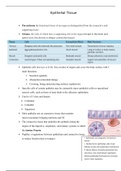
Epithelial Tissue
Parenchyma the functional tissue of an organ as distinguished from the connective and
supporting tissue
Stroma, the cells of which have a supporting role in the organ (Except in the brain and
spinal cord, the stroma is always connective tissue)
Epithelia cells (thin layer of ECM) line cavities of organs and cover the body surface with 3
main functions:
1. Secretion (glands)
2. Absorption (intestinal lining)
3. Covering, lining and protecting surfaces (epidermis)
Specific cells of certain epithelia may be contractile (myo-epithelial cells) or specialized
sensory cells, such as those of taste buds or the olfactory epithelium.
Can be of 3 sizes and shapes:
Columnar
Cuboidal
Squamous
Most epithelia rest on connective tissue that contains
microvasculature bringing nutrients and O2
The connective tissue that underlies the epithelia lining the
organs of the digestive, respiratory, and urinary systems is called
the lamina Propria.
Papillae: evaginations between epithelium and connective tissue
Epithelial and adjacent connective
to reduce friction (skin or tongue)
tissue
Nutrients for epithelial cells must
diffuse across the basement membrane.
Nerve fibers normally penetrate this
structure, but small blood capillaries
(being epithelial themselves) normally
never enter epithelia.
Parenchyma the functional tissue of an organ as distinguished from the connective and
supporting tissue
Stroma, the cells of which have a supporting role in the organ (Except in the brain and
spinal cord, the stroma is always connective tissue)
Epithelia cells (thin layer of ECM) line cavities of organs and cover the body surface with 3
main functions:
1. Secretion (glands)
2. Absorption (intestinal lining)
3. Covering, lining and protecting surfaces (epidermis)
Specific cells of certain epithelia may be contractile (myo-epithelial cells) or specialized
sensory cells, such as those of taste buds or the olfactory epithelium.
Can be of 3 sizes and shapes:
Columnar
Cuboidal
Squamous
Most epithelia rest on connective tissue that contains
microvasculature bringing nutrients and O2
The connective tissue that underlies the epithelia lining the
organs of the digestive, respiratory, and urinary systems is called
the lamina Propria.
Papillae: evaginations between epithelium and connective tissue
Epithelial and adjacent connective
to reduce friction (skin or tongue)
tissue
Nutrients for epithelial cells must
diffuse across the basement membrane.
Nerve fibers normally penetrate this
structure, but small blood capillaries
(being epithelial themselves) normally
never enter epithelia.