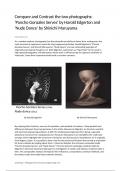
Compare and Contrast the two photographs:
'Pancho Gonzales Serves' by Harold Edgerton and
'Nude Dance' by Shinichi Maruyama
Introduction
As a crea ve medium, photography has the extraordinary ability to freeze me, making even the
most transient of experiences seem like they happened yesterday. Harold Edgerton's "Pancho
Gonzales Serves" and Shinichi Maruyama's "Nude Dance" are two outstanding examples of
originality and original thought in art. Both Edgerton, well known as "Papa Flash" for his work in
high-speed photography, and Maruyama, whose work is in uenced by the Japanese aesthe c of
'wabi-sabi,' share their respec ve worlds with us via their cameras.
Pancho Gonzales Serves (1946)
Nude dance (2012)
By Harold Edgerton By Shinichi Maruyama
By analysing their histories, sources of inspira on, and methods of crea on, I draw parallels and
di erences between these two geniuses in this ar cle. Because to Edgerton, an American scien st
and electrical engineering professor at MIT, the stroboscope progressed from being a specialist
laboratory instrument to a widespread one. However, Maruyama's art exempli es the 'wabi-sabi'
concept, which highlights the transience of existence and the beauty in imperfec on; he is originally
from Nagano, Japan. It is possible to have a feel for the period and loca on that served as inspira on
for these crea ves by reading about them. I intend to decipher the intricacies concealed inside
"Pancho Gonzales Serves" and "Nude Dance," from the dynamic exchanges rendered sta c by
Edgerton's technical mastery to Maruyama's inves ga on of mo on and s llness rendered sta c in
me. This compara ve analysis will explore their in uences, composi ons, technical methods, and
the dis nct styles that make these artworks meless.
Amelie Roper – Photography Unit 1 Personal Inves ga on Page 1 of 5
, As we journey through the frozen moments and dynamic expressions captured by Edgerton and
Maruyama, we will see the innova on, cultural in uences, and ar s c philosophies that are shown
in these two extraordinary photographs.
Biography of Harold Edgerton
Harold Eugene "Doc" Edgerton, born on April 6, 1903, in Fremont,
Nebraska, stands as an iconic gure whose contribu ons to the
elds of science and photography. Known as "Papa Flash,"
Edgerton's mul faceted career crossed the boundaries of
academia, science, and art.
His academic journey commenced at the University of Nebraska-
Lincoln, where he earned a bachelor's degree in electrical
engineering in 1925. Later, at the Massachuse s Ins tute of
Technology (MIT), he pursued a master's degree in electrical
engineering, which he obtained in 1927. Edgerton's high-speed
photography and stroboscopic imaging was started by his ScD
thesis at MIT, completed in 1931. The thesis marked the beginning
of his fascina on with capturing fast-paced events, with Charles
Stark Draper inspiring him to experiment with electronic ash
photography.
Edgerton had many awards and Recogni ons during his career. His achievements include a bronze
medal from the Royal Photographic Society in 1934, the Howard N. Po s Medal from the Franklin
Ins tute in 1941, and the Na onal Medal of Science in 1973. Alongside these accolades, Edgerton
co-founded EG&G, Inc., a company that played a pivotal role in photographing and recording nuclear
tests for the U.S. government.
Edgerton had an Oscar-winning short lm "Quicker'n a Wink" in 1940, showcasing his high-speed
stroboscopic cinematography. His legacy endures not only in the scien c advancements but also in
the beaty of his images, now displayed in art museums worldwide.
In 1990, Harold Edgerton passed away at the MIT Faculty Club at the age of 86.
Biography of Shinichi Maruyama
The Japanese aesthe c concept of wabi-sabi—an respect for
imperfec on, impermanence, and incompleteness— nds expression in
the work of Shinichi Maruyama, a modern photography master born in
Nagano, Japan in 1968. He is a master at visually portraying the spirit of
dynamic energy, thanks to his ar s c journey that fuses cultural
inspira ons with contemporary approaches.
During his forma ve years, Maruyama's fascina on with ar s c
expression began during high school, where he discovered a profound
interest in both tradi onal Chinese calligraphy and photography.
Maruyama's academic pursuits led him to Chiba University and became
a signi cant role as a member of Hakuhodo Photo Crea ve. He enjoys
exploring the energe c interac ons between forms, shown in his early
Amelie Roper – Photography Unit 1 Personal Inves ga on Page 2 of 5
'Pancho Gonzales Serves' by Harold Edgerton and
'Nude Dance' by Shinichi Maruyama
Introduction
As a crea ve medium, photography has the extraordinary ability to freeze me, making even the
most transient of experiences seem like they happened yesterday. Harold Edgerton's "Pancho
Gonzales Serves" and Shinichi Maruyama's "Nude Dance" are two outstanding examples of
originality and original thought in art. Both Edgerton, well known as "Papa Flash" for his work in
high-speed photography, and Maruyama, whose work is in uenced by the Japanese aesthe c of
'wabi-sabi,' share their respec ve worlds with us via their cameras.
Pancho Gonzales Serves (1946)
Nude dance (2012)
By Harold Edgerton By Shinichi Maruyama
By analysing their histories, sources of inspira on, and methods of crea on, I draw parallels and
di erences between these two geniuses in this ar cle. Because to Edgerton, an American scien st
and electrical engineering professor at MIT, the stroboscope progressed from being a specialist
laboratory instrument to a widespread one. However, Maruyama's art exempli es the 'wabi-sabi'
concept, which highlights the transience of existence and the beauty in imperfec on; he is originally
from Nagano, Japan. It is possible to have a feel for the period and loca on that served as inspira on
for these crea ves by reading about them. I intend to decipher the intricacies concealed inside
"Pancho Gonzales Serves" and "Nude Dance," from the dynamic exchanges rendered sta c by
Edgerton's technical mastery to Maruyama's inves ga on of mo on and s llness rendered sta c in
me. This compara ve analysis will explore their in uences, composi ons, technical methods, and
the dis nct styles that make these artworks meless.
Amelie Roper – Photography Unit 1 Personal Inves ga on Page 1 of 5
, As we journey through the frozen moments and dynamic expressions captured by Edgerton and
Maruyama, we will see the innova on, cultural in uences, and ar s c philosophies that are shown
in these two extraordinary photographs.
Biography of Harold Edgerton
Harold Eugene "Doc" Edgerton, born on April 6, 1903, in Fremont,
Nebraska, stands as an iconic gure whose contribu ons to the
elds of science and photography. Known as "Papa Flash,"
Edgerton's mul faceted career crossed the boundaries of
academia, science, and art.
His academic journey commenced at the University of Nebraska-
Lincoln, where he earned a bachelor's degree in electrical
engineering in 1925. Later, at the Massachuse s Ins tute of
Technology (MIT), he pursued a master's degree in electrical
engineering, which he obtained in 1927. Edgerton's high-speed
photography and stroboscopic imaging was started by his ScD
thesis at MIT, completed in 1931. The thesis marked the beginning
of his fascina on with capturing fast-paced events, with Charles
Stark Draper inspiring him to experiment with electronic ash
photography.
Edgerton had many awards and Recogni ons during his career. His achievements include a bronze
medal from the Royal Photographic Society in 1934, the Howard N. Po s Medal from the Franklin
Ins tute in 1941, and the Na onal Medal of Science in 1973. Alongside these accolades, Edgerton
co-founded EG&G, Inc., a company that played a pivotal role in photographing and recording nuclear
tests for the U.S. government.
Edgerton had an Oscar-winning short lm "Quicker'n a Wink" in 1940, showcasing his high-speed
stroboscopic cinematography. His legacy endures not only in the scien c advancements but also in
the beaty of his images, now displayed in art museums worldwide.
In 1990, Harold Edgerton passed away at the MIT Faculty Club at the age of 86.
Biography of Shinichi Maruyama
The Japanese aesthe c concept of wabi-sabi—an respect for
imperfec on, impermanence, and incompleteness— nds expression in
the work of Shinichi Maruyama, a modern photography master born in
Nagano, Japan in 1968. He is a master at visually portraying the spirit of
dynamic energy, thanks to his ar s c journey that fuses cultural
inspira ons with contemporary approaches.
During his forma ve years, Maruyama's fascina on with ar s c
expression began during high school, where he discovered a profound
interest in both tradi onal Chinese calligraphy and photography.
Maruyama's academic pursuits led him to Chiba University and became
a signi cant role as a member of Hakuhodo Photo Crea ve. He enjoys
exploring the energe c interac ons between forms, shown in his early
Amelie Roper – Photography Unit 1 Personal Inves ga on Page 2 of 5