Compare and contrast two building
designs: Singapore Changi Airport and
Haus des Meeres Wien
Introduction
In global architecture, Singapore Changi Airport and Haus des Meeres Wien are ne examples of
innova on. Separated by con nents, their designs cater to dis nct needs and audiences, o ering a
glimpse into the manifold facets of human culture and crea vity. While Changi Airport stands as an
interna onal transit hub, embodying e ciency and connec vity, Haus des Meeres Wien is a
cap va ng marine sanctuary, embodying educa on, and conserva on. This compara ve analysis
explores the intricate threads of their designs, unravelling the impact they have on their respec ve
environments.
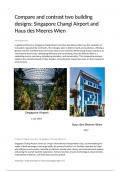
Singapore Airport:
1 July 1981
Haus des Meeres Wien
1957
Product Requirements: Singapore Changi Airport
Singapore Changi Airport serves as a major interna onal transporta on hub, accommoda ng the
needs of both passengers and cargo tra c. Its primary func on is to facilitate seamless air travel
with e ciency and comfort. Secondary func ons include retail, dining, and entertainment op ons,
enhancing the overall traveller experience. Ter ary func ons involve technological advancements,
sustainability ini a ves, and fostering economic growth.
Amelie Roper – Design Technology Unit 1 Personal Inves ga on Page 1 of 11
, While Changi Airport is fundamentally designed for func onality, aesthe cs plays a crucial role in
enhancing the overall passenger experience. The airport's design combines modern architectural
elements with green spaces, art installa ons, and cu ng-edge technology, crea ng a visually
appealing and user-friendly environment.
Changi Airport is designed to cater to a diverse global audience of travellers, including tourists,
business professionals, and transit passengers. The design considers the varied needs of this market,
o ering a wide range of services, ameni es, and facili es.
The use of the airport has a signi cant impact on passengers, contribu ng to a posi ve and
enjoyable travel experience. The airport's soothing green spaces, aesthe cally pleasing interiors, and
e cient services contribute to reducing travel-related stress. Ownership in this context refers to the
experience of using the airport rather than personal possession.
Changi Airport, as a global transit hub, transmits a message of Singapore's commitment to
excellence, e ciency, and innova on. Passengers associa ng with Changi Airport may feel a sense of
pres ge and recogni on, contribu ng to the airport's desirability as a travel des na on.
This Airport is designed for longevity, with con nuous expansions and updates to meet the growing
demands of air travel. The infrastructure is built to last, with regular maintenance and updates to
ensure func onality and relevance over the years.
Changi Airport adopts mass produc on methods to cater to the high volume of passengers. While
the airport is accessible to people from all parts of the world, the price is determined by opera onal
costs, user fees, and other economic factors associated with air travel.
Product Requirements: Haus des Meeres Wien
Haus des Meeres Wien primarily func ons as a public aquarium and research facility, showcasing
marine life from the Mediterranean Sea and tropical habitats. Secondary func ons include
educa onal programs, conserva on ini a ves, and public engagement with marine biodiversity.
The vivarium's design harmonizes func onality with aesthe cs, crea ng a thema c and visually
appealing environment. The curved forms and thema c sec ons enhance the overall experience,
making it more than just an aquarium.
Designed for the local Viennese community and tourists, the vivarium aims to promote marine
conserva on awareness. The design considers the needs and interests of families, students, and
individuals interested in marine life.
The use of the vivarium contributes to a posi ve emo onal experience, fostering apprecia on for
marine life. Visitors may nd joy, awe, and educa onal value in their interac ons with diverse aqua c
species.
Haus des Meeres Wien transmits a message of environmental consciousness and marine
conserva on. Visitors associa ng with the vivarium may feel a sense of responsibility toward the
oceans and an apprecia on for the ins tu on's commitment to marine research.
The vivarium is designed for longevity, with successive expansions and updates re ec ng a
commitment to ongoing marine research and public educa on. Regular maintenance ensures the
well-being of the animals and the func onality of the facili es.
Amelie Roper – Design Technology Unit 1 Personal Inves ga on Page 2 of 11
designs: Singapore Changi Airport and
Haus des Meeres Wien
Introduction
In global architecture, Singapore Changi Airport and Haus des Meeres Wien are ne examples of
innova on. Separated by con nents, their designs cater to dis nct needs and audiences, o ering a
glimpse into the manifold facets of human culture and crea vity. While Changi Airport stands as an
interna onal transit hub, embodying e ciency and connec vity, Haus des Meeres Wien is a
cap va ng marine sanctuary, embodying educa on, and conserva on. This compara ve analysis
explores the intricate threads of their designs, unravelling the impact they have on their respec ve
environments.
Singapore Airport:
1 July 1981
Haus des Meeres Wien
1957
Product Requirements: Singapore Changi Airport
Singapore Changi Airport serves as a major interna onal transporta on hub, accommoda ng the
needs of both passengers and cargo tra c. Its primary func on is to facilitate seamless air travel
with e ciency and comfort. Secondary func ons include retail, dining, and entertainment op ons,
enhancing the overall traveller experience. Ter ary func ons involve technological advancements,
sustainability ini a ves, and fostering economic growth.
Amelie Roper – Design Technology Unit 1 Personal Inves ga on Page 1 of 11
, While Changi Airport is fundamentally designed for func onality, aesthe cs plays a crucial role in
enhancing the overall passenger experience. The airport's design combines modern architectural
elements with green spaces, art installa ons, and cu ng-edge technology, crea ng a visually
appealing and user-friendly environment.
Changi Airport is designed to cater to a diverse global audience of travellers, including tourists,
business professionals, and transit passengers. The design considers the varied needs of this market,
o ering a wide range of services, ameni es, and facili es.
The use of the airport has a signi cant impact on passengers, contribu ng to a posi ve and
enjoyable travel experience. The airport's soothing green spaces, aesthe cally pleasing interiors, and
e cient services contribute to reducing travel-related stress. Ownership in this context refers to the
experience of using the airport rather than personal possession.
Changi Airport, as a global transit hub, transmits a message of Singapore's commitment to
excellence, e ciency, and innova on. Passengers associa ng with Changi Airport may feel a sense of
pres ge and recogni on, contribu ng to the airport's desirability as a travel des na on.
This Airport is designed for longevity, with con nuous expansions and updates to meet the growing
demands of air travel. The infrastructure is built to last, with regular maintenance and updates to
ensure func onality and relevance over the years.
Changi Airport adopts mass produc on methods to cater to the high volume of passengers. While
the airport is accessible to people from all parts of the world, the price is determined by opera onal
costs, user fees, and other economic factors associated with air travel.
Product Requirements: Haus des Meeres Wien
Haus des Meeres Wien primarily func ons as a public aquarium and research facility, showcasing
marine life from the Mediterranean Sea and tropical habitats. Secondary func ons include
educa onal programs, conserva on ini a ves, and public engagement with marine biodiversity.
The vivarium's design harmonizes func onality with aesthe cs, crea ng a thema c and visually
appealing environment. The curved forms and thema c sec ons enhance the overall experience,
making it more than just an aquarium.
Designed for the local Viennese community and tourists, the vivarium aims to promote marine
conserva on awareness. The design considers the needs and interests of families, students, and
individuals interested in marine life.
The use of the vivarium contributes to a posi ve emo onal experience, fostering apprecia on for
marine life. Visitors may nd joy, awe, and educa onal value in their interac ons with diverse aqua c
species.
Haus des Meeres Wien transmits a message of environmental consciousness and marine
conserva on. Visitors associa ng with the vivarium may feel a sense of responsibility toward the
oceans and an apprecia on for the ins tu on's commitment to marine research.
The vivarium is designed for longevity, with successive expansions and updates re ec ng a
commitment to ongoing marine research and public educa on. Regular maintenance ensures the
well-being of the animals and the func onality of the facili es.
Amelie Roper – Design Technology Unit 1 Personal Inves ga on Page 2 of 11