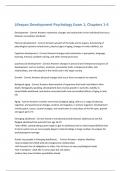
Lifespan Development Psychology Exam 1, Chapters 1-4
Development - Correct Answers-systematic changes and continuities in the individual that occur
between conception and death
Physical development - Correct Answers-growth of the body and its organs, functioning of
physiological systems include brain, physical signs of aging, changes in motor abilities, etc
Cognitive development - Correct Answers-changes and continuities in perception, language,
learning, memory, problem solving, and other mental processes
psychosocial development - Correct Answers-changes in personal and interpersonal aspects of
development, such as motives, emotions, personality traits, interpersonal skills, and
relationships, and roles played in the family and in the larger society
Growth - Correct Answers-physical changes that occur from conception to maturity
Biological aging - Correct Answers-deterioration of organisms that leads inevitably to their
death. Biologically speaking, development does involve growth in early life, stability in
early/middle adulthood, and decline associated with now-accumalted effects of aging in later
life
Aging - Correct Answers-involves more than biological aging, refers to a range of physical,
cognitive, and psychosocial changes, positive and negative, in mature organism. Development
involves gains, losses, neutral changes, and continuities in each phase of the life span, growth
and again part of it
Emerging adulthood - Correct Answers-transitional period between adolescence and full
fledged adulthood that extends from age 18-25
*after WWII, started taking youth longer to get to adulthood and its roles/responsibilities than
it had in earlier eras as more people began to attend college in large numbers to prepare for
work/postpone marriage
Arnett says people in Emerging Adulthood... - Correct Answers--explore identities
-lead unstable lives filled with job changes/new relationships
-self-focused, free of obligations to other, free to focus on own psychological needs
-feel in-between- adult like in some ways but not others
-believe they have limitless possibilities ahead
, Prenatal period - Correct Answers-conception to birth
infancy - Correct Answers-first 2 years of life
preschool period - Correct Answers-2-5/6 years
middle childhood - Correct Answers-6-10
adolescence - Correct Answers-(puberty) 10-18
emerging adulthood - Correct Answers-18-25
early adulthood - Correct Answers-25-40
middle adulthood - Correct Answers-40-65
late adulthood - Correct Answers-65+
Age grade - Correct Answers--socially defined age group in a society
-assigned different statuses, roles, privileges, and responsibilities
-separating children in grades in school is form of age grading
Ex: in Us, 18 year old's can vote, children can not, we define old age as 65+ but Kung San of
Botswana don't know chronological age and define old age in terms of functioning
Rite of Passage - Correct Answers-Ritual that marks a person's passage from one status to
another, usually in reference to passage from childhood to adulthood
Age norms - Correct Answers-society's way of telling people how to act their age
ex: most agree that 6 year olds are too young to date or drink beer, but old enough to attend
school, adults should think about marrying at 25
** important bc influence decisions about how to lead lives
different in people with higher SES than lower SES
ex: african american women in lower SES were mothers at 16
Social Clock - Correct Answers-a person's sense of when things should be done and when he or
she is ahead of or behind the schedule dictated by age norms
Development - Correct Answers-systematic changes and continuities in the individual that occur
between conception and death
Physical development - Correct Answers-growth of the body and its organs, functioning of
physiological systems include brain, physical signs of aging, changes in motor abilities, etc
Cognitive development - Correct Answers-changes and continuities in perception, language,
learning, memory, problem solving, and other mental processes
psychosocial development - Correct Answers-changes in personal and interpersonal aspects of
development, such as motives, emotions, personality traits, interpersonal skills, and
relationships, and roles played in the family and in the larger society
Growth - Correct Answers-physical changes that occur from conception to maturity
Biological aging - Correct Answers-deterioration of organisms that leads inevitably to their
death. Biologically speaking, development does involve growth in early life, stability in
early/middle adulthood, and decline associated with now-accumalted effects of aging in later
life
Aging - Correct Answers-involves more than biological aging, refers to a range of physical,
cognitive, and psychosocial changes, positive and negative, in mature organism. Development
involves gains, losses, neutral changes, and continuities in each phase of the life span, growth
and again part of it
Emerging adulthood - Correct Answers-transitional period between adolescence and full
fledged adulthood that extends from age 18-25
*after WWII, started taking youth longer to get to adulthood and its roles/responsibilities than
it had in earlier eras as more people began to attend college in large numbers to prepare for
work/postpone marriage
Arnett says people in Emerging Adulthood... - Correct Answers--explore identities
-lead unstable lives filled with job changes/new relationships
-self-focused, free of obligations to other, free to focus on own psychological needs
-feel in-between- adult like in some ways but not others
-believe they have limitless possibilities ahead
, Prenatal period - Correct Answers-conception to birth
infancy - Correct Answers-first 2 years of life
preschool period - Correct Answers-2-5/6 years
middle childhood - Correct Answers-6-10
adolescence - Correct Answers-(puberty) 10-18
emerging adulthood - Correct Answers-18-25
early adulthood - Correct Answers-25-40
middle adulthood - Correct Answers-40-65
late adulthood - Correct Answers-65+
Age grade - Correct Answers--socially defined age group in a society
-assigned different statuses, roles, privileges, and responsibilities
-separating children in grades in school is form of age grading
Ex: in Us, 18 year old's can vote, children can not, we define old age as 65+ but Kung San of
Botswana don't know chronological age and define old age in terms of functioning
Rite of Passage - Correct Answers-Ritual that marks a person's passage from one status to
another, usually in reference to passage from childhood to adulthood
Age norms - Correct Answers-society's way of telling people how to act their age
ex: most agree that 6 year olds are too young to date or drink beer, but old enough to attend
school, adults should think about marrying at 25
** important bc influence decisions about how to lead lives
different in people with higher SES than lower SES
ex: african american women in lower SES were mothers at 16
Social Clock - Correct Answers-a person's sense of when things should be done and when he or
she is ahead of or behind the schedule dictated by age norms