

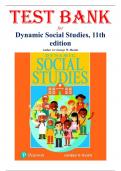
TEST BANK for
Dynamic Social Studies, 11th
edition
DR
Author (s): George W. Maxim
EAM
SH
UB
_S
? ?
, Chapter 1 Test Bank
Multiple Choice
1. Following the National Education Association’s initiative in 1916, social studies took on
the primary purpose to:
a. provide children opportunities to explore the world through each of the
social sciences.
b. encourage children’s patriotism and sense of community.
DR
c. promote the “social efficiency” of citizens in a rapidly changing society.
d. create an understanding among children that they live in a global society.
2. Professional curriculum standards for social studies were developed by
a. The National Council of Teachers of Social Studies.
E
b. The National Council for the Social Studies.
c. The American Association of Social Studies Educators.
AM
d. The Consortium of Social Studies Advocates.
3. According to the author, the overriding goal of social studies is to
a. ensure students understand critical historical content.
b. ready students for the office of citizen.
c. prepare young people to understand complex ideas.
SH
d. instill principles of fairness for all.
4. Most often, social studies curriculum at the elementary level follows an approach of
a. expanding history of humans from earliest civilizations to current events.
UB
b. expanding environment of the child from self, family, community, state,
world.
c. expanding geography from the neighborhood, city or town, state, country,
world.
a. expanding concepts from each social studies discipline from concrete to
_S
abstract.
5. The College, Career and Civic Life Framework (C3) were developed by
a. Nation at Risk.
?
b. The National Council for the Social Studies.
c. Common Core State Standards.
?
d. No Child Left Behind.
6. According to NCSS, powerful social studies teaching is
a. skills and technology based.
b. challenging, student-centered, and standards focused.
c. meaningful, integrative, value-based, challenging and active.
d. consistent, teacher-directed, well-planned.
, 7. The most basic responsibility of a teacher in a constructivist classroom is to
a. facilitate.
b. explain.
c. lecture.
d. direct.
8. Core democratic values are those that
a. reflect the traditions of the school.
b. are selected by the majority of the students.
c. give everyone a choice.
DR
d. the fundamental beliefs and constitutional principles of American society.
9. Constructivist learning environments are based on the belief that
a. learning is demonstrated by the random actions of the child which should be
encouraged.
E
b. adults and children learn in different ways and therefore children’s learning
must be structured and monitored.
AM
c. teachers and children must collaborate about what and is to be learned and
taught and how teaching and learning should occur.
d. children build their own knowledge of the world as they attempt to establish
connections between what they already know and what is new to them.
10. A democratic classroom is one that creates a classroom where
SH
a. children vote routinely so they learn about elections.
b. children are in “cities” and “states” so they learn about the levels of government.
c. trust and respect exist between teacher and children and among children.
d. security is essential to preserve the safety of all children.
UB
Essays
1. A Nation at Risk impacted the modern standards movement. Explain how the following:
NCSS curriculum standards, NCLB, Common Core State Standards, and C3 fit into the
_S
standards movement and how they have impacted social studies teaching.
2. Dynamic social studies instruction is essential to preparing our nation’s youth for civic
participation. Describe what “powerful and purposeful social studies instruction” will look like
?
in your classroom. Use specific examples to demonstrate your understanding of key
components of powerful and purposeful social studies instruction.
?
, Chapter 1 Answer Key
Multiple Choice Answers
1. C (p. 15)
2. B (p. 19)
3. B (p. 12)
4. B (p. 17)
5. B (p. 22)
6. C (p. 24)
DR
7. A (p. 26)
8. D (p. 24)
9. D (p. 26)
10. C (p. 29)
E
Possible Answers to Essays
AM
1. Provide a definition and/or description of each (NCSS, NCLB, CCSS, and C3) and
explain the relationship to current social studies practice; include NCSS themes, impact of
NCLB on social studies teaching, the cross-disciplinary nature of CCSS and the merging of
C3 with CCSS.
2. Specific descriptions that demonstrate instruction that is meaningful, integrative, value based,
SH
challenging, and active.
UB
_S
? ?
Dynamic Social Studies, 11th
edition
DR
Author (s): George W. Maxim
EAM
SH
UB
_S
? ?
, Chapter 1 Test Bank
Multiple Choice
1. Following the National Education Association’s initiative in 1916, social studies took on
the primary purpose to:
a. provide children opportunities to explore the world through each of the
social sciences.
b. encourage children’s patriotism and sense of community.
DR
c. promote the “social efficiency” of citizens in a rapidly changing society.
d. create an understanding among children that they live in a global society.
2. Professional curriculum standards for social studies were developed by
a. The National Council of Teachers of Social Studies.
E
b. The National Council for the Social Studies.
c. The American Association of Social Studies Educators.
AM
d. The Consortium of Social Studies Advocates.
3. According to the author, the overriding goal of social studies is to
a. ensure students understand critical historical content.
b. ready students for the office of citizen.
c. prepare young people to understand complex ideas.
SH
d. instill principles of fairness for all.
4. Most often, social studies curriculum at the elementary level follows an approach of
a. expanding history of humans from earliest civilizations to current events.
UB
b. expanding environment of the child from self, family, community, state,
world.
c. expanding geography from the neighborhood, city or town, state, country,
world.
a. expanding concepts from each social studies discipline from concrete to
_S
abstract.
5. The College, Career and Civic Life Framework (C3) were developed by
a. Nation at Risk.
?
b. The National Council for the Social Studies.
c. Common Core State Standards.
?
d. No Child Left Behind.
6. According to NCSS, powerful social studies teaching is
a. skills and technology based.
b. challenging, student-centered, and standards focused.
c. meaningful, integrative, value-based, challenging and active.
d. consistent, teacher-directed, well-planned.
, 7. The most basic responsibility of a teacher in a constructivist classroom is to
a. facilitate.
b. explain.
c. lecture.
d. direct.
8. Core democratic values are those that
a. reflect the traditions of the school.
b. are selected by the majority of the students.
c. give everyone a choice.
DR
d. the fundamental beliefs and constitutional principles of American society.
9. Constructivist learning environments are based on the belief that
a. learning is demonstrated by the random actions of the child which should be
encouraged.
E
b. adults and children learn in different ways and therefore children’s learning
must be structured and monitored.
AM
c. teachers and children must collaborate about what and is to be learned and
taught and how teaching and learning should occur.
d. children build their own knowledge of the world as they attempt to establish
connections between what they already know and what is new to them.
10. A democratic classroom is one that creates a classroom where
SH
a. children vote routinely so they learn about elections.
b. children are in “cities” and “states” so they learn about the levels of government.
c. trust and respect exist between teacher and children and among children.
d. security is essential to preserve the safety of all children.
UB
Essays
1. A Nation at Risk impacted the modern standards movement. Explain how the following:
NCSS curriculum standards, NCLB, Common Core State Standards, and C3 fit into the
_S
standards movement and how they have impacted social studies teaching.
2. Dynamic social studies instruction is essential to preparing our nation’s youth for civic
participation. Describe what “powerful and purposeful social studies instruction” will look like
?
in your classroom. Use specific examples to demonstrate your understanding of key
components of powerful and purposeful social studies instruction.
?
, Chapter 1 Answer Key
Multiple Choice Answers
1. C (p. 15)
2. B (p. 19)
3. B (p. 12)
4. B (p. 17)
5. B (p. 22)
6. C (p. 24)
DR
7. A (p. 26)
8. D (p. 24)
9. D (p. 26)
10. C (p. 29)
E
Possible Answers to Essays
AM
1. Provide a definition and/or description of each (NCSS, NCLB, CCSS, and C3) and
explain the relationship to current social studies practice; include NCSS themes, impact of
NCLB on social studies teaching, the cross-disciplinary nature of CCSS and the merging of
C3 with CCSS.
2. Specific descriptions that demonstrate instruction that is meaningful, integrative, value based,
SH
challenging, and active.
UB
_S
? ?


