
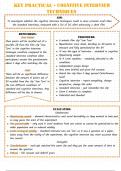
Key Practical - Cognitive Interview
Techniques
AIm:
To investigate whether the cognitive interview techniques result in more accurate recall than
the standard interviews, measured with a list of 20, after witnessing a short film.
Hypothesis:
One Tailed: Procedure:
More points will be recalled out of a 6 minute film clip ‘Sew Torn’
possible 20 from the film clip ‘Sew Quantitative score sheet, deciding on 20 points to
Torn’ in the cognitive interview measure and fully operationalise the DV
technique condition compared to the IV was the type of interview - standard or cognitive
standard interview condition when Opportunity sample
participants answer the questionnaire 16 A Level students - randomly allocated to the
about 5 days after watching the clip. conditions
Independent groups design
Null: Ppts were briefed and given full consent
There will be no significant difference Watch the clip then 5 days passed (interference
between the amount of points out of task)
20 recalled from the clip ‘Sew Torn’ in Cognitive interview - report everything, change
the two different conditions of perspective, change the order
standard and cognitive interviews. Any Standard interview - just remember the clip
difference will be due to chance. Given 6 minutes to complete
Debriefed and thanked
Evaluation:
Weaknesses:
Opportunity sample - demand characteristics and social desirability as they wanted to take part
so may guess the aims of the experiment
Not generalisable - only used A Level students from one school so cannot be generalised to the
wider population and so reduced validity
Lacks ecological validity - standard interview was not ‘live’ as it was a question on a paper,
takes away from the reality of the experiment, the cognitive interview was more accurate than
the control
Strengths:
Standardisation - each ppt watched the same clip and they got the same amount of time to
answer the question
Ethical - full consent and debrief given
Techniques
AIm:
To investigate whether the cognitive interview techniques result in more accurate recall than
the standard interviews, measured with a list of 20, after witnessing a short film.
Hypothesis:
One Tailed: Procedure:
More points will be recalled out of a 6 minute film clip ‘Sew Torn’
possible 20 from the film clip ‘Sew Quantitative score sheet, deciding on 20 points to
Torn’ in the cognitive interview measure and fully operationalise the DV
technique condition compared to the IV was the type of interview - standard or cognitive
standard interview condition when Opportunity sample
participants answer the questionnaire 16 A Level students - randomly allocated to the
about 5 days after watching the clip. conditions
Independent groups design
Null: Ppts were briefed and given full consent
There will be no significant difference Watch the clip then 5 days passed (interference
between the amount of points out of task)
20 recalled from the clip ‘Sew Torn’ in Cognitive interview - report everything, change
the two different conditions of perspective, change the order
standard and cognitive interviews. Any Standard interview - just remember the clip
difference will be due to chance. Given 6 minutes to complete
Debriefed and thanked
Evaluation:
Weaknesses:
Opportunity sample - demand characteristics and social desirability as they wanted to take part
so may guess the aims of the experiment
Not generalisable - only used A Level students from one school so cannot be generalised to the
wider population and so reduced validity
Lacks ecological validity - standard interview was not ‘live’ as it was a question on a paper,
takes away from the reality of the experiment, the cognitive interview was more accurate than
the control
Strengths:
Standardisation - each ppt watched the same clip and they got the same amount of time to
answer the question
Ethical - full consent and debrief given


