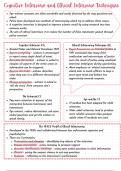
Cognitive Interview and Ethical Interview Techniques
Eye-witness accounts are often unreliable and easily distorted by the way questions are
asked.
Police have developed new methods of interviewing which try to address these issues.
A cognitive interview is designed to improve witness recall by using research into how
memory works,
The aim of ethical interviews it to reduce the number of false statements gained through
police coercion.
Cognitive Interview (CI): Ethical Interviewing Techniques (EI):
Ronald Fisher and Edward Geiselman 1992 Royal Commission on Criminal Justice in
Report everything - witness is encouraged 1991 concluded that many false
to report every single detail of event. confessions and miscarriages of justice
Reinstate the context - witness is asked to were the result of police using unethical
imagine all aspects of the crime scene so interview techniques during questioning.
information can be triggered. More emphasis on ‘ethical interviewing’
Reverse the order - witness describes which aims to teach officers to keep a
what they saw in a different chronological more open mind and behave less
order. aggressively towards suspects.
Change perspective - witness is asked to
‘tell the story’ from someone else’s
perspective.
The Enhanced CI:
Pay more attention to aspects of the Age and the CI:
interaction between interviewer and CI method has been adapted for child
interviewee. witnesses.
Eye contact, reduce distractions, ask open Older adult witnesses tend to produce
ended questions and get the witness to more reliable accounts than younger
speak slowly. adults when CI methods are used.
The PEACE Model of Ethical Interviewing:
Developed in the 1990s and collaborated between law enforcement agencies and
psychologists.
There are 5 principles:
Preparation and planning - identifying key objects of the interview
Engage and explain - active listening to promote rapport
Account, clarification, challenge - using open ended questions to elicit information
Closure - giving the suspect chance to ask any questions
Evaluate - reflecting on the interviewer's performance
Eye-witness accounts are often unreliable and easily distorted by the way questions are
asked.
Police have developed new methods of interviewing which try to address these issues.
A cognitive interview is designed to improve witness recall by using research into how
memory works,
The aim of ethical interviews it to reduce the number of false statements gained through
police coercion.
Cognitive Interview (CI): Ethical Interviewing Techniques (EI):
Ronald Fisher and Edward Geiselman 1992 Royal Commission on Criminal Justice in
Report everything - witness is encouraged 1991 concluded that many false
to report every single detail of event. confessions and miscarriages of justice
Reinstate the context - witness is asked to were the result of police using unethical
imagine all aspects of the crime scene so interview techniques during questioning.
information can be triggered. More emphasis on ‘ethical interviewing’
Reverse the order - witness describes which aims to teach officers to keep a
what they saw in a different chronological more open mind and behave less
order. aggressively towards suspects.
Change perspective - witness is asked to
‘tell the story’ from someone else’s
perspective.
The Enhanced CI:
Pay more attention to aspects of the Age and the CI:
interaction between interviewer and CI method has been adapted for child
interviewee. witnesses.
Eye contact, reduce distractions, ask open Older adult witnesses tend to produce
ended questions and get the witness to more reliable accounts than younger
speak slowly. adults when CI methods are used.
The PEACE Model of Ethical Interviewing:
Developed in the 1990s and collaborated between law enforcement agencies and
psychologists.
There are 5 principles:
Preparation and planning - identifying key objects of the interview
Engage and explain - active listening to promote rapport
Account, clarification, challenge - using open ended questions to elicit information
Closure - giving the suspect chance to ask any questions
Evaluate - reflecting on the interviewer's performance