
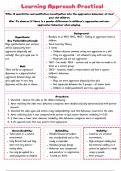
Learning Approach Practical
Title: A quantative and qualitative investigation into the aggressive behaviour of four
year old children.
Aim: To observe if there is a gender difference in children’s aggression and non-
aggressive behaviour when playing.
Background:
Hypothesis: Bandura et al 1961. 1963, 1965 - looking at aggression levels in
One Tailed (Directional): children.
Boys aged between four and five Social Learning Theory.
will be significantly more 3 rooms:
aggressive (physically and Children observe someone acting out aggression on a doll
verbally) than girls aged four to They are aggravated - not allowed to play with new toys
five. Playroom and act out aggression
1961 - live model. 1963 - cartoon and tv and then no model in all
Null: three as a control group.
There will be no significant 1965 - examines model’s reinforcement and how it affects
difference in a physical/verbal children’s behaviour.
aggression between boys and Findings:
girls aged four to five. Any Boys are more aggressive physically than girls
difference will be due to chance. Not significant between the 3 groups - all similar levels
Children in model punishment were less aggressive
Procedure:
1. Watched - observe the video of the children behaving.
2. After watching the video once, behaviour categories were decided and fully operationalised with partner
research.
3. Watched the video again and noted a tally (independently) each time behaviour occurred in the video.
4. After collecting data it was compared with partner to gain water-observer reliability (r=0.8).
5. If there was a lower inter-observer reliability, then behaviour categories were re-negotiated.
6. A chi squared stats test was used to test significance.
Generalisability: Reliability: Validity:
Taken place in a natural Reliable because procedure Cameras are artificial
environment. was standardised and so the environment.
Only British kids and they study is replicable. High ecological validity but
were not very diverse - Individual groups design. low external validity as it
mainly white. Behaviour was categorised cannot be applied to a wide
Can only be applied to a and paired for re-negotiation. range of people.
small population of children. Tested for 80%. Peer pressure .
Title: A quantative and qualitative investigation into the aggressive behaviour of four
year old children.
Aim: To observe if there is a gender difference in children’s aggression and non-
aggressive behaviour when playing.
Background:
Hypothesis: Bandura et al 1961. 1963, 1965 - looking at aggression levels in
One Tailed (Directional): children.
Boys aged between four and five Social Learning Theory.
will be significantly more 3 rooms:
aggressive (physically and Children observe someone acting out aggression on a doll
verbally) than girls aged four to They are aggravated - not allowed to play with new toys
five. Playroom and act out aggression
1961 - live model. 1963 - cartoon and tv and then no model in all
Null: three as a control group.
There will be no significant 1965 - examines model’s reinforcement and how it affects
difference in a physical/verbal children’s behaviour.
aggression between boys and Findings:
girls aged four to five. Any Boys are more aggressive physically than girls
difference will be due to chance. Not significant between the 3 groups - all similar levels
Children in model punishment were less aggressive
Procedure:
1. Watched - observe the video of the children behaving.
2. After watching the video once, behaviour categories were decided and fully operationalised with partner
research.
3. Watched the video again and noted a tally (independently) each time behaviour occurred in the video.
4. After collecting data it was compared with partner to gain water-observer reliability (r=0.8).
5. If there was a lower inter-observer reliability, then behaviour categories were re-negotiated.
6. A chi squared stats test was used to test significance.
Generalisability: Reliability: Validity:
Taken place in a natural Reliable because procedure Cameras are artificial
environment. was standardised and so the environment.
Only British kids and they study is replicable. High ecological validity but
were not very diverse - Individual groups design. low external validity as it
mainly white. Behaviour was categorised cannot be applied to a wide
Can only be applied to a and paired for re-negotiation. range of people.
small population of children. Tested for 80%. Peer pressure .


