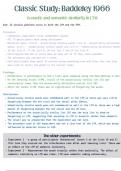
Classic Study: Baddeley 1966
Acoustic and semantic similarity in LTM
Aim: If similar patterns occur in both the LTM and the STM.
Procedure:
Laboratory experiment using independent groups
All 75 participants were young servicemen
Materials were: List A - acoustically similar words, List B - acoustically dissimilar
words, List C - semantically similar words and List D - semantically dissimilar words.
18 for list A, 17 for list B, 20 for list C and 20 for list D.
Participants had 40s to write down as many out of 10 they could remember.
The procedure was carried out 4 times.
Each participant then spent 20 minutes doing something else and after the time they
were told to recall the words in the correct order.
Findings:
Differences is performance on the 4 lists were compared using the Mann-Whitney U test.
On the learning trials (STM), recall of the acoustically similar list (A) was
consistently lower than the acoustically dissimilar control list (B).
After the recall (LTM) there was no significance of forgetting the words.
Conclusions:
Acoustically similar words were remembered well in the LTM as there was very little
forgetting between the 4th trial and the recall after 20mins.
Semantically similar words were not remembered as well in the LTM as there was a high
amount of forgetting between the 4th recall and the 20 mins.
Performance on the acoustically similar list (A) was the only list to show no
forgetting in LTM, suggesting that encoding in LTM is acoustic rather than semantic.
The result was so unexpected that the experiment was not over.
The procedure used in the experiment was not a true test of the LTM, which was being
influenced by material stores in STM.
The other experiments:
Experiment 2 - a group of participants (housewives) learnt 2 of the lists (A and C).
This time they carried out the interference task after each learning trial. There was
an effect on the LTM of semantic similarity.
Experiment 3 - Represented the words visually rather than auditorily. The effect of
semantic similarity on LTM was clear. LTM uses semantic coding extensively.
Acoustic and semantic similarity in LTM
Aim: If similar patterns occur in both the LTM and the STM.
Procedure:
Laboratory experiment using independent groups
All 75 participants were young servicemen
Materials were: List A - acoustically similar words, List B - acoustically dissimilar
words, List C - semantically similar words and List D - semantically dissimilar words.
18 for list A, 17 for list B, 20 for list C and 20 for list D.
Participants had 40s to write down as many out of 10 they could remember.
The procedure was carried out 4 times.
Each participant then spent 20 minutes doing something else and after the time they
were told to recall the words in the correct order.
Findings:
Differences is performance on the 4 lists were compared using the Mann-Whitney U test.
On the learning trials (STM), recall of the acoustically similar list (A) was
consistently lower than the acoustically dissimilar control list (B).
After the recall (LTM) there was no significance of forgetting the words.
Conclusions:
Acoustically similar words were remembered well in the LTM as there was very little
forgetting between the 4th trial and the recall after 20mins.
Semantically similar words were not remembered as well in the LTM as there was a high
amount of forgetting between the 4th recall and the 20 mins.
Performance on the acoustically similar list (A) was the only list to show no
forgetting in LTM, suggesting that encoding in LTM is acoustic rather than semantic.
The result was so unexpected that the experiment was not over.
The procedure used in the experiment was not a true test of the LTM, which was being
influenced by material stores in STM.
The other experiments:
Experiment 2 - a group of participants (housewives) learnt 2 of the lists (A and C).
This time they carried out the interference task after each learning trial. There was
an effect on the LTM of semantic similarity.
Experiment 3 - Represented the words visually rather than auditorily. The effect of
semantic similarity on LTM was clear. LTM uses semantic coding extensively.