Exam 1)NUR 101 Exam 1: NUR 101 Exam 1 Questions & Answers: Complete Solution: : Latest Updated
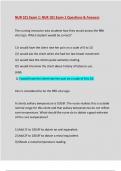
The nursing instructor asks students how they would assess the fifth vital sign. Which student would be correct? 1) I would have the client rate her pain on a scale of 0 to 10. 2) I would ask the client when she had her last bowel movement. 3) I would take the clients pulse oximetry reading. 4) I would interview the client about history of tobacco use. (ANS: 1) I would have the client rate her pain on a scale of 0 to 10. Pain is considered to be the fifth vital sign. A clients axillary temperature is 100.8F. The nurse realizes this is outside normal range for this client and that axillary temperatures do not reflect core temperature. What should the nurse do to obtain a good estimate of the core temperature? 1) Add 1F to 100.8F to obtain an oral equivalent. 2) Add 2F to 100.8F to obtain a rectal equivalent. 3) Obtain a rectal temperature reading.4) Obtain a tympanic membrane reading. (ANS: 3) Obtain a rectal temperature reading. Body temperatures, from lowest to highest, are axillary, oral, rectal, and tympanic. For oral, axillary, and rectal temperatures, there is a 1F degree difference between each site and the next higher one. However, mathematical conversions between sites are not reliable and should be used only when a rough estimate is needed for instance, to decide whether a reading needs to be validated by another site or another thermometer. Rectal temperatures are most reliable and most accurately reflect the core temperature. Tympanic membrane readings are considered by most to be the least accurate and least reliable. In caring for a client who has a fever, it would be important for the nurse to monitor for increased 1) Urine output 2) Sensitivity to pain 3) Blood pressure 4) Respiratory rate (ANS: 4) Respiratory rate The metabolic rate increases with a fever, increasing a persons respiratory rate. Urine output would more likely decrease, rather thanincrease, because of increased insensible loss and possible loss of intake because of loss of appetite. Change in pain sensation is not a symptom of a fever. Blood pressure is more likely to decrease with a fever because of peripheral vasodilation.
Written for
- Institution
-
Fortis College Of Nursing
- Course
-
NUR 101
Document information
- Uploaded on
- June 12, 2025
- Number of pages
- 154
- Written in
- 2024/2025
- Type
- Exam (elaborations)
- Contains
- Questions & answers
Subjects
-
the nursing instructor asks students how they woul
-
a clients axillary temperature is 1008f the nurs
-
the nurse is teaching a client how to use a portab

Also available in package deal