

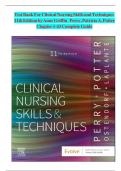
Test Bank For Clinical Nursing Skills and Techniques
q q q q q q q q
11th Edition by Anne Griffin Perry, Patricia A. Potter
q q q q q q q q q q
Chapter 1-43 Complete Guide
q q q q
,Test Bank For Clinical Nursing Skills and Techniques 11th Edition by Anne Griffin
q q q q q q q q q q q q q
Perry, Patricia A. Potter Chapter 1-43 Complete Guide
q q q q q q q q
Table Of Content
q q
Chapter 1. Using Evidence in Nursing Practice
q q q q q q
Chapter 2. Communication and Collaboration
q q q q q
Chapter 3. Admitting, Transfer, and Discharge
q q q q q q
Chapter 4. Documentation and Informatics
q q q q q
Chapter 5. Vital Signs
q q q q
Chapter 6. Health Assessment
q q q
Chapter 7. Specimen Collection
q q q q
Chapter 8. Diagnostic Procedures
q q q q
Chapter 9. Medical Asepsis
q q q q
Chapter 10. Sterile Technique
q q q q
Chapter 11. Safe Patient Handling and Mobility (SPHM)
q q q q q q q
Chapter 12. Exercise and Mobility
q q q q q
Chapter 13. Support Surfaces and Special Beds
q q q q q q
Chapter 14. Patient Safety
q q q q
Chapter 15. Disaster Preparedness
q q q
Chapter 16. Pain Management
q q q q
Chapter 17. End-of-Life Care
q q q q
Chapter 18. Personal Hygiene and Bed Making
q q q q q q
Chapter 19. Care of the Eye and Ear
q q q q q q q q
Chapter 20. Safe Medication Preparation
q q q q
Chapter 21. Nonparenteral Medications
q q q q
Chapter 22. Parenteral Medications
q q q q
Chapter 23. Oxygen Therapy
q q q q
Chapter 24. Performing Chest Physiotherapy
q q q q
Chapter 25. Airway Management
q q q q
Chapter 26. Cardiac Care
q q q
Chapter 27. Closed Chest Drainage Systems
q q q q q
Chapter 28. Emergency Measures for Life Support
q q q q q q q
Chapter 29. Intravenous and Vascular Access Therapy
q q q q q q
Chapter 30. Blood Therapy
q q q q
Chapter 31. Oral Nutrition
q q q
Chapter 32. Enteral Nutrition
q q q q
Chapter 33. Parenteral Nutrition
q q q q
Chapter 34. Urinary Elimination
q q q q
Chapter 35. Bowel Elimination and Gastric Intubation
q q q q q q
Chapter 36. Ostomy Care
q q q q
Chapter 37. Preoperative and Postoperative Care
q q q q q
Chapter 38. Intraoperative Care
q q q q
Chapter 39. Wound Care and Irrigations
q q q q q
Chapter 40. Impaired Skin Integrity Prevention and Care
q q q q q q q
Chapter 41. Dressings, Bandages, and Binders
q q q q q q
Chapter 42. Home Care Safety
q q q q
Chapter 43. Home Care Teaching
q q q q q
,Chapter 01: Using Evidence in Nursing Practice
q q q q q q
Perry et al.: Clinical Nursing Skills & Techniques, 11th Edition
q q q q q q q q q
MULTIPLE CHOICE q
1. Evidence-based practice is a problem-solving approach to making decisions about patient care
q q q q q q q q q q q
that is grounded in:
q q q q
a. the latest information found in textbooks.
q q q q q
b. systematically conducted research studies. q q q
c. tradition in clinical practice. q q q
d. quality improvement and risk-management data.q q q q
ANSWER: B q
The best evidence comes from well-designed, systematically conducted research studies
q q q q q q q q q
described in scientific journals. Portions of a textbook often become outdated by the time it is
q q q q q q q q q q q q q q q q
published. Many health care settings do not have a process to help staff adopt new evidence in
q q q q q q q q q q q q q q q q q
practice, and nurses in practice settings lack easy access to risk-management data, relying
q q q q q q q q q q q q q
instead on tradition or convenience. Some sources of evidence do not originate from research.
q q q q q q q q q q q q q q
These include quality improvement and risk-management data; infection control data;
q q q q q q q q q q
retrospective or concurrent chart reviews; and clinicians‘ expertise. Although
q q q q q q q q q
non–research-based evidence is often very valuable, it is important that you learn to rely more q q q q q q q q q q q q q q
on research-based evidence.
q q q
DIF: CognitiveLevel: Comprehension OBJ: Discuss the benefits of evidence-based practice. q q q q q q q
TOP: Evidence-Based Practice
q q KEY: Nursing Process Step: Assessment q q q q q
MSC: NCLEX: Safe and Effective Care Environment (management of care)
q q q q q q q q q
2. When evidence-based practice is used, patient care will be:
q q q q q q q q
a. standardized for all. q q
b. unhampered by patient culture. q q q
c. variable according to the situation. q q q q
d. safe from the hazards of critical thinking.
q q q q q q
ANSWER: C q
Using your clinical expertise and considering patients‘ cultures, values, and preferences
q q q q q q q q q q
ensures that you will apply available evidence in practice ethically and appropriately. Even
q q q q q q q q q q q q q
when you use the best evidence available, application and outcomes will differ; as a nurse,
q q q q q q q q q q q q q q q
you will develop critical thinking skills to determine whether evidence is relevant and
q q q q q q q q q q q q q
appropriate.
q
DIF: CognitiveLevel: Application OBJ: Discuss the benefits of evidence-based practice. q q q q q q q
TOP: Evidence-Based Practice
q q KEY: Nursing Process Step: Assessment q q q q q
MSC: NCLEX: Safe and Effective Care Environment (management of care)
q q q q q q q q q
3. When a PICOT question is developed, the letter that corresponds with the usual standard of
q q q q q q q q q q q q q q
care is:
q q
a. P.
b. I.
c.
, c. CHOICE BLANK q
d. O.
ANSWER: C q
C = Comparison of interest. What standard of care or current intervention do you usually use
q q q q q q q q q q q q q q q
now in practice?
q q q
P = Patient population of interest. Identify your patient by age, gender, ethnicity, disease, or
q q q q q q q q q q q q q q
health problem.
q q
I = Intervention of interest. What intervention (e.g., treatment, diagnostic test, and prognostic
q q q q q q q q q q q q
factor) do you think is worthwhile to use in practice?
q q q q q q q q q q
O = Outcome. What result (e.g., change in patient‘s behavior, physical finding, and change in
q q q q q q q q q q q q q q
patient‘s perception) do you wish to achieve or observe as the result of an intervention?
q q q q q q q q q q q q q q q
DIF: CognitiveLevel: Knowledge OBJ: Develop a PICO question. q q q q q
TOP: PICO
q KEY: Nursing Process Step: Implementation
q q q q q
MSC: NCLEX: Safe and Effective Care Environment (management of care)
q q q q q q q q q
4. A well-developed PICOT question helps the nurse:
q q q q q q
a. search for evidence. q q
b. include all five elements of the sequence. q q q q q q
c. find as many articles as possible in a literature search.
q q q q q q q q q
d. accept standard clinical routines. q q q
ANSWER: A q
The more focused a question that you ask is, the easier it is to search for evidence in the
q q q q q q q q q q q q q q q q q q
scientific literature. A well-designed PICOT question does not have to include all five
q q q q q q q q q q q q q
elements, nor does it have to follow the PICOT sequence. Do not be satisfied with clinical
q q q q q q q q q q q q q q q q
routines. Always question and use critical thinking to consider better ways to provide patient
q q q q q q q q q q q q q q
care.
q
DIF: CognitiveLevel: Analysis OBJ: Describe the six steps of evidence-based practice. q q q q q q q q
TOP: Evidence-Based Practice
q q KEY: Nursing Process Step: Implementation q q q q q
MSC: NCLEX: Safe and Effective Care Environment (management of care)
q q q q q q q q q
5. The nurse is not sure that the procedure the patient requires is the best possible for the
q q q q q q q q q q q q q q q q
situation. Utilizing which of the following resources would be the quickest way to review
q q q q q q q q q q q q q q
research on the topic?
q q q q
a. CINAHL
b. PubMed
c. MEDLINE
d. The Cochrane Database q q
ANSWER: D q
The Cochrane Community Database of Systematic Reviews is a valuable source of
q q q q q q q q q q q
synthesized evidence (i.e., pre-appraised evidence). The Cochrane Database includes the full
q q q q q q q q q q q
text of regularly updated systematic reviews and protocols for reviews currently happening.
q q q q q q q q q q q q
MEDLINE, CINAHL, and PubMed are among the most comprehensive databases and
q q q q q q q q q q q
represent the scientific knowledge base of health care.
q q q q q q q q
DIF: CognitiveLevel: Synthesis OBJ: Describe the six steps of evidence-based practice. q q q q q q q q
TOP: Evidence-Based Practice
q q KEY: Nursing Process Step: Implementation q q q q q
MSC: NCLEX: Safe and Effective Care Environment (management of care)
q q q q q q q q q
q q q q q q q q
11th Edition by Anne Griffin Perry, Patricia A. Potter
q q q q q q q q q q
Chapter 1-43 Complete Guide
q q q q
,Test Bank For Clinical Nursing Skills and Techniques 11th Edition by Anne Griffin
q q q q q q q q q q q q q
Perry, Patricia A. Potter Chapter 1-43 Complete Guide
q q q q q q q q
Table Of Content
q q
Chapter 1. Using Evidence in Nursing Practice
q q q q q q
Chapter 2. Communication and Collaboration
q q q q q
Chapter 3. Admitting, Transfer, and Discharge
q q q q q q
Chapter 4. Documentation and Informatics
q q q q q
Chapter 5. Vital Signs
q q q q
Chapter 6. Health Assessment
q q q
Chapter 7. Specimen Collection
q q q q
Chapter 8. Diagnostic Procedures
q q q q
Chapter 9. Medical Asepsis
q q q q
Chapter 10. Sterile Technique
q q q q
Chapter 11. Safe Patient Handling and Mobility (SPHM)
q q q q q q q
Chapter 12. Exercise and Mobility
q q q q q
Chapter 13. Support Surfaces and Special Beds
q q q q q q
Chapter 14. Patient Safety
q q q q
Chapter 15. Disaster Preparedness
q q q
Chapter 16. Pain Management
q q q q
Chapter 17. End-of-Life Care
q q q q
Chapter 18. Personal Hygiene and Bed Making
q q q q q q
Chapter 19. Care of the Eye and Ear
q q q q q q q q
Chapter 20. Safe Medication Preparation
q q q q
Chapter 21. Nonparenteral Medications
q q q q
Chapter 22. Parenteral Medications
q q q q
Chapter 23. Oxygen Therapy
q q q q
Chapter 24. Performing Chest Physiotherapy
q q q q
Chapter 25. Airway Management
q q q q
Chapter 26. Cardiac Care
q q q
Chapter 27. Closed Chest Drainage Systems
q q q q q
Chapter 28. Emergency Measures for Life Support
q q q q q q q
Chapter 29. Intravenous and Vascular Access Therapy
q q q q q q
Chapter 30. Blood Therapy
q q q q
Chapter 31. Oral Nutrition
q q q
Chapter 32. Enteral Nutrition
q q q q
Chapter 33. Parenteral Nutrition
q q q q
Chapter 34. Urinary Elimination
q q q q
Chapter 35. Bowel Elimination and Gastric Intubation
q q q q q q
Chapter 36. Ostomy Care
q q q q
Chapter 37. Preoperative and Postoperative Care
q q q q q
Chapter 38. Intraoperative Care
q q q q
Chapter 39. Wound Care and Irrigations
q q q q q
Chapter 40. Impaired Skin Integrity Prevention and Care
q q q q q q q
Chapter 41. Dressings, Bandages, and Binders
q q q q q q
Chapter 42. Home Care Safety
q q q q
Chapter 43. Home Care Teaching
q q q q q
,Chapter 01: Using Evidence in Nursing Practice
q q q q q q
Perry et al.: Clinical Nursing Skills & Techniques, 11th Edition
q q q q q q q q q
MULTIPLE CHOICE q
1. Evidence-based practice is a problem-solving approach to making decisions about patient care
q q q q q q q q q q q
that is grounded in:
q q q q
a. the latest information found in textbooks.
q q q q q
b. systematically conducted research studies. q q q
c. tradition in clinical practice. q q q
d. quality improvement and risk-management data.q q q q
ANSWER: B q
The best evidence comes from well-designed, systematically conducted research studies
q q q q q q q q q
described in scientific journals. Portions of a textbook often become outdated by the time it is
q q q q q q q q q q q q q q q q
published. Many health care settings do not have a process to help staff adopt new evidence in
q q q q q q q q q q q q q q q q q
practice, and nurses in practice settings lack easy access to risk-management data, relying
q q q q q q q q q q q q q
instead on tradition or convenience. Some sources of evidence do not originate from research.
q q q q q q q q q q q q q q
These include quality improvement and risk-management data; infection control data;
q q q q q q q q q q
retrospective or concurrent chart reviews; and clinicians‘ expertise. Although
q q q q q q q q q
non–research-based evidence is often very valuable, it is important that you learn to rely more q q q q q q q q q q q q q q
on research-based evidence.
q q q
DIF: CognitiveLevel: Comprehension OBJ: Discuss the benefits of evidence-based practice. q q q q q q q
TOP: Evidence-Based Practice
q q KEY: Nursing Process Step: Assessment q q q q q
MSC: NCLEX: Safe and Effective Care Environment (management of care)
q q q q q q q q q
2. When evidence-based practice is used, patient care will be:
q q q q q q q q
a. standardized for all. q q
b. unhampered by patient culture. q q q
c. variable according to the situation. q q q q
d. safe from the hazards of critical thinking.
q q q q q q
ANSWER: C q
Using your clinical expertise and considering patients‘ cultures, values, and preferences
q q q q q q q q q q
ensures that you will apply available evidence in practice ethically and appropriately. Even
q q q q q q q q q q q q q
when you use the best evidence available, application and outcomes will differ; as a nurse,
q q q q q q q q q q q q q q q
you will develop critical thinking skills to determine whether evidence is relevant and
q q q q q q q q q q q q q
appropriate.
q
DIF: CognitiveLevel: Application OBJ: Discuss the benefits of evidence-based practice. q q q q q q q
TOP: Evidence-Based Practice
q q KEY: Nursing Process Step: Assessment q q q q q
MSC: NCLEX: Safe and Effective Care Environment (management of care)
q q q q q q q q q
3. When a PICOT question is developed, the letter that corresponds with the usual standard of
q q q q q q q q q q q q q q
care is:
q q
a. P.
b. I.
c.
, c. CHOICE BLANK q
d. O.
ANSWER: C q
C = Comparison of interest. What standard of care or current intervention do you usually use
q q q q q q q q q q q q q q q
now in practice?
q q q
P = Patient population of interest. Identify your patient by age, gender, ethnicity, disease, or
q q q q q q q q q q q q q q
health problem.
q q
I = Intervention of interest. What intervention (e.g., treatment, diagnostic test, and prognostic
q q q q q q q q q q q q
factor) do you think is worthwhile to use in practice?
q q q q q q q q q q
O = Outcome. What result (e.g., change in patient‘s behavior, physical finding, and change in
q q q q q q q q q q q q q q
patient‘s perception) do you wish to achieve or observe as the result of an intervention?
q q q q q q q q q q q q q q q
DIF: CognitiveLevel: Knowledge OBJ: Develop a PICO question. q q q q q
TOP: PICO
q KEY: Nursing Process Step: Implementation
q q q q q
MSC: NCLEX: Safe and Effective Care Environment (management of care)
q q q q q q q q q
4. A well-developed PICOT question helps the nurse:
q q q q q q
a. search for evidence. q q
b. include all five elements of the sequence. q q q q q q
c. find as many articles as possible in a literature search.
q q q q q q q q q
d. accept standard clinical routines. q q q
ANSWER: A q
The more focused a question that you ask is, the easier it is to search for evidence in the
q q q q q q q q q q q q q q q q q q
scientific literature. A well-designed PICOT question does not have to include all five
q q q q q q q q q q q q q
elements, nor does it have to follow the PICOT sequence. Do not be satisfied with clinical
q q q q q q q q q q q q q q q q
routines. Always question and use critical thinking to consider better ways to provide patient
q q q q q q q q q q q q q q
care.
q
DIF: CognitiveLevel: Analysis OBJ: Describe the six steps of evidence-based practice. q q q q q q q q
TOP: Evidence-Based Practice
q q KEY: Nursing Process Step: Implementation q q q q q
MSC: NCLEX: Safe and Effective Care Environment (management of care)
q q q q q q q q q
5. The nurse is not sure that the procedure the patient requires is the best possible for the
q q q q q q q q q q q q q q q q
situation. Utilizing which of the following resources would be the quickest way to review
q q q q q q q q q q q q q q
research on the topic?
q q q q
a. CINAHL
b. PubMed
c. MEDLINE
d. The Cochrane Database q q
ANSWER: D q
The Cochrane Community Database of Systematic Reviews is a valuable source of
q q q q q q q q q q q
synthesized evidence (i.e., pre-appraised evidence). The Cochrane Database includes the full
q q q q q q q q q q q
text of regularly updated systematic reviews and protocols for reviews currently happening.
q q q q q q q q q q q q
MEDLINE, CINAHL, and PubMed are among the most comprehensive databases and
q q q q q q q q q q q
represent the scientific knowledge base of health care.
q q q q q q q q
DIF: CognitiveLevel: Synthesis OBJ: Describe the six steps of evidence-based practice. q q q q q q q q
TOP: Evidence-Based Practice
q q KEY: Nursing Process Step: Implementation q q q q q
MSC: NCLEX: Safe and Effective Care Environment (management of care)
q q q q q q q q q


