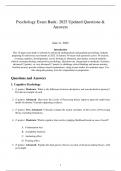
Psychology Exam Bank: 2025 Updated Questions &
Answers
June 11, 2025
Introduction
This 10-page exam bank is tailored for advanced undergraduate and graduate psychology students
preparing for university assessments in 2025. It features 50 exam-style questions across 10 sections,
covering cognitive, developmental, social, biological, abnormal, personality, research methods,
clinical, neuropsychology, and positive psychology. Questions are categorized as moderate (3 points),
advanced (5 points), or very advanced (7 points) to challenge critical thinking and ensure mastery.
Verified answers provide evidence-based explanations, citing recent studies for academic rigor. Use
this alongside primary texts for comprehensive preparation.
Questions and Answers
1. Cognitive Psychology
1. (3 points) Moderate: What is the difference between declarative and non-declarative memory?
Provide an example of each.
2. (5 points) Advanced: How does the Levels of Processing theory improve upon the multi-store
model of memory? Include supporting evidence.
3. (7 points) Very Advanced: Critically evaluate the neural correlates of the Levels of Processing
theory, including limitations.
4. (3 points) Moderate: Which cognitive bias involves judging likelihood based on ease of recall?
A. Confirmation bias
B. Availability heuristic
C. Anchoring effect
D. Framing effect
5. (5 points) Advanced: Explain the dual-process theorys account of decision-making biases, with
an example.
1
, 2. Developmental Psychology
1. (3 points) Moderate: What are two characteristics of Piagets concrete operational stage?
2. (5 points) Advanced: Compare Eriksons and Kohlbergs theories of development, focusing on
adolescence.
3. (7 points) Very Advanced: Evaluate the empirical support for Eriksons identity vs. role confu-
sion stage, including one critique.
4. (3 points) Moderate: What is the Zone of Proximal Development (ZPD)?
5. (5 points) Advanced: How does Vygotskys ZPD inform modern educational practices?
3. Social Psychology
1. (3 points) Moderate: Define the fundamental attribution error with an example.
2. (5 points) Advanced: Explain how the elaboration likelihood model (ELM) accounts for persua-
sion, with an example.
3. (7 points) Very Advanced: Critically assess the ELMs application in digital advertising, with
empirical evidence.
4. (3 points) Moderate: What is social loafing?
5. (5 points) Advanced: How does social identity theory explain group dynamics in organizations?
4. Biological Psychology
1. (3 points) Moderate: What is the primary function of the cerebellum?
2. (5 points) Advanced: Explain the role of the prefrontal cortex in executive functions, with sup-
porting evidence.
3. (7 points) Very Advanced: Critically evaluate the PFCs role in impulse control disorders, with
empirical evidence.
4. (3 points) Moderate: Which neurotransmitter is linked to mood regulation?
5. (5 points) Advanced: How does the HPA axis influence stress-related health outcomes?
Page 2
Answers
June 11, 2025
Introduction
This 10-page exam bank is tailored for advanced undergraduate and graduate psychology students
preparing for university assessments in 2025. It features 50 exam-style questions across 10 sections,
covering cognitive, developmental, social, biological, abnormal, personality, research methods,
clinical, neuropsychology, and positive psychology. Questions are categorized as moderate (3 points),
advanced (5 points), or very advanced (7 points) to challenge critical thinking and ensure mastery.
Verified answers provide evidence-based explanations, citing recent studies for academic rigor. Use
this alongside primary texts for comprehensive preparation.
Questions and Answers
1. Cognitive Psychology
1. (3 points) Moderate: What is the difference between declarative and non-declarative memory?
Provide an example of each.
2. (5 points) Advanced: How does the Levels of Processing theory improve upon the multi-store
model of memory? Include supporting evidence.
3. (7 points) Very Advanced: Critically evaluate the neural correlates of the Levels of Processing
theory, including limitations.
4. (3 points) Moderate: Which cognitive bias involves judging likelihood based on ease of recall?
A. Confirmation bias
B. Availability heuristic
C. Anchoring effect
D. Framing effect
5. (5 points) Advanced: Explain the dual-process theorys account of decision-making biases, with
an example.
1
, 2. Developmental Psychology
1. (3 points) Moderate: What are two characteristics of Piagets concrete operational stage?
2. (5 points) Advanced: Compare Eriksons and Kohlbergs theories of development, focusing on
adolescence.
3. (7 points) Very Advanced: Evaluate the empirical support for Eriksons identity vs. role confu-
sion stage, including one critique.
4. (3 points) Moderate: What is the Zone of Proximal Development (ZPD)?
5. (5 points) Advanced: How does Vygotskys ZPD inform modern educational practices?
3. Social Psychology
1. (3 points) Moderate: Define the fundamental attribution error with an example.
2. (5 points) Advanced: Explain how the elaboration likelihood model (ELM) accounts for persua-
sion, with an example.
3. (7 points) Very Advanced: Critically assess the ELMs application in digital advertising, with
empirical evidence.
4. (3 points) Moderate: What is social loafing?
5. (5 points) Advanced: How does social identity theory explain group dynamics in organizations?
4. Biological Psychology
1. (3 points) Moderate: What is the primary function of the cerebellum?
2. (5 points) Advanced: Explain the role of the prefrontal cortex in executive functions, with sup-
porting evidence.
3. (7 points) Very Advanced: Critically evaluate the PFCs role in impulse control disorders, with
empirical evidence.
4. (3 points) Moderate: Which neurotransmitter is linked to mood regulation?
5. (5 points) Advanced: How does the HPA axis influence stress-related health outcomes?
Page 2