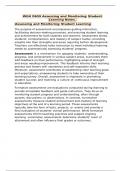
WGU D659 Assessing and Monitoring Student
Learning Notes.
Assessing and Monitoring Student Learning
The purpose of assessment encompasses guiding instruction,
facilitating decision-making processes, and ensuring student learning
and achievement for both students and teachers. Assessment shows
students' comprehension and mastery of subject matter, providing
insights into their strengths and areas requiring further development.
Teachers can effectively tailor instruction to meet individual learning
needs by systematically assessing students' progress.
Assessment is a mechanism for gauging students' understanding,
progress, and achievement in various subject areas. It provides them
with feedback on their performance, highlighting areas of strength
and areas needing improvement. This feedback informs their learning
process and fosters self- awareness and self-regulation skills.
Moreover, assessment contributes to establishing clear learning goals
and expectations, empowering students to take ownership of their
learning journey. Overall, assessment is important in promoting
student success and fostering a culture of continuous improvement
in education.
Formative assessments are evaluations conducted during learning to
provide immediate feedback and guide instruction. They focus on
monitoring student progress and understanding, often through
quizzes, discussions, or observations. In contrast, summative
assessments measure student achievement and mastery of learning
objectives at the end of a learning period. These assessments
typically take the form of tests, projects, or exams and provide a
final evaluation of students' overall performance. While formative
assessments inform teaching practices and support ongoing
learning, summative assessments determine students' level of
attainment and often influence final grades or outcomes.
,Assessment is a cornerstone in guiding decisions made by both
teachers and students in the classroom. Teachers rely on
assessment data to determine how to effectively engage students,
monitor their progress, and adapt instructional approaches. These
decisions occur frequently, from making swift adjustments during
lessons to planning for the entire academic year.
For example, within a single lesson, teachers may need to decide on
the pacing of instruction, assess student comprehension, and employ
various teaching methods within minutes. Additionally, teachers
make decisions between school days, such as identifying areas that
require further review or additional challenges based on student
performance, and throughout the school year, adjusting lessons and
support to meet evolving student needs.
The impact of these decisions can range from minor adjustments to
significant changes in teaching methodologies or curriculum
content. Teachers consider not only students' academic
achievements but also their emotional and social well-being when
making decisions. These decisions include:
•
o individual student needs,
o group dynamics,
o specific learning objectives,
o lesson planning,
o unit development, and
, o overall curriculum alignment.
Teachers continually question themselves on when to progress to the
next topic, how to support struggling students effectively, how to
structure future lessons based on assessment insights, and how to
enhance teaching methods to maintain student engagement.
The quality of these decisions heavily relies on the information gathered
from assessments. Assessments provide teachers with crucial data
regarding students' knowledge and skills, allowing them to identify
areas of proficiency requiring improvement. Teachers can effectively
tailor their instructional approaches to address their students' needs
by analyzing assessment data.
Furthermore, assessments enable teachers to monitor students'
progress, identify learning trends, and make informed decisions to
optimize student outcomes.
Assessment in education encompasses various approaches designed
to evaluate student learning and inform instructional practice.
These approaches fit into three main categories:
o assessment of learning
o assessment for learning
o assessment as learning
Assessment of learning, or summative assessment, takes place
at the end of a lesson or unit to see how much students have
learned. It usually involves tests, projects, or other activities that
show what students know and can do. Summative assessment helps
teachers evaluate student performance and decide how well they
have met the learning goals. It also helps teachers give grades and
feedback to students about their overall progress.
Assessment for learning, or formative assessment, is a way
for teachers to understand how well students learn as they teach. It
helps teachers decide what to teach next and how to teach it
better. By giving students feedback during lessons, teachers can
see where students are struggling and provide extra help or
different activities to support their learning.
Assessment as learning, or formative or diagnostic
assessment, is when students actively assess their learning
progress. This type of assessment happens at the beginning of a
lesson or unit, where students
, think about what they already know and need to learn. Through
self- assessment, students can set goals for themselves and
determine how to achieve them. This helps students become more
independent and take charge of their learning journey.
Learning Notes.
Assessing and Monitoring Student Learning
The purpose of assessment encompasses guiding instruction,
facilitating decision-making processes, and ensuring student learning
and achievement for both students and teachers. Assessment shows
students' comprehension and mastery of subject matter, providing
insights into their strengths and areas requiring further development.
Teachers can effectively tailor instruction to meet individual learning
needs by systematically assessing students' progress.
Assessment is a mechanism for gauging students' understanding,
progress, and achievement in various subject areas. It provides them
with feedback on their performance, highlighting areas of strength
and areas needing improvement. This feedback informs their learning
process and fosters self- awareness and self-regulation skills.
Moreover, assessment contributes to establishing clear learning goals
and expectations, empowering students to take ownership of their
learning journey. Overall, assessment is important in promoting
student success and fostering a culture of continuous improvement
in education.
Formative assessments are evaluations conducted during learning to
provide immediate feedback and guide instruction. They focus on
monitoring student progress and understanding, often through
quizzes, discussions, or observations. In contrast, summative
assessments measure student achievement and mastery of learning
objectives at the end of a learning period. These assessments
typically take the form of tests, projects, or exams and provide a
final evaluation of students' overall performance. While formative
assessments inform teaching practices and support ongoing
learning, summative assessments determine students' level of
attainment and often influence final grades or outcomes.
,Assessment is a cornerstone in guiding decisions made by both
teachers and students in the classroom. Teachers rely on
assessment data to determine how to effectively engage students,
monitor their progress, and adapt instructional approaches. These
decisions occur frequently, from making swift adjustments during
lessons to planning for the entire academic year.
For example, within a single lesson, teachers may need to decide on
the pacing of instruction, assess student comprehension, and employ
various teaching methods within minutes. Additionally, teachers
make decisions between school days, such as identifying areas that
require further review or additional challenges based on student
performance, and throughout the school year, adjusting lessons and
support to meet evolving student needs.
The impact of these decisions can range from minor adjustments to
significant changes in teaching methodologies or curriculum
content. Teachers consider not only students' academic
achievements but also their emotional and social well-being when
making decisions. These decisions include:
•
o individual student needs,
o group dynamics,
o specific learning objectives,
o lesson planning,
o unit development, and
, o overall curriculum alignment.
Teachers continually question themselves on when to progress to the
next topic, how to support struggling students effectively, how to
structure future lessons based on assessment insights, and how to
enhance teaching methods to maintain student engagement.
The quality of these decisions heavily relies on the information gathered
from assessments. Assessments provide teachers with crucial data
regarding students' knowledge and skills, allowing them to identify
areas of proficiency requiring improvement. Teachers can effectively
tailor their instructional approaches to address their students' needs
by analyzing assessment data.
Furthermore, assessments enable teachers to monitor students'
progress, identify learning trends, and make informed decisions to
optimize student outcomes.
Assessment in education encompasses various approaches designed
to evaluate student learning and inform instructional practice.
These approaches fit into three main categories:
o assessment of learning
o assessment for learning
o assessment as learning
Assessment of learning, or summative assessment, takes place
at the end of a lesson or unit to see how much students have
learned. It usually involves tests, projects, or other activities that
show what students know and can do. Summative assessment helps
teachers evaluate student performance and decide how well they
have met the learning goals. It also helps teachers give grades and
feedback to students about their overall progress.
Assessment for learning, or formative assessment, is a way
for teachers to understand how well students learn as they teach. It
helps teachers decide what to teach next and how to teach it
better. By giving students feedback during lessons, teachers can
see where students are struggling and provide extra help or
different activities to support their learning.
Assessment as learning, or formative or diagnostic
assessment, is when students actively assess their learning
progress. This type of assessment happens at the beginning of a
lesson or unit, where students
, think about what they already know and need to learn. Through
self- assessment, students can set goals for themselves and
determine how to achieve them. This helps students become more
independent and take charge of their learning journey.