🫡
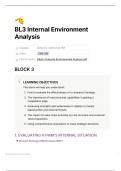
BL3 Internal Environment
Analysis
Created @April 2, 2025 9:22 PM
Class OBS 310
Files & media Block 3 Internal Environmental Analysis.pdf
BLOCK 3
💡 LEARNING OBJECTIVES
This block will help you understand:
1. How to evaluate the effectiveness of a company’s strategy.
2. The importance of resources and capabilities in gaining a
competitive edge.
3. Assessing strengths and weaknesses in relation to market
opportunities and external threats.
4. The impact of value chain activities on cost structure and customer
value proposition.
5. Using comprehensive evaluations to make strategic decisions.
1. EVALUATING A FIRM’S INTERNAL SITUATION
Present Strategy Effectiveness (NB)*
BL3 Internal Environment Analysis 1
, Indicators: Financial and strategic objectives achievement, above-average
financial performance, customer acquisition, and market share growth.
The three best indicators of how well a company’s strategy is working are:
Whether the company is achieving its stated financial and strategic
objectives
Whether its financial performance is above the industry average
Whether it is gaining customers and increasing its market share
Specific Indicators: Sales and earnings growth trends, stock price trends,
financial strength, customer retention rate, new customer acquisition rate,
internal process improvements.
Important Resources and Capabilities:
Competitive assets: Resources and capabilities.
Types of Resources: Tangible (physical, financial, technological,
organizational) and Intangible (human assets, intellectual capital, brand,
company image, relationships, company culture).
Capabilities: Proficiency in performing activities using resources.
Strengths and Weaknesses in Relation to Opportunities and Threats:
SWOT Analysis: Evaluates internal strengths, weaknesses, market
opportunities, and external threats.
Strengths: Competence, core competence, distinctive competence.
Weaknesses: Inferior skills, expertise, intellectual capital, deficiencies in
assets, missing capabilities.
Value Chain Activities Impact:
Value Chain: Identifies primary and support activities creating customer
value.
Competitive Strength: Prices and costs alignment with rivals, competitive
customer-value proposition, sustainable competitive advantage.
Benchmarking: Learning from other firms’ best practices to improve
internal activities.
BL3 Internal Environment Analysis 2
, Competitive Strength Assessment:
Steps: List key success factors, assign weights, score competitors, sum
weighted ratings, draw conclusions.
Implications: High scores indicate strong competitive position; low scores
indicate weaknesses.
Strategic Issues and Problems:
Priority Issues: Challenges from foreign competitors, price discounting,
cost reduction, growth sustainability, demographic changes.
Strategic Agenda: List of problems and roadblocks for managerial
attention.
Strategic Decisions: Expansion, repositioning, countering substitutes,
product line expansion, correcting deficiencies.
Q1 (NB!)
HOW WELL IS THE FIRM’S PRESENT STRATEGY WORKING?
The three best indicators of how well a company’s
strategy is working are:
1. Whether the company is achieving its stated financial and strategic
objectives
2. Whether its financial performance is above the industry average
3. Whether it is gaining customers and increasing its market share
💡 Components of a Single- Business Company’s Strategy
BL3 Internal Environment Analysis 3
BL3 Internal Environment
Analysis
Created @April 2, 2025 9:22 PM
Class OBS 310
Files & media Block 3 Internal Environmental Analysis.pdf
BLOCK 3
💡 LEARNING OBJECTIVES
This block will help you understand:
1. How to evaluate the effectiveness of a company’s strategy.
2. The importance of resources and capabilities in gaining a
competitive edge.
3. Assessing strengths and weaknesses in relation to market
opportunities and external threats.
4. The impact of value chain activities on cost structure and customer
value proposition.
5. Using comprehensive evaluations to make strategic decisions.
1. EVALUATING A FIRM’S INTERNAL SITUATION
Present Strategy Effectiveness (NB)*
BL3 Internal Environment Analysis 1
, Indicators: Financial and strategic objectives achievement, above-average
financial performance, customer acquisition, and market share growth.
The three best indicators of how well a company’s strategy is working are:
Whether the company is achieving its stated financial and strategic
objectives
Whether its financial performance is above the industry average
Whether it is gaining customers and increasing its market share
Specific Indicators: Sales and earnings growth trends, stock price trends,
financial strength, customer retention rate, new customer acquisition rate,
internal process improvements.
Important Resources and Capabilities:
Competitive assets: Resources and capabilities.
Types of Resources: Tangible (physical, financial, technological,
organizational) and Intangible (human assets, intellectual capital, brand,
company image, relationships, company culture).
Capabilities: Proficiency in performing activities using resources.
Strengths and Weaknesses in Relation to Opportunities and Threats:
SWOT Analysis: Evaluates internal strengths, weaknesses, market
opportunities, and external threats.
Strengths: Competence, core competence, distinctive competence.
Weaknesses: Inferior skills, expertise, intellectual capital, deficiencies in
assets, missing capabilities.
Value Chain Activities Impact:
Value Chain: Identifies primary and support activities creating customer
value.
Competitive Strength: Prices and costs alignment with rivals, competitive
customer-value proposition, sustainable competitive advantage.
Benchmarking: Learning from other firms’ best practices to improve
internal activities.
BL3 Internal Environment Analysis 2
, Competitive Strength Assessment:
Steps: List key success factors, assign weights, score competitors, sum
weighted ratings, draw conclusions.
Implications: High scores indicate strong competitive position; low scores
indicate weaknesses.
Strategic Issues and Problems:
Priority Issues: Challenges from foreign competitors, price discounting,
cost reduction, growth sustainability, demographic changes.
Strategic Agenda: List of problems and roadblocks for managerial
attention.
Strategic Decisions: Expansion, repositioning, countering substitutes,
product line expansion, correcting deficiencies.
Q1 (NB!)
HOW WELL IS THE FIRM’S PRESENT STRATEGY WORKING?
The three best indicators of how well a company’s
strategy is working are:
1. Whether the company is achieving its stated financial and strategic
objectives
2. Whether its financial performance is above the industry average
3. Whether it is gaining customers and increasing its market share
💡 Components of a Single- Business Company’s Strategy
BL3 Internal Environment Analysis 3