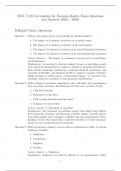
WGU C213 Accounting for Decision Makers Exam Questions
and Answers ()
Multiple-Choice Questions
Question 1: What is the primary focus of accounting for decision makers?
a. The impact of a business’s activities on its public image
b. The impact of a business’s activities on the environment
c. The impact of a business’s activities on its overall financial performance
d. The impact of a business’s activities on its relationships with customers
Correct Answer: c. The impact of a business’s activities on its overall finan-
cial performance
Explanation: Accounting for decision makers focuses on providing quanti-
tative financial information to evaluate a business’s financial performance.
This includes analyzing transactions, preparing financial statements, and
assessing profitability and financial health to support economic decisions,
unlike focusing on public image, environmental impact, or customer rela-
tionships, which are secondary or non-financial considerations.
Question 2: Which financial statement summarizes cash collections and expenditures
from operating, investing, and financing activities over a period of time?
a. Cash flow schedule
b. Statement of cash flows
c. Cash receipts and disbursements sheet
d. Summary of cash receipts
Correct Answer: b. Statement of cash flows
Explanation: The statement of cash flows reports cash inflows and outflows
from operating, investing, and financing activities during a specific period.
It provides insights into a company’s liquidity and cash management, distin-
guishing it from other reports like a cash flow schedule or receipts summary,
which are not standard financial statements.
Question 3: Which group has a primary concern with an organization’s ability to provide
healthcare benefits?
a. Employees
b. Competitors
c. Suppliers
d. Vendors
Correct Answer: a. Employees
Explanation: Employees are directly affected by an organization’s ability
1
, to provide healthcare benefits, as these benefits impact their compensation
and well-being. Competitors, suppliers, and vendors may be interested in the
company’s financial health but do not have a primary concern with employee
benefits.
Question 4: Which benefit does a corporation gain by following Generally Accepted Ac-
counting Principles (GAAP)?
a. A decrease in its income tax obligations
b. An increase in its comparability to other companies
c. A decrease in regulatory oversight
d. An increase in managerial flexibility
Correct Answer: b. An increase in its comparability to other companies
Explanation: GAAP provides a standardized framework for financial report-
ing, ensuring consistency and comparability across companies. This allows
investors and creditors to make informed comparisons. GAAP does not di-
rectly reduce tax obligations, regulatory oversight, or increase managerial
flexibility.
Question 5: Which organization has the legal authority to establish accounting standards
for publicly held companies in the United States?
a. Internal Revenue Service (IRS)
b. Financial Accounting Standards Board (FASB)
c. Securities and Exchange Commission (SEC)
d. Public Company Accounting Oversight Board (PCAOB)
Correct Answer: c. Securities and Exchange Commission (SEC)
Explanation: The SEC has the ultimate legal authority to set accounting
standards for publicly held companies in the U.S. While the FASB develops
GAAP, the SEC oversees and enforces its application for public companies.
The IRS handles tax regulations, and the PCAOB regulates audits, not
standards.
Question 6: Which financial statement reports a company’s assets, liabilities, and owners’
equity at a specific point in time?
a. Income statement
b. Statement of cash flows
c. Balance sheet
d. Statement of retained earnings
Correct Answer: c. Balance sheet
Explanation: The balance sheet provides a snapshot of a company’s financial
position at a specific point, detailing assets, liabilities, and owners’ equity.
The income statement reports revenues and expenses, the statement of cash
2
, flows tracks cash movements, and the statement of retained earnings shows
changes in retained earnings.
Question 7: Which financial statement reports the excess of a company’s revenues over
its expenses?
a. Balance sheet
b. Income statement
c. Statement of cash flows
d. Statement of retained earnings
Correct Answer: b. Income statement
Explanation: The income statement reports revenues, expenses, and the re-
sulting net income (revenues minus expenses) over a period. The balance
sheet shows financial position, the statement of cash flows tracks cash ac-
tivities, and the statement of retained earnings details changes in retained
earnings.
Question 8: Which of the following is NOT an external user of accounting information?
a. Management
b. Investors
c. Creditors
d. Regulators
Correct Answer: a. Management
Explanation: External users of accounting information include investors,
creditors, and regulators who rely on financial reports for decision-making.
Management, as an internal group, uses accounting information for planning
and control, not as an external user.
Question 9: What is the primary purpose of financial accounting?
a. To provide information for internal planning
b. To provide financial information to external users
c. To execute sales transactions
d. To manage employee benefits
Correct Answer: b. To provide financial information to external users
Explanation: Financial accounting focuses on preparing financial statements
for external users like investors and creditors to assess the company’s finan-
cial health. Internal planning is the domain of managerial accounting, while
sales transactions and employee benefits are operational tasks.
Question 10: Which body is the current standard-setting organization for financial ac-
counting in the United States?
a. International Accounting Standards Board (IASB)
3
and Answers ()
Multiple-Choice Questions
Question 1: What is the primary focus of accounting for decision makers?
a. The impact of a business’s activities on its public image
b. The impact of a business’s activities on the environment
c. The impact of a business’s activities on its overall financial performance
d. The impact of a business’s activities on its relationships with customers
Correct Answer: c. The impact of a business’s activities on its overall finan-
cial performance
Explanation: Accounting for decision makers focuses on providing quanti-
tative financial information to evaluate a business’s financial performance.
This includes analyzing transactions, preparing financial statements, and
assessing profitability and financial health to support economic decisions,
unlike focusing on public image, environmental impact, or customer rela-
tionships, which are secondary or non-financial considerations.
Question 2: Which financial statement summarizes cash collections and expenditures
from operating, investing, and financing activities over a period of time?
a. Cash flow schedule
b. Statement of cash flows
c. Cash receipts and disbursements sheet
d. Summary of cash receipts
Correct Answer: b. Statement of cash flows
Explanation: The statement of cash flows reports cash inflows and outflows
from operating, investing, and financing activities during a specific period.
It provides insights into a company’s liquidity and cash management, distin-
guishing it from other reports like a cash flow schedule or receipts summary,
which are not standard financial statements.
Question 3: Which group has a primary concern with an organization’s ability to provide
healthcare benefits?
a. Employees
b. Competitors
c. Suppliers
d. Vendors
Correct Answer: a. Employees
Explanation: Employees are directly affected by an organization’s ability
1
, to provide healthcare benefits, as these benefits impact their compensation
and well-being. Competitors, suppliers, and vendors may be interested in the
company’s financial health but do not have a primary concern with employee
benefits.
Question 4: Which benefit does a corporation gain by following Generally Accepted Ac-
counting Principles (GAAP)?
a. A decrease in its income tax obligations
b. An increase in its comparability to other companies
c. A decrease in regulatory oversight
d. An increase in managerial flexibility
Correct Answer: b. An increase in its comparability to other companies
Explanation: GAAP provides a standardized framework for financial report-
ing, ensuring consistency and comparability across companies. This allows
investors and creditors to make informed comparisons. GAAP does not di-
rectly reduce tax obligations, regulatory oversight, or increase managerial
flexibility.
Question 5: Which organization has the legal authority to establish accounting standards
for publicly held companies in the United States?
a. Internal Revenue Service (IRS)
b. Financial Accounting Standards Board (FASB)
c. Securities and Exchange Commission (SEC)
d. Public Company Accounting Oversight Board (PCAOB)
Correct Answer: c. Securities and Exchange Commission (SEC)
Explanation: The SEC has the ultimate legal authority to set accounting
standards for publicly held companies in the U.S. While the FASB develops
GAAP, the SEC oversees and enforces its application for public companies.
The IRS handles tax regulations, and the PCAOB regulates audits, not
standards.
Question 6: Which financial statement reports a company’s assets, liabilities, and owners’
equity at a specific point in time?
a. Income statement
b. Statement of cash flows
c. Balance sheet
d. Statement of retained earnings
Correct Answer: c. Balance sheet
Explanation: The balance sheet provides a snapshot of a company’s financial
position at a specific point, detailing assets, liabilities, and owners’ equity.
The income statement reports revenues and expenses, the statement of cash
2
, flows tracks cash movements, and the statement of retained earnings shows
changes in retained earnings.
Question 7: Which financial statement reports the excess of a company’s revenues over
its expenses?
a. Balance sheet
b. Income statement
c. Statement of cash flows
d. Statement of retained earnings
Correct Answer: b. Income statement
Explanation: The income statement reports revenues, expenses, and the re-
sulting net income (revenues minus expenses) over a period. The balance
sheet shows financial position, the statement of cash flows tracks cash ac-
tivities, and the statement of retained earnings details changes in retained
earnings.
Question 8: Which of the following is NOT an external user of accounting information?
a. Management
b. Investors
c. Creditors
d. Regulators
Correct Answer: a. Management
Explanation: External users of accounting information include investors,
creditors, and regulators who rely on financial reports for decision-making.
Management, as an internal group, uses accounting information for planning
and control, not as an external user.
Question 9: What is the primary purpose of financial accounting?
a. To provide information for internal planning
b. To provide financial information to external users
c. To execute sales transactions
d. To manage employee benefits
Correct Answer: b. To provide financial information to external users
Explanation: Financial accounting focuses on preparing financial statements
for external users like investors and creditors to assess the company’s finan-
cial health. Internal planning is the domain of managerial accounting, while
sales transactions and employee benefits are operational tasks.
Question 10: Which body is the current standard-setting organization for financial ac-
counting in the United States?
a. International Accounting Standards Board (IASB)
3