

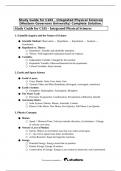
Study Guide for C165 - Integrated Physical Sciences
(Western Governors University) Complete Solution.
Study Guide for C165 - Integrated Physical Sciences
1. Scientific Inquiry and the Nature of Science
● Scientific Method: Observation → Hypothesis → Experiment → Analysis →
Conclusion.
● Hypothesis vs. Theory:
○ Hypothesis: Testable and falsifiable statement.
○ Theory: Well-supported explanation based on evidence.
● Variables:
○ Independent Variable: Changed by the scientist.
○ Dependent Variable: Observed/measured in the experiment.
○ Control Variables: Kept constant.
2. Earth and Space Science
● Earth's Layers:
○ Crust, Mantle, Outer Core, Inner Core.
○ Tectonic Plates and Plate Boundaries (divergent, convergent, transform).
● Earth's Systems:
○ Geosphere, Hydrosphere, Atmosphere, Biosphere.
● The Water Cycle:
○ Processes: Evaporation, Condensation, Precipitation, Infiltration, Runoff.
● Astronomy Basics:
○ Solar System: Planets, Moons, Asteroids, Comets.
○ Phases of the Moon: New Moon, First Quarter, Full Moon, Last Quarter.
3. Physics Concepts
● Motion:
○ Speed = Distance/Time; Velocity includes direction; Acceleration = Change
in velocity over time.
● Newton’s Laws of Motion:
○ Inertia: Objects at rest/motion stay that way unless acted upon.
○ F = ma: Force equals mass times acceleration.
○ Action-Reaction: Equal and opposite reactions.
● Energy:
○ Potential Energy: Energy stored due to position.
○ Kinetic Energy: Energy of motion.
○ Conservation of Energy: Energy is not created or destroyed, only transformed.
(Western Governors University) Complete Solution.
Study Guide for C165 - Integrated Physical Sciences
1. Scientific Inquiry and the Nature of Science
● Scientific Method: Observation → Hypothesis → Experiment → Analysis →
Conclusion.
● Hypothesis vs. Theory:
○ Hypothesis: Testable and falsifiable statement.
○ Theory: Well-supported explanation based on evidence.
● Variables:
○ Independent Variable: Changed by the scientist.
○ Dependent Variable: Observed/measured in the experiment.
○ Control Variables: Kept constant.
2. Earth and Space Science
● Earth's Layers:
○ Crust, Mantle, Outer Core, Inner Core.
○ Tectonic Plates and Plate Boundaries (divergent, convergent, transform).
● Earth's Systems:
○ Geosphere, Hydrosphere, Atmosphere, Biosphere.
● The Water Cycle:
○ Processes: Evaporation, Condensation, Precipitation, Infiltration, Runoff.
● Astronomy Basics:
○ Solar System: Planets, Moons, Asteroids, Comets.
○ Phases of the Moon: New Moon, First Quarter, Full Moon, Last Quarter.
3. Physics Concepts
● Motion:
○ Speed = Distance/Time; Velocity includes direction; Acceleration = Change
in velocity over time.
● Newton’s Laws of Motion:
○ Inertia: Objects at rest/motion stay that way unless acted upon.
○ F = ma: Force equals mass times acceleration.
○ Action-Reaction: Equal and opposite reactions.
● Energy:
○ Potential Energy: Energy stored due to position.
○ Kinetic Energy: Energy of motion.
○ Conservation of Energy: Energy is not created or destroyed, only transformed.


