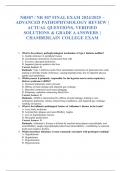
NR507 Final Exam NR 507 Week 8
Exam Advanced Pathophysiology Expected
Questions and Answers () (Verified
Answers) - Chamberlain AD
Question 1: What is the primary source of energy for Earth’s climate system?
A Solar radiation
B Geothermal heat
C Tidal forces
D Human activity
Answer: A
Rationale: Solar radiation is the primary source of energy for Earth’s climate
system, driving atmospheric and oceanic circulation, temperature gradients, and
weather patterns. Geothermal heat and tidal forces contribute minimally, while
human activity influences climate but is not the primary energy source.
Question 2: Which condition results from inadequate perfusion of tissues due to a sudden drop
in blood pressure?
A Hypertension
B Shock
C Edema
D Thrombosis
Answer: B
Rationale: Shock is a life-threatening condition characterized by inadequate tissue
perfusion due to a sudden drop in blood pressure, impairing oxygen and nutrient
delivery. Hypertension is elevated blood pressure, edema is fluid accumulation, and
thrombosis is clot formation.
Question 3: What is the hallmark feature of type 1 hypersensitivity reactions?
A Cytotoxic damage
B Immune complex deposition
C IgE-mediated response
D Delayed T-cell activation
Answer: C
Rationale: Type 1 hypersensitivity reactions, such as anaphylaxis, are mediated
by IgE antibodies binding to mast cells and basophils, triggering histamine release
and allergic symptoms. Cytotoxic damage (type 2), immune complexes (type 3),
and T-cell activation (type 4) define other hypersensitivity types.
Question 4: Which electrolyte imbalance is most commonly associated with prolonged vomiting?
1
, A Hyperkalemia
B Hypokalemia
C Hypernatremia
D Hyponatremia
Answer: B
Rationale: Prolonged vomiting leads to loss of gastric acid and potassium, causing
hypokalemia (low potassium). This can result in muscle weakness, arrhythmias,
and metabolic alkalosis. Hyperkalemia, hypernatremia, and hyponatremia are less
directly linked to vomiting.
Question 5: What is the primary cause of prerenal acute kidney injury?
A Direct tubular damage
B Reduced renal blood flow
C Ureteral obstruction
D Glomerular inflammation
Answer: B
Rationale: Prerenal acute kidney injury results from reduced renal blood flow,
often due to hypovolemia, hypotension, or heart failure, impairing kidney perfusion.
Tubular damage (intrarenal), obstruction (postrenal), and glomerular issues are
distinct causes.
Question 6: Which hormone is primarily responsible for regulating blood calcium levels?
A Insulin
B Cortisol
C Parathyroid hormone
D Thyroxine
Answer: C
Rationale: Parathyroid hormone (PTH) regulates blood calcium by increasing
bone resorption, renal calcium reabsorption, and vitamin D activation. Insulin
manages glucose, cortisol affects stress and metabolism, and thyroxine regulates
metabolism.
Question 7: What is the primary pathophysiological mechanism of pulmonary edema in heart
failure?
A Increased capillary permeability
B Elevated pulmonary venous pressure
C Reduced surfactant production
D Bronchial constriction
Answer: B
Rationale: In heart failure, impaired left ventricular function increases pulmonary
venous pressure, forcing fluid into alveoli and causing pulmonary edema. Permeabil-
ity issues, surfactant loss, and bronchial constriction are not primary mechanisms.
2
, Question 8: Which condition is characterized by irreversible dilation of the bronchi?
A Asthma
B Bronchiectasis
C Chronic bronchitis
D Emphysema
Answer: B
Rationale: Bronchiectasis involves irreversible bronchial dilation due to chronic
infection or inflammation, leading to mucus accumulation and recurrent infections.
Asthma is reversible, bronchitis involves inflammation, and emphysema affects alve-
oli.
Question 9: What is the primary trigger for the release of antidiuretic hormone (ADH)?
A Low blood glucose
B Increased plasma osmolality
C Elevated blood pressure
D Decreased body temperature
Answer: B
Rationale: Increased plasma osmolality, detected by hypothalamic osmoreceptors,
triggers ADH release to promote water reabsorption in the kidneys, concentrating
urine. Glucose, blood pressure, and temperature are not primary triggers.
Question 10: Which type of anemia is caused by vitamin B12 deficiency?
A Iron deficiency anemia
B Megaloblastic anemia
C Aplastic anemia
D Hemolytic anemia
Answer: B
Rationale: Megaloblastic anemia results from vitamin B12 or folate deficiency,
impairing DNA synthesis and producing large, immature red blood cells. Iron
deficiency causes microcytic anemia, aplastic anemia reduces cell production, and
hemolytic anemia involves RBC destruction.
Question 11: What is the primary site of hematopoiesis in adults?
A Liver
B Spleen
C Bone marrow
D Lymph nodes
Answer: C
Rationale: In adults, hematopoiesis primarily occurs in the bone marrow, produc-
ing red blood cells, white blood cells, and platelets. The liver and spleen are active
in fetuses, and lymph nodes produce lymphocytes.
3
Exam Advanced Pathophysiology Expected
Questions and Answers () (Verified
Answers) - Chamberlain AD
Question 1: What is the primary source of energy for Earth’s climate system?
A Solar radiation
B Geothermal heat
C Tidal forces
D Human activity
Answer: A
Rationale: Solar radiation is the primary source of energy for Earth’s climate
system, driving atmospheric and oceanic circulation, temperature gradients, and
weather patterns. Geothermal heat and tidal forces contribute minimally, while
human activity influences climate but is not the primary energy source.
Question 2: Which condition results from inadequate perfusion of tissues due to a sudden drop
in blood pressure?
A Hypertension
B Shock
C Edema
D Thrombosis
Answer: B
Rationale: Shock is a life-threatening condition characterized by inadequate tissue
perfusion due to a sudden drop in blood pressure, impairing oxygen and nutrient
delivery. Hypertension is elevated blood pressure, edema is fluid accumulation, and
thrombosis is clot formation.
Question 3: What is the hallmark feature of type 1 hypersensitivity reactions?
A Cytotoxic damage
B Immune complex deposition
C IgE-mediated response
D Delayed T-cell activation
Answer: C
Rationale: Type 1 hypersensitivity reactions, such as anaphylaxis, are mediated
by IgE antibodies binding to mast cells and basophils, triggering histamine release
and allergic symptoms. Cytotoxic damage (type 2), immune complexes (type 3),
and T-cell activation (type 4) define other hypersensitivity types.
Question 4: Which electrolyte imbalance is most commonly associated with prolonged vomiting?
1
, A Hyperkalemia
B Hypokalemia
C Hypernatremia
D Hyponatremia
Answer: B
Rationale: Prolonged vomiting leads to loss of gastric acid and potassium, causing
hypokalemia (low potassium). This can result in muscle weakness, arrhythmias,
and metabolic alkalosis. Hyperkalemia, hypernatremia, and hyponatremia are less
directly linked to vomiting.
Question 5: What is the primary cause of prerenal acute kidney injury?
A Direct tubular damage
B Reduced renal blood flow
C Ureteral obstruction
D Glomerular inflammation
Answer: B
Rationale: Prerenal acute kidney injury results from reduced renal blood flow,
often due to hypovolemia, hypotension, or heart failure, impairing kidney perfusion.
Tubular damage (intrarenal), obstruction (postrenal), and glomerular issues are
distinct causes.
Question 6: Which hormone is primarily responsible for regulating blood calcium levels?
A Insulin
B Cortisol
C Parathyroid hormone
D Thyroxine
Answer: C
Rationale: Parathyroid hormone (PTH) regulates blood calcium by increasing
bone resorption, renal calcium reabsorption, and vitamin D activation. Insulin
manages glucose, cortisol affects stress and metabolism, and thyroxine regulates
metabolism.
Question 7: What is the primary pathophysiological mechanism of pulmonary edema in heart
failure?
A Increased capillary permeability
B Elevated pulmonary venous pressure
C Reduced surfactant production
D Bronchial constriction
Answer: B
Rationale: In heart failure, impaired left ventricular function increases pulmonary
venous pressure, forcing fluid into alveoli and causing pulmonary edema. Permeabil-
ity issues, surfactant loss, and bronchial constriction are not primary mechanisms.
2
, Question 8: Which condition is characterized by irreversible dilation of the bronchi?
A Asthma
B Bronchiectasis
C Chronic bronchitis
D Emphysema
Answer: B
Rationale: Bronchiectasis involves irreversible bronchial dilation due to chronic
infection or inflammation, leading to mucus accumulation and recurrent infections.
Asthma is reversible, bronchitis involves inflammation, and emphysema affects alve-
oli.
Question 9: What is the primary trigger for the release of antidiuretic hormone (ADH)?
A Low blood glucose
B Increased plasma osmolality
C Elevated blood pressure
D Decreased body temperature
Answer: B
Rationale: Increased plasma osmolality, detected by hypothalamic osmoreceptors,
triggers ADH release to promote water reabsorption in the kidneys, concentrating
urine. Glucose, blood pressure, and temperature are not primary triggers.
Question 10: Which type of anemia is caused by vitamin B12 deficiency?
A Iron deficiency anemia
B Megaloblastic anemia
C Aplastic anemia
D Hemolytic anemia
Answer: B
Rationale: Megaloblastic anemia results from vitamin B12 or folate deficiency,
impairing DNA synthesis and producing large, immature red blood cells. Iron
deficiency causes microcytic anemia, aplastic anemia reduces cell production, and
hemolytic anemia involves RBC destruction.
Question 11: What is the primary site of hematopoiesis in adults?
A Liver
B Spleen
C Bone marrow
D Lymph nodes
Answer: C
Rationale: In adults, hematopoiesis primarily occurs in the bone marrow, produc-
ing red blood cells, white blood cells, and platelets. The liver and spleen are active
in fetuses, and lymph nodes produce lymphocytes.
3