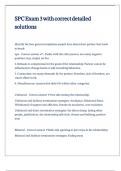
SPC Exam 3 with correct detailed| | | | | |
solutions
Identify the four general complaints people have about their partner that leads
| | | | | | | | | | | |
to break-
|
ups - Correct answer ✔1. Faults with the other person, too many negative
| | | | | | | | | | | | |
qualities: lazy, stupid, no fun. | | | | |
2. Refusals to compromise for the good of the relationship. Partner cannot be
| | | | | | | | | | | | |
influenced to change faults or add rewarding behaviors.
| | | | | | |
3. Constraints: too many demands by the partner: boredom, lack of freedom, too
| | | | | | | | | | | |
much effort/work.
| | |
4. Miscellaneous: reasons that didn't fit within other categories.
| | | | | | | |
Unilateral - Correct answer ✔One side ending the relationship.
| | | | | | | |
Unilateral and Indirect termination strategies: Avoidance, Relational Rues,
| | | | | | | |
Withdrawal of support and affection, Pseudo de escalation, cost escalation
| | | | | | | | |
Unilateral and direct termination strategies: the direct dump, dating other
| | | | | | | | | |
people, justification, the relationship talk trick, threats and bullying, positive
| | | | | | | | | |
tone
Bilateral - Correct answer ✔Both side agreeing to part ways in the relationship.
| | | | | | | | | | | |
Bilateral and Indirect termination strategies: Fading away
| | | | | |
, Bilateral and Direct termination strategies: the blame game, the negotiated
| | | | | | | | | |
farewell
"The four horseman of the apocalypse of the marriage" - Correct answer
| | | | | | | | | | | |
✔Criticism, Defensiveness, Contempt, and Stonewalling | | | |
What is the divorce rate for first marriages and is it higher or lower for second
| | | | | | | | | | | | | | | |
marriages? - Correct answer ✔50% in first marriages and divorce rates are
| | | | | | | | | | | |
higher in second marriage.
| | | |
40% for individuals 18-19 and 24% individuals older than 25
| | | | | | | | |
Identify and describe Gottman's Cascade Model of
| | | | | | |
divorce - Correct answer ✔1. physiological responses: decline in marital
| | | | | | | | | |
satisfaction
2. flooding and negative sentiment override: consideration of separation
| | | | | | | |
3. recasting history of marriage and considering alternatives: separating and
| | | | | | | | | |
thinking about divorce | |
4. divorce
|
Identify behaviors associated with the communication of Distance and
| | | | | | | | |
Dissociation - Correct answer ✔Distance: avoidance (no longer talking like
| | | | | | | | | |
friends, no compliments, admiration, understanding decrease, avoidance)
| | | | | |
Dissociation: emphasizing individuality, | |
no longer using pet names/shortcuts,
| | | |
showing interest in activities that deviates from the relationship norm,
| | | | | | | | | |
diverging from normal communication/behavioral techniques
| | | |
solutions
Identify the four general complaints people have about their partner that leads
| | | | | | | | | | | |
to break-
|
ups - Correct answer ✔1. Faults with the other person, too many negative
| | | | | | | | | | | | |
qualities: lazy, stupid, no fun. | | | | |
2. Refusals to compromise for the good of the relationship. Partner cannot be
| | | | | | | | | | | | |
influenced to change faults or add rewarding behaviors.
| | | | | | |
3. Constraints: too many demands by the partner: boredom, lack of freedom, too
| | | | | | | | | | | |
much effort/work.
| | |
4. Miscellaneous: reasons that didn't fit within other categories.
| | | | | | | |
Unilateral - Correct answer ✔One side ending the relationship.
| | | | | | | |
Unilateral and Indirect termination strategies: Avoidance, Relational Rues,
| | | | | | | |
Withdrawal of support and affection, Pseudo de escalation, cost escalation
| | | | | | | | |
Unilateral and direct termination strategies: the direct dump, dating other
| | | | | | | | | |
people, justification, the relationship talk trick, threats and bullying, positive
| | | | | | | | | |
tone
Bilateral - Correct answer ✔Both side agreeing to part ways in the relationship.
| | | | | | | | | | | |
Bilateral and Indirect termination strategies: Fading away
| | | | | |
, Bilateral and Direct termination strategies: the blame game, the negotiated
| | | | | | | | | |
farewell
"The four horseman of the apocalypse of the marriage" - Correct answer
| | | | | | | | | | | |
✔Criticism, Defensiveness, Contempt, and Stonewalling | | | |
What is the divorce rate for first marriages and is it higher or lower for second
| | | | | | | | | | | | | | | |
marriages? - Correct answer ✔50% in first marriages and divorce rates are
| | | | | | | | | | | |
higher in second marriage.
| | | |
40% for individuals 18-19 and 24% individuals older than 25
| | | | | | | | |
Identify and describe Gottman's Cascade Model of
| | | | | | |
divorce - Correct answer ✔1. physiological responses: decline in marital
| | | | | | | | | |
satisfaction
2. flooding and negative sentiment override: consideration of separation
| | | | | | | |
3. recasting history of marriage and considering alternatives: separating and
| | | | | | | | | |
thinking about divorce | |
4. divorce
|
Identify behaviors associated with the communication of Distance and
| | | | | | | | |
Dissociation - Correct answer ✔Distance: avoidance (no longer talking like
| | | | | | | | | |
friends, no compliments, admiration, understanding decrease, avoidance)
| | | | | |
Dissociation: emphasizing individuality, | |
no longer using pet names/shortcuts,
| | | |
showing interest in activities that deviates from the relationship norm,
| | | | | | | | | |
diverging from normal communication/behavioral techniques
| | | |