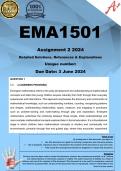
EMA1501
Assignment 2
(EXCEPTIONAL ANSWERS)
Due 13 June 2025
,EMA1501
Assignment 2
Semester 1
Due: 13 June 2025
Question 1
1.1 Differentiate between mathematical concepts and mathematical skills, and
provide an example for each.
Mathematical concepts refer to the fundamental ideas or abstract understandings that
children develop about mathematics. These are the "big ideas" that underpin
mathematical thinking, such as understanding what numbers represent or grasping
spatial relationships. Concepts involve comprehension of the principles behind
mathematical processes and are about "knowing" and "understanding."
Mathematical skills, on the other hand, are the practical abilities children develop to
apply mathematical concepts in real-world or problem-solving contexts. These are the
"doing" aspects of mathematics, such as performing calculations accurately or
measuring objects precisely.
Key Differences:
• Nature: Concepts are theoretical and abstract; skills are practical and action-
oriented.
• Development: Concepts are constructed through exploration and understanding;
skills are refined through practice and application.
• Focus: Concepts focus on understanding "why" and "what"; skills focus on
"how."
Examples:
• Mathematical Concept: Understanding the relation between addition and
subtraction, such as recognizing that adding 2 to 3 results in 5.
, • Mathematical Skill: Calculating the total cost of items when shopping, e.g.,
adding prices of different products.
1.2 Define the following terms and give two examples for each.
1.2.1 Number Sense
Definition: Number sense is a child's intuitive understanding of numbers, their
relationships, and magnitudes. It involves recognizing numbers, understanding their
value, comparing quantities, and performing basic operations like combining or
separating sets (Clements & Sarama, 2009).
Examples:
• A child recognizes that 7 is less than 10 when comparing two piles of counters.
• A child groups 12 beads into two sets of 6 each to share equally.
1.2.2 Patterns
Definition: Patterns are predictable sequences or arrangements of objects, shapes, or
numbers that repeat or follow a rule. Recognizing and creating patterns helps children
predict and understand order in their environment (Charlesworth, 2015).
Examples:
• Arranging colored blocks in a sequence: red, blue, red, blue.
• Clapping in a rhythm: clap, clap, pause, clap, clap, pause.
1.2.3 Measurement
Definition: Measurement involves comparing and quantifying attributes like length,
weight, or time using standard or non-standard units. It helps children describe and
compare objects in their environment (Van de Walle et al., 2019).
Examples:
• Using a string to measure the length of a table by counting how many sticks fit
along its side.
• Comparing the weight of two toys by holding each and stating which is heavier.
Assignment 2
(EXCEPTIONAL ANSWERS)
Due 13 June 2025
,EMA1501
Assignment 2
Semester 1
Due: 13 June 2025
Question 1
1.1 Differentiate between mathematical concepts and mathematical skills, and
provide an example for each.
Mathematical concepts refer to the fundamental ideas or abstract understandings that
children develop about mathematics. These are the "big ideas" that underpin
mathematical thinking, such as understanding what numbers represent or grasping
spatial relationships. Concepts involve comprehension of the principles behind
mathematical processes and are about "knowing" and "understanding."
Mathematical skills, on the other hand, are the practical abilities children develop to
apply mathematical concepts in real-world or problem-solving contexts. These are the
"doing" aspects of mathematics, such as performing calculations accurately or
measuring objects precisely.
Key Differences:
• Nature: Concepts are theoretical and abstract; skills are practical and action-
oriented.
• Development: Concepts are constructed through exploration and understanding;
skills are refined through practice and application.
• Focus: Concepts focus on understanding "why" and "what"; skills focus on
"how."
Examples:
• Mathematical Concept: Understanding the relation between addition and
subtraction, such as recognizing that adding 2 to 3 results in 5.
, • Mathematical Skill: Calculating the total cost of items when shopping, e.g.,
adding prices of different products.
1.2 Define the following terms and give two examples for each.
1.2.1 Number Sense
Definition: Number sense is a child's intuitive understanding of numbers, their
relationships, and magnitudes. It involves recognizing numbers, understanding their
value, comparing quantities, and performing basic operations like combining or
separating sets (Clements & Sarama, 2009).
Examples:
• A child recognizes that 7 is less than 10 when comparing two piles of counters.
• A child groups 12 beads into two sets of 6 each to share equally.
1.2.2 Patterns
Definition: Patterns are predictable sequences or arrangements of objects, shapes, or
numbers that repeat or follow a rule. Recognizing and creating patterns helps children
predict and understand order in their environment (Charlesworth, 2015).
Examples:
• Arranging colored blocks in a sequence: red, blue, red, blue.
• Clapping in a rhythm: clap, clap, pause, clap, clap, pause.
1.2.3 Measurement
Definition: Measurement involves comparing and quantifying attributes like length,
weight, or time using standard or non-standard units. It helps children describe and
compare objects in their environment (Van de Walle et al., 2019).
Examples:
• Using a string to measure the length of a table by counting how many sticks fit
along its side.
• Comparing the weight of two toys by holding each and stating which is heavier.