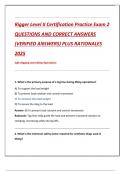
Rigger Level II Certification Practice Exam 2
QUESTIONS AND CORRECT ANSWERS
(VERIFIED ANSWERS) PLUS RATIONALES
2025
Safe Rigging and Lifting Operations
1. What is the primary purpose of a tag line during lifting operations?
A) To support the load weight
B) To prevent load rotation and control movement
C) To measure the load weight
D) To secure the sling to the load
Answer: B) To prevent load rotation and control movement
Rationale: Tag lines help guide the load and prevent unwanted rotation or
swinging, increasing safety during lifts.
2. What is the minimum safety factor required for synthetic slings used in
lifting?
,A) 3:1
B) 4:1
C) 5:1
D) 6:1
Answer: C) 5:1
Rationale: Synthetic slings typically require a safety factor of at least 5:1 to ensure
adequate margin against failure.
3. Which of the following inspection criteria would disqualify a wire rope sling
from service?
A) Slight rust on the surface
B) Broken wires in the rope exceeding 10% of total wires in one rope lay
C) Kinks or bird caging in the rope
D) Light dirt or grease on the surface
Answer: C) Kinks or bird caging in the rope
Rationale: Kinks and bird caging significantly weaken the wire rope and pose a
serious safety hazard.
4. When performing a load test on a rigging assembly, what is the minimum
load the assembly should be tested at?
A) Working Load Limit (WLL)
B) 125% of the WLL
, C) 150% of the WLL
D) 100% of the breaking strength
Answer: B) 125% of the WLL
Rationale: Testing at 125% ensures the rigging assembly can safely handle loads
above the rated WLL.
5. Which type of hitch is generally used when you want to lift a load vertically
without sling lengthening?
A) Vertical hitch
B) Choker hitch
C) Basket hitch
D) Double wrap hitch
Answer: A) Vertical hitch
Rationale: A vertical hitch suspends the load directly under the sling, minimizing
sling lengthening.
6. What is the main hazard when a sling is twisted before or during a lift?
A) Load slipping from the sling
B) Excessive sling lengthening
C) Reduction of sling strength
D) Difficulty in attaching the sling
QUESTIONS AND CORRECT ANSWERS
(VERIFIED ANSWERS) PLUS RATIONALES
2025
Safe Rigging and Lifting Operations
1. What is the primary purpose of a tag line during lifting operations?
A) To support the load weight
B) To prevent load rotation and control movement
C) To measure the load weight
D) To secure the sling to the load
Answer: B) To prevent load rotation and control movement
Rationale: Tag lines help guide the load and prevent unwanted rotation or
swinging, increasing safety during lifts.
2. What is the minimum safety factor required for synthetic slings used in
lifting?
,A) 3:1
B) 4:1
C) 5:1
D) 6:1
Answer: C) 5:1
Rationale: Synthetic slings typically require a safety factor of at least 5:1 to ensure
adequate margin against failure.
3. Which of the following inspection criteria would disqualify a wire rope sling
from service?
A) Slight rust on the surface
B) Broken wires in the rope exceeding 10% of total wires in one rope lay
C) Kinks or bird caging in the rope
D) Light dirt or grease on the surface
Answer: C) Kinks or bird caging in the rope
Rationale: Kinks and bird caging significantly weaken the wire rope and pose a
serious safety hazard.
4. When performing a load test on a rigging assembly, what is the minimum
load the assembly should be tested at?
A) Working Load Limit (WLL)
B) 125% of the WLL
, C) 150% of the WLL
D) 100% of the breaking strength
Answer: B) 125% of the WLL
Rationale: Testing at 125% ensures the rigging assembly can safely handle loads
above the rated WLL.
5. Which type of hitch is generally used when you want to lift a load vertically
without sling lengthening?
A) Vertical hitch
B) Choker hitch
C) Basket hitch
D) Double wrap hitch
Answer: A) Vertical hitch
Rationale: A vertical hitch suspends the load directly under the sling, minimizing
sling lengthening.
6. What is the main hazard when a sling is twisted before or during a lift?
A) Load slipping from the sling
B) Excessive sling lengthening
C) Reduction of sling strength
D) Difficulty in attaching the sling