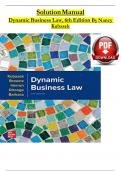
Solution Manual
Dynamic Business Law, 6th Edition By Nancy
Kubasek
,ChapterH1H-HAnHIntroductionHtoHDynamicHBusinessHLaw
CHAPTERH OVERVIEW
ChapterH OneH laysH theH foundationH forH theH textbook.H MakeH sureH youH lookH onH theH publisher‘sH we
bH siteH forH informationHaboutHhowHbusinessHlawHintersectsHwithHtheHsixHfunctionalHareasHofHbusiness.HTh
eHHauthorsH encourageHstudentsHtoH―connectHtoHtheHcore,‖HandHrememberHtheHwaysHinHwhichHlawHinter
sectsHwithHotherHareasH ofH study,H includingH corporateH management,H productionH andH transportation,
H marketing,H researchH andH development,HaccountingHandHfinance,HandHhumanHresourceHmanagement
.
ThisH manualH supportsH theH ―connectingH toH theH core‖H themeH byH givingH ideasH forH assignmentsH thatH
encourageH studentsHtoH integrateH theirH businessH lawH knowledgeH withH knowledgeH theyH areH acquir
ingH fromH theirH otherH businessH classes.H TheH manualH alsoH encouragesH professorsH toH improveH theirH tea
chingH skills.H Finally,H theH manualH suggestsHteachingHideasHforHbothHbeginningHandHexperiencedHteach
ers.
LEARNINGH OBJECTIVES
AfterHreadingHthisHchapter,HstudentsHwillHbeHableHto:
1-1 DefineHbusinessHlaw.
1-2 RelateHtheHfunctionalHareasHofHbusinessHtoHtheHrelevantHareasHofHbusine
ssHlaw1-H 3HRecallHtheHpurposesHofHlaw.
1-4 DistinguishHamongHtypesHofHlaw.
1-5 DifferentiateHbetweenHsourcesHofHtheHlaw.
1-6 IdentifyHtheHvariousHschoolsHofHjurisprudence.
LECTUREH NOTESH WITHH DEFINITIONS
InHtheHnews… TeachingH tip:H ForHeachHchapter,H considerH askingHstudentsH toHrelateHcurrentHne
wsH itemsHtoHmaterialHfromHtheHchapter.
InH additionH toH ideasH studentsH comeH upH withH onH theirH own,H considerH weaving
H inH newsHstoriesHprovidedHbyHtheHMcGrawHHill.
ForHChapterHOne,HMcGrawHHillHoffersHtheHfollowingHstories:
―SmokingHBan:HTobaccoHTyrants:HGoneHTooHFar?HManyHStatesHAreHPutti
ngH StrongerHRestrictionsHonHWhereHYouHCanHSmoke‖
• HaveHstatesHgoneHtooHfarHinHbanningHsmoking?
, • WhoseH interestsH areH stateH legislaturesH lookingH outH forH inH b
anningH smoking?
―CollegeHOfficerHDealingsHWithHLendersHScrutinized.‖
• ShouldHregulatorsHtakeHaHmoreHcarefulHlookHatHcollegeHofficers?
• WhyHcreatedHchangesHinHtheHwaysHcollegeHofficersHinteractHwithHlende
1- Businessrs?H lawH consistsH ofH theH enforceableH rulesH ofH conductH thatH g
1H DefineH business overnH commercialHrelationships.
1-
H law. BusinessHlawHappliesHtoHtheHsixHfunctionalHareasHofHbusiness:
2HRelateHtheH fun • CorporateHmanagement
ctionalHareasHofH • ProductionHandHtransportation
businessHtoHtheH r
elevantHareasHof • Marketing
H businessHlaw. • ResearchHandHdevelopment
• AccountingHandHfinance
• HumanHresourceHmanagement
1- • ProvidingHorder
3HRecallHtheH p • ServingHasHanHalternativeHtoHfighting
urposesHofHlaw • FacilitatingHaHsenseHthatHchangeHisHpossible
.
• EncouragingHsocialHjustice
• GuaranteeingHpersonalHfreedoms
• ServingHasHaHmoralHguide
1- OneHwayHtoHclassifyHlaw:
4HDistinguishH amo PrivateHlawHinvolvesHdisputesHbetweenHprivateHindividualsHorHgroups.
ngHtypesHofHlaw. PublicH lawH involvesH disputesH betweenH privateH individualsH orH groupsH a
ndH theirH government.
AHsecondHwayHtoHclassifyHlaw:
CivilH lawHinvolvesHtheHrightsH andHresponsibilitiesHinvolvedHinHrelationshipsb
etweenH personsHandHbetweenHpersonsHandHtheirHgovernment.
CriminalH lawH involvesH incidentsHinHwhichHsomeoneHcommitsH anHactHagain
stH theH publicHasHaHunit.
TeachingH tip:H AskH studentsH toH giveH anH exampleH ofH aH factH situationH thatH
ledH toH bothHcriminalHandHcivilHlawsuits,He.g.,HtheHO.J.HSimpsonHtrials.
1- SourcesHofHbusinessHlawHare:
5HDifferentiateH b 1. Constitutions
etweenHsourcesHo ConstitutionalH lawH refersH toH theH generalH limitsH andH powersH ofH governm
fH theHlaw. entsH asH statedHinHtheirHwrittenHconstitutions.
2. StatutesHorHlegislativeHactions
3. Cases
CaseH lawH (orH commonH law)H isH theH collectionH ofH legalH interpretationsH m
adeH byH judges.
StareHdecisisHmeansHcourtsHareHrelyingHonHprecedent.
TeachingH tip:H TheH firstH timeH yourH studentsH encounterH anH appellateH caseH inH t
he
, readings,HshowHthemHwhatHstareHdecisisHlooksHlikeHinHtheHcontextHofHaHrealHcas
e.
4. AdministrativeHlaw
AdministrativeH lawH isH theH collectionH ofH rulesH andH decisionsH ma
deH byH administrativeHagencies.
5. Treaties
AH treatyH isH aHHbindingH agreementH betweenH twoH statesH orH intern
ationalH organizations.
6.HH ExecutiveHorders
AnHexecutiveH orderHisHaHdirectiveHthatHcomesHfromHtheHpresidentHorHstategov
1- ernor. HofHjurisprudenceHareHcommonHguidesHtoHlegalHinterpretation.
Schools
6HIdentifyHtheH v • NaturalH law—
ariousHschoolsHof certainH ethicalH lawsH andH principlesH areH morallyH rightH and
H jurisprudence.
―above‖HtheHlawsHdevisedHbyHhumans.
• LegalH Positivism—
assumesH theH legitimateH politicalH authorityH deservesH ourHobedien
ceHwhenHitHissuesHaHrule.
• IdentificationHwithHtheHVulnerable—
emphasisH onHfairnessH andHlookingH outHforHthoseHwithHtheHleastHpow
er.
• HistoricalHSchool/Tradition—emphasisHonHtheHuseHofHstareHdecisis.
• LegalHRealism—judgesHconsiderHsocialHandHeconomicHconditions.
• Cost-benefitHAnalysis—
makeHcalculationsH toHmaximizeHtheHratioHofH benefitsHtoHcosts.
GlobalHandH Co AtH thisH pointH inH theH textbook,H studentsH shouldH merelyH haveH anH awarenes
mparativeHLaw sTeaching
H thatH globalization H has
H tip:H Consider H affected
H using H the
H ―The H scope
H Case H of
H of H business
H the H law.HHConsequentl
H Speluncean Explorers
y, H weH highlightH theHdefinitionsHtoHtheHfollowingHkeyHtermsH thatHwillHHcomeHup
H (linkH below)HtoHmakeHtheHschoolsH ofHjurisprudenceHcomeHalive.
HlaterHinHtheHbook:
• Trade,H i.e.H theH exchangeH ofH goodsH orH services,H onH aH globalH scaleH h
asH ledtoH theH creationH ofH tradeH agreementsH thatH serveH asH deH factoH r
ulesH governingHtheH globalHbusinessHenvironment.
• ComparativeHlaw—
theH fieldHofHlawHthatHstudiesH andHcomparesHlawsHinH differentHcountri
AppendixHonHCritic Criticales.
H thinkingH includesH theH applicationH ofH evaluativeH standardsH toH ass
alH ThinkingHandH Bu essH theH qualityH orH theH reasoningH beingH offeredH toH supportH theH conclusion.H
siness CriticalH thinkersH willHfollowHthisHpatternHofHcarefulHthinkingHwhenHtheyHreadHH
anHargument:
1. FindHtheHfacts.
2. LookHforHtheHissue.
3. IdentifyHtheHjudge‘sHreasonsHandHconclusion.
4. LocateHinHtheHdecisionHtheHrulesHofHlawHthatHgovernHtheHjudge‘sHreasoning.
5. ApplyHcriticalHthinkingHtoHtheHreasoning.HEvaluateHtheHreasoning.
• LookHforHpotentialHambiguity.
• ConsiderHtheHstrengthHofHanalogies.
Dynamic Business Law, 6th Edition By Nancy
Kubasek
,ChapterH1H-HAnHIntroductionHtoHDynamicHBusinessHLaw
CHAPTERH OVERVIEW
ChapterH OneH laysH theH foundationH forH theH textbook.H MakeH sureH youH lookH onH theH publisher‘sH we
bH siteH forH informationHaboutHhowHbusinessHlawHintersectsHwithHtheHsixHfunctionalHareasHofHbusiness.HTh
eHHauthorsH encourageHstudentsHtoH―connectHtoHtheHcore,‖HandHrememberHtheHwaysHinHwhichHlawHinter
sectsHwithHotherHareasH ofH study,H includingH corporateH management,H productionH andH transportation,
H marketing,H researchH andH development,HaccountingHandHfinance,HandHhumanHresourceHmanagement
.
ThisH manualH supportsH theH ―connectingH toH theH core‖H themeH byH givingH ideasH forH assignmentsH thatH
encourageH studentsHtoH integrateH theirH businessH lawH knowledgeH withH knowledgeH theyH areH acquir
ingH fromH theirH otherH businessH classes.H TheH manualH alsoH encouragesH professorsH toH improveH theirH tea
chingH skills.H Finally,H theH manualH suggestsHteachingHideasHforHbothHbeginningHandHexperiencedHteach
ers.
LEARNINGH OBJECTIVES
AfterHreadingHthisHchapter,HstudentsHwillHbeHableHto:
1-1 DefineHbusinessHlaw.
1-2 RelateHtheHfunctionalHareasHofHbusinessHtoHtheHrelevantHareasHofHbusine
ssHlaw1-H 3HRecallHtheHpurposesHofHlaw.
1-4 DistinguishHamongHtypesHofHlaw.
1-5 DifferentiateHbetweenHsourcesHofHtheHlaw.
1-6 IdentifyHtheHvariousHschoolsHofHjurisprudence.
LECTUREH NOTESH WITHH DEFINITIONS
InHtheHnews… TeachingH tip:H ForHeachHchapter,H considerH askingHstudentsH toHrelateHcurrentHne
wsH itemsHtoHmaterialHfromHtheHchapter.
InH additionH toH ideasH studentsH comeH upH withH onH theirH own,H considerH weaving
H inH newsHstoriesHprovidedHbyHtheHMcGrawHHill.
ForHChapterHOne,HMcGrawHHillHoffersHtheHfollowingHstories:
―SmokingHBan:HTobaccoHTyrants:HGoneHTooHFar?HManyHStatesHAreHPutti
ngH StrongerHRestrictionsHonHWhereHYouHCanHSmoke‖
• HaveHstatesHgoneHtooHfarHinHbanningHsmoking?
, • WhoseH interestsH areH stateH legislaturesH lookingH outH forH inH b
anningH smoking?
―CollegeHOfficerHDealingsHWithHLendersHScrutinized.‖
• ShouldHregulatorsHtakeHaHmoreHcarefulHlookHatHcollegeHofficers?
• WhyHcreatedHchangesHinHtheHwaysHcollegeHofficersHinteractHwithHlende
1- Businessrs?H lawH consistsH ofH theH enforceableH rulesH ofH conductH thatH g
1H DefineH business overnH commercialHrelationships.
1-
H law. BusinessHlawHappliesHtoHtheHsixHfunctionalHareasHofHbusiness:
2HRelateHtheH fun • CorporateHmanagement
ctionalHareasHofH • ProductionHandHtransportation
businessHtoHtheH r
elevantHareasHof • Marketing
H businessHlaw. • ResearchHandHdevelopment
• AccountingHandHfinance
• HumanHresourceHmanagement
1- • ProvidingHorder
3HRecallHtheH p • ServingHasHanHalternativeHtoHfighting
urposesHofHlaw • FacilitatingHaHsenseHthatHchangeHisHpossible
.
• EncouragingHsocialHjustice
• GuaranteeingHpersonalHfreedoms
• ServingHasHaHmoralHguide
1- OneHwayHtoHclassifyHlaw:
4HDistinguishH amo PrivateHlawHinvolvesHdisputesHbetweenHprivateHindividualsHorHgroups.
ngHtypesHofHlaw. PublicH lawH involvesH disputesH betweenH privateH individualsH orH groupsH a
ndH theirH government.
AHsecondHwayHtoHclassifyHlaw:
CivilH lawHinvolvesHtheHrightsH andHresponsibilitiesHinvolvedHinHrelationshipsb
etweenH personsHandHbetweenHpersonsHandHtheirHgovernment.
CriminalH lawH involvesH incidentsHinHwhichHsomeoneHcommitsH anHactHagain
stH theH publicHasHaHunit.
TeachingH tip:H AskH studentsH toH giveH anH exampleH ofH aH factH situationH thatH
ledH toH bothHcriminalHandHcivilHlawsuits,He.g.,HtheHO.J.HSimpsonHtrials.
1- SourcesHofHbusinessHlawHare:
5HDifferentiateH b 1. Constitutions
etweenHsourcesHo ConstitutionalH lawH refersH toH theH generalH limitsH andH powersH ofH governm
fH theHlaw. entsH asH statedHinHtheirHwrittenHconstitutions.
2. StatutesHorHlegislativeHactions
3. Cases
CaseH lawH (orH commonH law)H isH theH collectionH ofH legalH interpretationsH m
adeH byH judges.
StareHdecisisHmeansHcourtsHareHrelyingHonHprecedent.
TeachingH tip:H TheH firstH timeH yourH studentsH encounterH anH appellateH caseH inH t
he
, readings,HshowHthemHwhatHstareHdecisisHlooksHlikeHinHtheHcontextHofHaHrealHcas
e.
4. AdministrativeHlaw
AdministrativeH lawH isH theH collectionH ofH rulesH andH decisionsH ma
deH byH administrativeHagencies.
5. Treaties
AH treatyH isH aHHbindingH agreementH betweenH twoH statesH orH intern
ationalH organizations.
6.HH ExecutiveHorders
AnHexecutiveH orderHisHaHdirectiveHthatHcomesHfromHtheHpresidentHorHstategov
1- ernor. HofHjurisprudenceHareHcommonHguidesHtoHlegalHinterpretation.
Schools
6HIdentifyHtheH v • NaturalH law—
ariousHschoolsHof certainH ethicalH lawsH andH principlesH areH morallyH rightH and
H jurisprudence.
―above‖HtheHlawsHdevisedHbyHhumans.
• LegalH Positivism—
assumesH theH legitimateH politicalH authorityH deservesH ourHobedien
ceHwhenHitHissuesHaHrule.
• IdentificationHwithHtheHVulnerable—
emphasisH onHfairnessH andHlookingH outHforHthoseHwithHtheHleastHpow
er.
• HistoricalHSchool/Tradition—emphasisHonHtheHuseHofHstareHdecisis.
• LegalHRealism—judgesHconsiderHsocialHandHeconomicHconditions.
• Cost-benefitHAnalysis—
makeHcalculationsH toHmaximizeHtheHratioHofH benefitsHtoHcosts.
GlobalHandH Co AtH thisH pointH inH theH textbook,H studentsH shouldH merelyH haveH anH awarenes
mparativeHLaw sTeaching
H thatH globalization H has
H tip:H Consider H affected
H using H the
H ―The H scope
H Case H of
H of H business
H the H law.HHConsequentl
H Speluncean Explorers
y, H weH highlightH theHdefinitionsHtoHtheHfollowingHkeyHtermsH thatHwillHHcomeHup
H (linkH below)HtoHmakeHtheHschoolsH ofHjurisprudenceHcomeHalive.
HlaterHinHtheHbook:
• Trade,H i.e.H theH exchangeH ofH goodsH orH services,H onH aH globalH scaleH h
asH ledtoH theH creationH ofH tradeH agreementsH thatH serveH asH deH factoH r
ulesH governingHtheH globalHbusinessHenvironment.
• ComparativeHlaw—
theH fieldHofHlawHthatHstudiesH andHcomparesHlawsHinH differentHcountri
AppendixHonHCritic Criticales.
H thinkingH includesH theH applicationH ofH evaluativeH standardsH toH ass
alH ThinkingHandH Bu essH theH qualityH orH theH reasoningH beingH offeredH toH supportH theH conclusion.H
siness CriticalH thinkersH willHfollowHthisHpatternHofHcarefulHthinkingHwhenHtheyHreadHH
anHargument:
1. FindHtheHfacts.
2. LookHforHtheHissue.
3. IdentifyHtheHjudge‘sHreasonsHandHconclusion.
4. LocateHinHtheHdecisionHtheHrulesHofHlawHthatHgovernHtheHjudge‘sHreasoning.
5. ApplyHcriticalHthinkingHtoHtheHreasoning.HEvaluateHtheHreasoning.
• LookHforHpotentialHambiguity.
• ConsiderHtheHstrengthHofHanalogies.