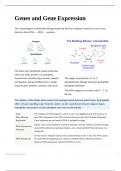
Genes and Gene Expression
The central dogma of molecular biology states that the flow of genetic material occurs in one
direction from DNA → RNA → proteins.
The bases are hydrophobic planar molecules
which are either purines or pyrimidines.
Purines have a double ring structure; adenine The sugars are joined by a 5’ to 3’
and guanine, and pyrimidines have a single phosphodiester linkage forming a hydrophilic
ring structure; thymine, cytosine, and uracil. phosphate backbone.
The DNA sequence is written with 5’ - 3’ on
the top.
The stability of the double helix results from hydrogen bonds between paired bases, hydrophobic
effect of bases expelling water from the centre, van der waals forces between adjacent bases,
hydrophilic interactions of polar phosphate and water on the outside.
Semi The synthesis of DNA fragments which occurs in the lagging strand. The presence of
Discontinuous short DNA fragments in the DNA extracted from growing cells (Okazaki fragments).
Replication These fragments are not found if DNA is inhibited by drugs.
Initiate a new strand synthesis as DNA polymerase can only extend an already existing
RNA Polymerases
strand. RNA polymerase (primase) begins a new strand and the DNA polymerase can
(Primase)
extend this.
Always needs a template and can only add nucleotides to the 3’ end. The DNA cannot
DNA Polymerase be made from the beginning and a primer is needed (often an RNA polymerase -
primase). DNA polymerase checks the DNA for errors.
Genes and Gene Expression 1
, DNA Replication
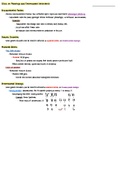
1. Topoisomerase works in the region about to be replicated to release tension in DNA making
the unravelling much easier. This prevents supercoiling.
2. DNA helicase breaks down the hydrogen bonds between the DNA strands causing the
double helix to unwind. This produces two replication forks known as a replication bubble
where DNA polymerase moves in opposite directions on each strand. The single strand
binding proteins (SSBPs) keep the two strands apart.
3. Primase (RNA polymerase) then produces a small section of RNA known as a primer, the
starting point of the new DNA strand.
4. DNA polymerase binds to the primer producing the new DNA strand through
complementary base pairing moving from the 5’ to the 3’.
5. The leading strand is made continuously while the lagging strand cannot be made in this
way due to the antiparallel nature of DNA.
6. DNA polymerase makes the lagging strand in small sections called Okazaki Fragments.
Each fragment is started with an RNA primer with DNA polymerase then adding bases. The
next primer is then added further down the lagging strand and this process is repeated.
7. The enzyme exonuclease then removes all the RNA primers from the strands.
8. DNA polymerase then fills in the gaps with nucleotides.
9. DNA ligase then seals the fragments of DNA to form a continuous double strand.
10. This is semi-conservative replication.
Topoisomerase plays an important role in maintaining DNA during replication. This prevents the
DNA double helix from getting too tightly wound as it makes temporary nicks in the helix to
release tension, then reseals these nicks. It prevents supercoiling.
The unwinding process which DNA causes results in positive supercoils being present.
These destabilise the molecule by increasing its energy. DNA gyrase then has to bind to the
DNA to stabilise the molecule introducing negative supercoils which reduce the amount of
positive supercoils present and therefore decrease the amount of stress on the DNA.
Transcription
Genes and Gene Expression 2
The central dogma of molecular biology states that the flow of genetic material occurs in one
direction from DNA → RNA → proteins.
The bases are hydrophobic planar molecules
which are either purines or pyrimidines.
Purines have a double ring structure; adenine The sugars are joined by a 5’ to 3’
and guanine, and pyrimidines have a single phosphodiester linkage forming a hydrophilic
ring structure; thymine, cytosine, and uracil. phosphate backbone.
The DNA sequence is written with 5’ - 3’ on
the top.
The stability of the double helix results from hydrogen bonds between paired bases, hydrophobic
effect of bases expelling water from the centre, van der waals forces between adjacent bases,
hydrophilic interactions of polar phosphate and water on the outside.
Semi The synthesis of DNA fragments which occurs in the lagging strand. The presence of
Discontinuous short DNA fragments in the DNA extracted from growing cells (Okazaki fragments).
Replication These fragments are not found if DNA is inhibited by drugs.
Initiate a new strand synthesis as DNA polymerase can only extend an already existing
RNA Polymerases
strand. RNA polymerase (primase) begins a new strand and the DNA polymerase can
(Primase)
extend this.
Always needs a template and can only add nucleotides to the 3’ end. The DNA cannot
DNA Polymerase be made from the beginning and a primer is needed (often an RNA polymerase -
primase). DNA polymerase checks the DNA for errors.
Genes and Gene Expression 1
, DNA Replication
1. Topoisomerase works in the region about to be replicated to release tension in DNA making
the unravelling much easier. This prevents supercoiling.
2. DNA helicase breaks down the hydrogen bonds between the DNA strands causing the
double helix to unwind. This produces two replication forks known as a replication bubble
where DNA polymerase moves in opposite directions on each strand. The single strand
binding proteins (SSBPs) keep the two strands apart.
3. Primase (RNA polymerase) then produces a small section of RNA known as a primer, the
starting point of the new DNA strand.
4. DNA polymerase binds to the primer producing the new DNA strand through
complementary base pairing moving from the 5’ to the 3’.
5. The leading strand is made continuously while the lagging strand cannot be made in this
way due to the antiparallel nature of DNA.
6. DNA polymerase makes the lagging strand in small sections called Okazaki Fragments.
Each fragment is started with an RNA primer with DNA polymerase then adding bases. The
next primer is then added further down the lagging strand and this process is repeated.
7. The enzyme exonuclease then removes all the RNA primers from the strands.
8. DNA polymerase then fills in the gaps with nucleotides.
9. DNA ligase then seals the fragments of DNA to form a continuous double strand.
10. This is semi-conservative replication.
Topoisomerase plays an important role in maintaining DNA during replication. This prevents the
DNA double helix from getting too tightly wound as it makes temporary nicks in the helix to
release tension, then reseals these nicks. It prevents supercoiling.
The unwinding process which DNA causes results in positive supercoils being present.
These destabilise the molecule by increasing its energy. DNA gyrase then has to bind to the
DNA to stabilise the molecule introducing negative supercoils which reduce the amount of
positive supercoils present and therefore decrease the amount of stress on the DNA.
Transcription
Genes and Gene Expression 2