Organogenesis
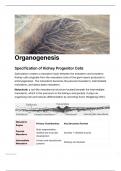
Specification of Kidney Progenitor Cells
Gastrulation creates a mesoderm layer between the endoderm and ectoderm.
Kidney cells originate from the mesoderm (one of the germ layers produced in
embryogenesis). The mesoderm becomes the paraxial mesoderm, intermediate
mesoderm, and lateral plate mesoderm.
Notochord: a rod-like mesodermal structure located beneath the intermediate
mesoderm, which is the precursor to the kidneys and gonads. It plays an
organising role and induces differentiation by secreting Sonic Hedgehog (Shh).
Mesoderm
Primary Contributions Key Structures Formed
Region
Body segmentation,
Paraxial
skeletal and muscular Somites → Skeletal muscle
Mesoderm
development
Intermediate Urinary and reproductive
Kidneys and Gonads
Mesoderm systems
Organogenesis 1
, Cardiovascular system,
Lateral Plate Circulatory System (heart and blood
body cavities, limb
Mesoderm vessels)
skeleton
Lateral Plate Mesoderm: lateral to the intermediate mesoderm. It forms the
circulatory system (heart and blood vessels).
Growth and Branching of the
Nephric Duct (Collecting Duct)
Paraxial Mesoderm: positioned on both sides of the
notochord and the neural tube. It forms somites
(precursor cells which form important tissue
structures in this case the skeletal muscles) then
skeletal muscles. A paracrine signal from the paraxial
mesoderm to the intermediate mesoderm induces
kidney tissues.
The exact identity of the signalling molecules from the
paraxial mesoderm that induce kidney development is
not yet fully understood.
A paracrine signal causes the lateral plate
mesoderm to secrete Bone Morphogenetic Protein
2 (BMP2).
It is a morphogen that directs different cell fates
according to concentration.
Kidney tissue is induced at a medium level of
BMP2 activity.
Induction and Formation of
Nephrons
Intermediate Mesoderm: positioned between the
paraxial mesoderm and lateral plate mesoderm. It
forms the kidney and gonads.
Organogenesis 2
Specification of Kidney Progenitor Cells
Gastrulation creates a mesoderm layer between the endoderm and ectoderm.
Kidney cells originate from the mesoderm (one of the germ layers produced in
embryogenesis). The mesoderm becomes the paraxial mesoderm, intermediate
mesoderm, and lateral plate mesoderm.
Notochord: a rod-like mesodermal structure located beneath the intermediate
mesoderm, which is the precursor to the kidneys and gonads. It plays an
organising role and induces differentiation by secreting Sonic Hedgehog (Shh).
Mesoderm
Primary Contributions Key Structures Formed
Region
Body segmentation,
Paraxial
skeletal and muscular Somites → Skeletal muscle
Mesoderm
development
Intermediate Urinary and reproductive
Kidneys and Gonads
Mesoderm systems
Organogenesis 1
, Cardiovascular system,
Lateral Plate Circulatory System (heart and blood
body cavities, limb
Mesoderm vessels)
skeleton
Lateral Plate Mesoderm: lateral to the intermediate mesoderm. It forms the
circulatory system (heart and blood vessels).
Growth and Branching of the
Nephric Duct (Collecting Duct)
Paraxial Mesoderm: positioned on both sides of the
notochord and the neural tube. It forms somites
(precursor cells which form important tissue
structures in this case the skeletal muscles) then
skeletal muscles. A paracrine signal from the paraxial
mesoderm to the intermediate mesoderm induces
kidney tissues.
The exact identity of the signalling molecules from the
paraxial mesoderm that induce kidney development is
not yet fully understood.
A paracrine signal causes the lateral plate
mesoderm to secrete Bone Morphogenetic Protein
2 (BMP2).
It is a morphogen that directs different cell fates
according to concentration.
Kidney tissue is induced at a medium level of
BMP2 activity.
Induction and Formation of
Nephrons
Intermediate Mesoderm: positioned between the
paraxial mesoderm and lateral plate mesoderm. It
forms the kidney and gonads.
Organogenesis 2